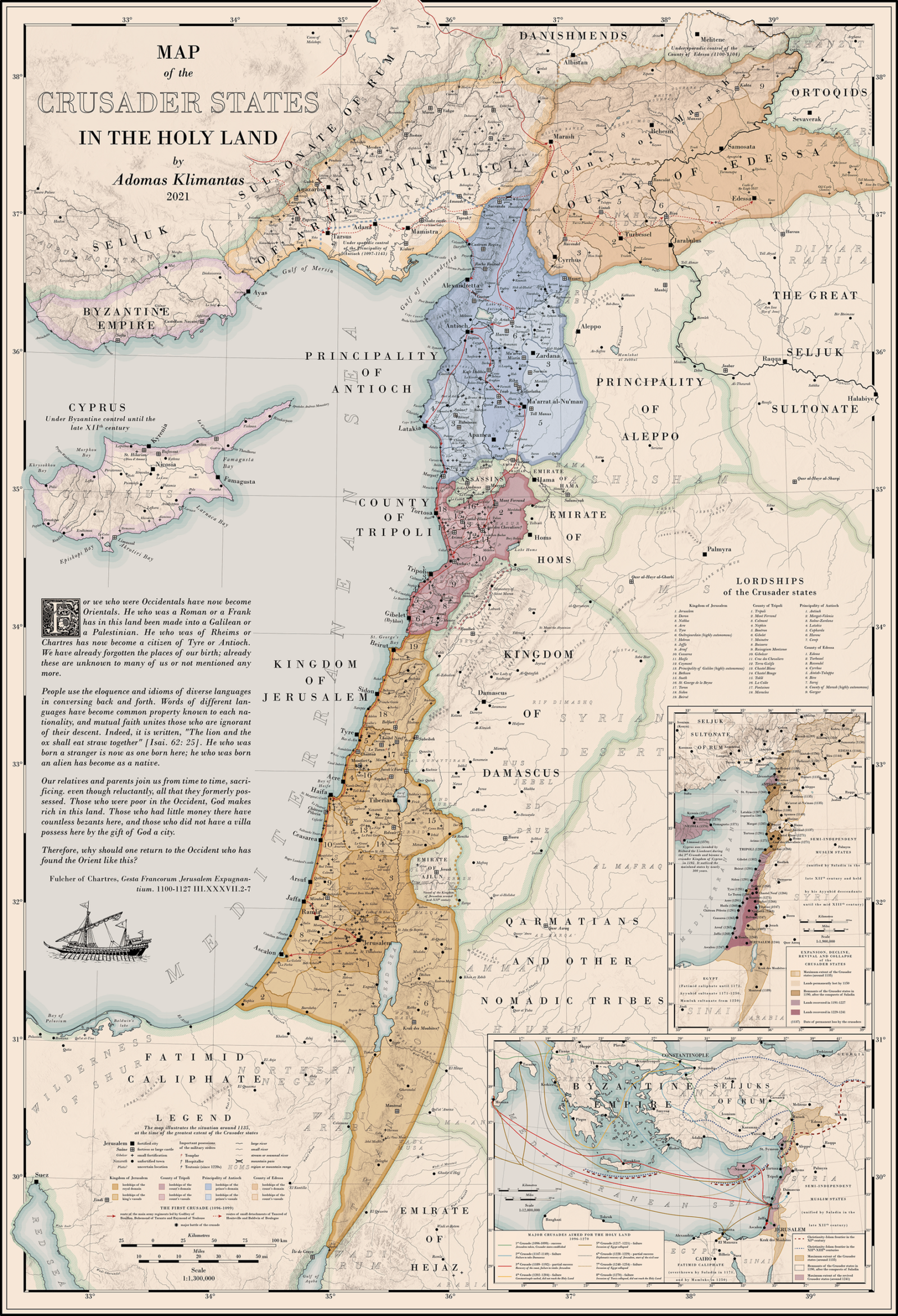
The four principal Crusader states lay around Edessa, now Şanlıurfa; Antioch, or Antakya; Jerusalem in Palestine; and Tripoli in present-day Lebanon. Established between 1098 and 1109, Latin rulers governed them through lordship, vassals, courts and local administrative cooperation. Their losses unfolded in stages, from Edessa in 1144 to Antioch in 1268, Tripoli in 1289 and Acre, the surviving royal centre of Jerusalem, in 1291.
How could a kingdom continue after losing the city in its name? Jerusalem’s royal administration operated from Acre after Jerusalem fell. If you follow the four states separately, their courts, ports and alliances explain both their survival and their eventual losses.
When and where were the four principal Crusader states established?
The County of Edessa formed in 1098 around present-day Şanlıurfa. Its first ruler was Count Baldwin I. For you as a traveler to Turkey, Şanlıurfa provides a direct geographical connection to one of the four principal states.
The Principality of Antioch followed the Crusader capture of Antioch on 3 June 1098. Bohemond I became its ruler. Antioch and Edessa therefore shared a foundation year, but Antioch was a principality and Edessa a county, each under its respective ruler.
The Kingdom of Jerusalem emerged in Palestine after the Crusaders captured Jerusalem in 1099. Its existence continued until 1291. That span requires care: the kingdom’s survival did not mean continuous Latin possession of Jerusalem itself.
Raymond de Saint-Gilles laid the foundations of the County of Tripoli. It secured its centre when Tripoli, in present-day Lebanon, was captured in 1109 under his son Bertrand. The county’s formation was therefore a process, with the acquisition of its central city marking a decisive stage.
Western observers collectively called these Latin settlements Outremer, meaning the land beyond the sea. The term connected Jerusalem, Antioch, Edessa and Tripoli through a shared geographical perspective. Their institutions, however, included different arrangements for courts, towns and landed authority.
How were Jerusalem, Antioch, Edessa and Tripoli governed?
In Jerusalem, the Haute Cour was a central institution of government and law. The king and his direct vassals participated in it. Royal government thus included a formal relationship between the ruler and the lords who held directly from him.
Edessa’s town councils included local Christians. This gave members of an established local population a place in urban administration under Latin rule.
Antioch had a legal tradition represented by the Assizes of Antioch. These texts survive through thirteenth-century Armenian translations. They provide evidence of the principality’s law and its preservation in Armenian.
Tripoli’s counts governed some towns directly and distributed others as fiefs. They granted Jubayl to the Genoese in return for naval support. A grant of local authority could therefore also secure assistance from the sea, linking government with the county’s practical needs.
How did Latin rulers interact with local Christian, Muslim, and Jewish communities?
The Crusader capture of Jerusalem in 1099 included a massacre of Muslims, Jews and local Christians. Local Christian identity did not protect everyone from the violence of conquest. This event belongs alongside the later evidence of administrative cooperation and commercial contact.
Legal participation also involved unequal treatment. Muslims could testify in the Kingdom of Jerusalem’s Cour des Syriens, but their testimony carried less weight than Latin testimony. Access to a court therefore did not mean equal standing within it.
Local cooperation extended beyond Edessa’s Christian council members. The Franks entrusted the administration of villages around al-Atharib to Hamdan ibn Abd al-Rahim, a Muslim who lived from 1068 to 1147. His appointment shows that Latin rule could incorporate Muslim administrative service.
Acre’s Jewish population grew during the thirteenth century, when the city served as a Crusader capital and trading centre. Much of this population consisted of immigrants from Europe. The massacre in Jerusalem in 1099 and Jewish settlement in later Acre describe different experiences within the history of Latin rule.
Commerce crossed political boundaries even during warfare. Describing his journey of 1183–1185, Ibn Jubayr recorded Muslim merchants traveling from Damascus to Acre and Christian merchants entering Muslim territories. If you connect history with the everyday task of buying food or goods, these journeys offer a useful comparison: trade could continue while rulers fought.
How did castles, ports, and maritime connections sustain these states?
According to John H. Pryor, continuously renewed supplies of people and financial resources arriving by sea from the West were decisive to Crusader survival in the twelfth and thirteenth centuries. Shortly after Jerusalem’s capture in 1099, most unarmed pilgrims and armed pilgrims coming to fight began arriving by sea.
Tripoli’s grant of Jubayl to the Genoese illustrates how rulers secured maritime assistance. Acre later combined royal government with a trading role. You can understand the importance of ports by keeping both functions in view: they connected political centres with movement across the sea.
Castles supported connections between the coast and the interior. Krak des Chevaliers stood about 650 metres above sea level on the route between the port of Tartus and Homs. Its position controlled the Homs Gap, which linked coastal and inland areas.
Krak des Chevaliers passed to the Hospitallers in 1142. They strengthened it in stages before its capture by the Mamluks in 1271. Its history joins the long development of a fortified position to the later loss of Crusader strongholds.
How did warfare and alliances with neighbouring powers evolve?
In 1140, the Damascus ruler Muin al-Din Unur and King Fulk of Jerusalem allied against Zengi. Their agreement provided for Frankish assistance in defending Damascus. A Muslim ruler and a Latin king could cooperate against a shared opponent.
That arrangement contrasts with the Crusader attempt to capture Damascus during the Second Crusade of 1147–1149. The attempt failed. Damascus thus appears as both an ally and a target within the changing relationships of the period.
Saladin defeated King Guy de Lusignan’s army at Hattin on 4 July 1187 and captured the king. He took Jerusalem in October. These events ended the period of Latin control over the city that had begun in 1099.
Diplomacy later restored Frankish possession of Jerusalem. Frederick II’s agreement of 1229 returned the city while leaving the Haram al-Sharif under Muslim control. In 1244, another Frankish alliance with Damascus fought Egyptian-Khwarazmian forces at La Forbie and suffered defeat.
What stages led from the loss of Edessa to the fall of Acre in 1291?
Zengi’s capture of Edessa in 1144 began the dismantling of the first of the four principal states. Jerusalem’s losses in 1187 came later. These were separate stages in a longer contraction, rather than the simultaneous destruction of all four states.
By the end of the Third Crusade of 1189–1192, the Crusaders had obtained Acre and Cyprus. Jerusalem’s royal administration operated at Acre after the loss of Jerusalem. The kingdom could therefore continue with its government based in another city.
Jerusalem returned by agreement in 1229, but the Khwarazmians sacked it in 1244. The same year brought the defeat at La Forbie. Later Mamluk victories removed Antioch’s centre in 1268, Tripoli’s in 1289 and Acre in 1291.
Timeline
- 1098: Edessa and Antioch were established.
- 1099: Jerusalem was captured and its kingdom founded.
- 1109: Tripoli was captured under Bertrand.
- 1140: Damascus and Jerusalem allied against Zengi.
- 1142: Krak des Chevaliers passed to the Hospitallers.
- 1144: Zengi captured Edessa.
- 1147–1149: The Second Crusade failed to capture Damascus.
- 1187: Saladin won at Hattin and captured Jerusalem.
- 1189–1192: The Third Crusade brought Acre and Cyprus into Crusader hands.
- 1229: An agreement returned Jerusalem to the Franks.
- 1244: Jerusalem was sacked; the Frankish-Damascene alliance lost at La Forbie.
- 1268: Baybars captured Antioch.
- 1271: The Mamluks captured Krak des Chevaliers.
- 1289: The Mamluks captured Tripoli.
- 1291: Acre fell, ending the major Latin Crusader centres on the Levantine mainland.
Details you won’t find in guidebooks
Antioch’s surviving law texts reached later readers through thirteenth-century Armenian translations. The Assizes of Antioch thus preserve the principality’s legal material in Armenian.
Krak des Chevaliers had two concentric defensive circuits. Its layout extended about 300 metres along its longest axis and 140 metres across its widest. Those measurements give a concrete sense of the fortified complex controlling the route between Tartus and Homs.
Much of Acre’s Crusader construction from 1104–1291 survives beneath the Ottoman city of the eighteenth and nineteenth centuries. If you picture Acre only at street level, this buried fabric adds another dimension to its role as a royal and commercial centre.
FAQ
Where were the four principal Crusader states?
They centred on Edessa, now Şanlıurfa; Antioch, or Antakya; Jerusalem in Palestine; and Tripoli in present-day Lebanon. They developed between 1098 and 1109.
How were the Crusader states governed?
Latin rulers governed through lordship, vassalage and courts. Jerusalem had the Haute Cour, local Christians served on Edessa’s town councils, and Tripoli’s counts combined direct rule with grants of fiefs.
Did the Kingdom of Jerusalem end in 1187?
No. Saladin captured Jerusalem in October 1187, but the kingdom’s royal administration continued at Acre. Jerusalem returned to Frankish control by agreement in 1229, while the kingdom survived until 1291.
Which Crusader state fell first, and what ended their mainland presence?
Zengi’s capture of Edessa in 1144 began the dismantling of the first principal Crusader state. Antioch fell in 1268, Tripoli in 1289, and Acre’s fall in 1291 ended the major Latin Crusader centres on the Levantine mainland.
Sources
- Vikipedi — Haçlı devletleri tr.wikipedia.org
- Wikipedia — Crusader states en.wikipedia.org
- The Metropolitan Museum of Art — Jerusalem 1000–1400: Exhibition Galleries metmuseum.org
- Cambridge University Press — The Islamic countryside and food supplies to the Levantine crusader cities cambridge.org
- The Metropolitan Museum of Art — The Crusades (1095–1291) metmuseum.org
- The Metropolitan Museum of Art — Jerusalem 1000–1400, including Martin Jacobs: Jewish-Muslim Encounters in the Holy Land resources.metmuseum.org
- John H. Pryor, Cambridge University Press — The twelfth and thirteenth centuries: the Crusader states cambridge.org
- Museum With No Frontiers — Crac des Chevaliers islamicart.museumwnf.org
- French Ministry of Culture — About the castle archeologie.culture.gouv.fr
- UNESCO World Heritage Centre — Old City of Acre whc.unesco.org
- Michael A. Köhler — Alliances and Treaties between Frankish and Muslim Rulers in the Middle East edit.fis.uni-hamburg.de
- Cambridge Core — How the Crusades Could Have Been Won cambridge.org
- Cambridge Core — The Crusades, the Latin East and Medieval History-Writing: An Introduction cambridge.org
Image: Map of the Crusader states and castles.png — MapKlimantas, CC BY 4.0