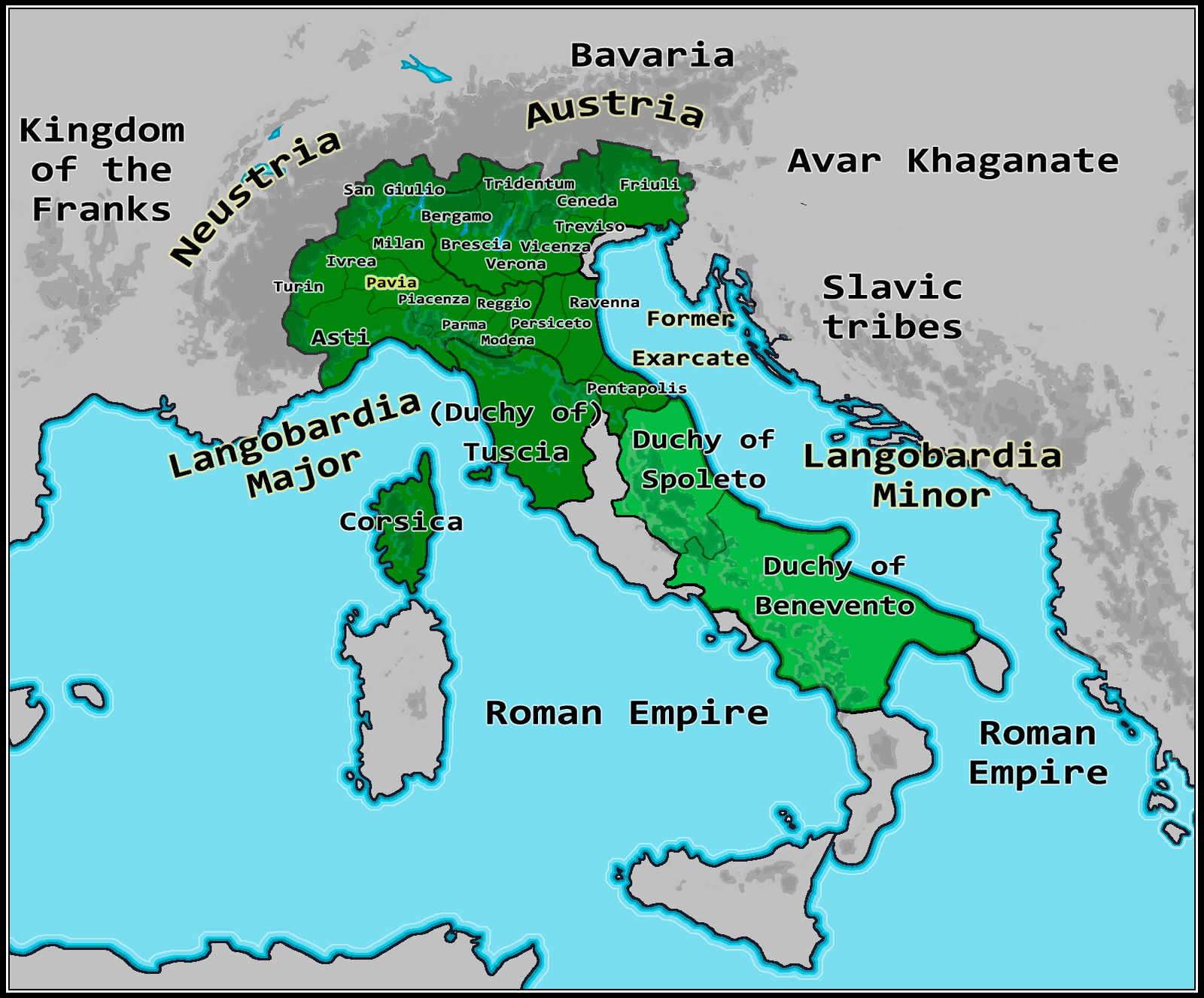
The Lombards were a Germanic people, called Langobardi in Latin sources, who entered Italy under Alboin in 568 and established a kingdom centered on Pavia. Their name gave rise to Lombardy, while their independent kingdom ended when Charlemagne conquered Pavia in 774.
Yet the Lombards’ story reaches beyond the region now called Lombardy. Their route led from the Lower Elbe to Pannonia and then Italy. If you follow that route, the kingdom’s divided geography, written laws, and surviving monuments explain how a migrating people left a lasting geographical name.
Where did the Lombards come from?
The Lombards’ known early settlement area lay east of the Lower Elbe, in what is now northern Germany. They were recorded around this area in the first century AD. This provides an early geographical anchor for a people later associated with Italy.
Their origin stories point elsewhere. The Origo and Paulus Diaconus describe a Scandinavian origin. The alternative account in the Codex Gothanus begins the migration at a river called Vindilicus, at the edge of Gaul. These are differing accounts of beginnings, rather than a single agreed route.
Around 500, the Lombards were north of the Danube. They subsequently spread into Pannonia, covering parts of present-day western Hungary and Lower Austria. Pannonia was therefore a major stage between their earlier northern settlements and their entry into Italy.
In 567, King Alboin joined the Avars in destroying the Gepid Kingdom. The following year, he led the Lombards into Italy. These successive events connect the end of one kingdom with the beginning of Lombard conquest farther west.
How did the Lombards establish their Italian kingdom?
Alboin entered Italy in 568 and began taking territory under Byzantine rule. Italy had already suffered through the Gothic War of 535–554. The small Byzantine army that remained could not stop the Lombard advance.
The first Lombard duchy in Italy was Friuli, in the northeast. Milan fell in 569. Pavia resisted longer: the Lombards captured it in 572 after a siege lasting about three years. Their progress involved both rapid territorial gains and prolonged resistance.
Pavia became the kingdom’s principal administrative center and the residence of its kings. Its importance therefore rested on government as well as conquest. When you encounter Pavia in Lombard history, it marks the place where royal residence and the administration of the kingdom came together.
The monarchy did not continue without interruption. Between 574 and 584, the Lombards experienced roughly ten years without a king. Authari’s election in 584 restored the monarchy. The kingdom’s early history thus included a substantial interval without royal leadership.
Did the Lombards rule all of Italy?
The Lombards never conquered the entire peninsula. Byzantium retained a corridor linking Rome and Ravenna through Perugia. This surviving connection prevented Lombard conquests from becoming control over all of Italy.
Lombard rule nevertheless reached well beyond the north. It extended from Langobardia Maior into Spoleto in central Italy and to Benevento and Gargano in the south. A history confined to present-day Lombardy would leave out much of this territory.
If you picture the kingdom on a map, keep both its reach and its interruptions in view. Northern Lombard territories, central and southern centers, and the Byzantine corridor belonged to the same political landscape. The name of the kingdom should not suggest an entirely conquered Italy.
How did the Lombards write down their laws?
In November 643, an army assembly at Pavia accepted the Edict of Rothari. It formed the written foundation of Lombard law. Pavia’s role in this event adds a legal dimension to its position as the principal royal and administrative center.
The edict contained 388 chapters and dealt mainly with criminal law. It was therefore a substantial collection with a particular emphasis, rather than a brief royal declaration. Its adoption gives a concrete point at which Lombard law took written form.
The collection continued to change. The Lombards’ conversion to Catholicism brought changes in law, and Grimoald added provisions to Rothari’s edict in 668. The written legal tradition was not fixed permanently by its acceptance in 643.
Why is Lombardy called Lombardy?
Lombardy takes its name from Longobardus or Langobardus, Latin forms of the name of the people who arrived in Italy in 568. The geographical name preserves the connection between the Lombards and the territories associated with their rule.
Its geographical meaning also changed. In the early Middle Ages, Lombardy referred to the Lombard Kingdom. In later centuries, the name could mean northern Italy as a whole, extending beyond the boundaries of the present region.
You can connect this history to everyday life through the place names you use when reading an address or planning a journey. Lombardy is a case in which a familiar regional name carries the name of an earlier people, even though its geographical scope has shifted.
The meaning of Langobardi itself remains debated. One explanation interprets it as “long beards.” An alternative connects the second element with a Proto-Germanic word meaning “axe.” The familiar beard explanation should therefore be presented as an interpretation, rather than an uncontested meaning.
Timeline
- First century AD: The Lombards were recorded around the Lower Elbe.
- Around 500: They were north of the Danube and subsequently spread into Pannonia.
- 567: Alboin and the Avars destroyed the Gepid Kingdom.
- 568: Alboin led the Lombards into Italy, beginning their conquest of Byzantine territory.
- 569: The Lombards captured Milan.
- 572: Pavia fell after a siege of about three years.
- 574–584: The Lombards experienced a period without a king.
- 584: Authari’s election restored the monarchy.
- 643: The Edict of Rothari was accepted at Pavia.
- 668: Grimoald added provisions to the legal collection.
- 774: Charlemagne conquered Pavia and ended the kingdom’s independence.
- 2011: UNESCO listed seven groups of Lombard monuments as World Heritage.
Details you won’t find in guidebooks
A 2018 paleogenomic study examined DNA from 63 individuals buried at Szólád in Hungary and Collegno in Italy. The researchers explicitly stated that identifying Lombard ethnic identity from genetics was not their aim. The study’s scope matters when connecting biological evidence with the history of a named people.
A tomb discovered at Cividale in 1874 was attributed to Gisulf, the first Duke of Friuli. That identification is doubtful because its grave goods date to after the middle of the seventh century. The proposed occupant and the dating evidence should therefore be kept distinct.
The same tomb contained a seal ring set with a gold coin of the Roman emperor Tiberius. The object is a specific detail of the burial, even though the attribution of the tomb to Gisulf remains uncertain. An uncertain identification does not remove the evidence of its contents.
UNESCO’s seven-part Lombard property also has a less obvious feature: its selection criteria excluded former Lombard royal capitals. Pavia’s importance in the kingdom and its absence from this particular monument grouping can therefore coexist. The World Heritage selection is not a list of every major Lombard center.
What survived after the kingdom lost its independence?
Charlemagne’s capture of Pavia in 774 ended the Lombard Kingdom’s independence. It did not end the Lombard legal tradition. That tradition continued especially in Benevento, surviving into the eleventh century and beyond.
The monumental legacy is spread across Italy. In 2011, UNESCO inscribed seven groups at Cividale del Friuli, Brescia, Castelseprio-Torba, Spoleto, Campello sul Clitunno, Benevento, and Monte Sant’Angelo. Their distribution reflects a Lombard history extending from the north into central and southern Italy.
For you as a visitor, those locations offer a geographical framework for understanding that wider presence. Pavia explains royal government, while the seven UNESCO groups preserve a separately selected monumental heritage. Both belong to the history behind the name Lombardy.
FAQ
Who were the Lombards?
The Lombards were a Germanic people known in Latin sources as Langobardi. They entered Italy under Alboin in 568 and established a kingdom with Pavia as its principal administrative center and royal residence.
Did the Lombards conquer all of Italy?
No. Byzantium retained a corridor connecting Rome and Ravenna through Perugia. Lombard rule extended across northern territories and into central and southern Italy.
Why is Lombardy called Lombardy?
The name derives from Longobardus or Langobardus, Latin forms of the name of the Lombard people. Its historical geographical meaning extended beyond the boundaries of the present region.
What ended the Lombard Kingdom?
Charlemagne conquered Pavia in 774, ending the kingdom’s independence. Lombard legal traditions continued afterward, especially in Benevento.
Sources
- Vikipedi — Lombardlar tr.wikipedia.org
- Nature Communications — Understanding 6th-century barbarian social organization and migration through paleogenomics nature.com
- Wikipedia — Lombards en.wikipedia.org
- Italia.it — The Longobards and Their Places of Power italia.it
- Wikipedia — Pavia en.wikipedia.org
- University of Cologne, Bibliotheca legum — Leges Langobardorum leges.uni-koeln.de
- Wikipedia — Lombardy en.wikipedia.org
- UNESCO — Longobards in Italy, Places of the Power whc.unesco.org
- National Archaeological Museum of Cividale — La tomba di Gisulfo museoarcheologicocividale.beniculturali.it
Image: Lombard (Kingdom of) Italy.png — Wario2, CC BY-SA 4.0