What was the Rose Revolution?
The Rose Revolution was a peaceful popular movement that ended Eduard Shevardnadze’s rule in Georgia in November 2003. Protests followed the parliamentary election of 2 November. They culminated in demonstrators entering parliament and the president resigning on 23 November. Tbilisi, Georgia’s capital, was the main center of the confrontation and transfer of power.
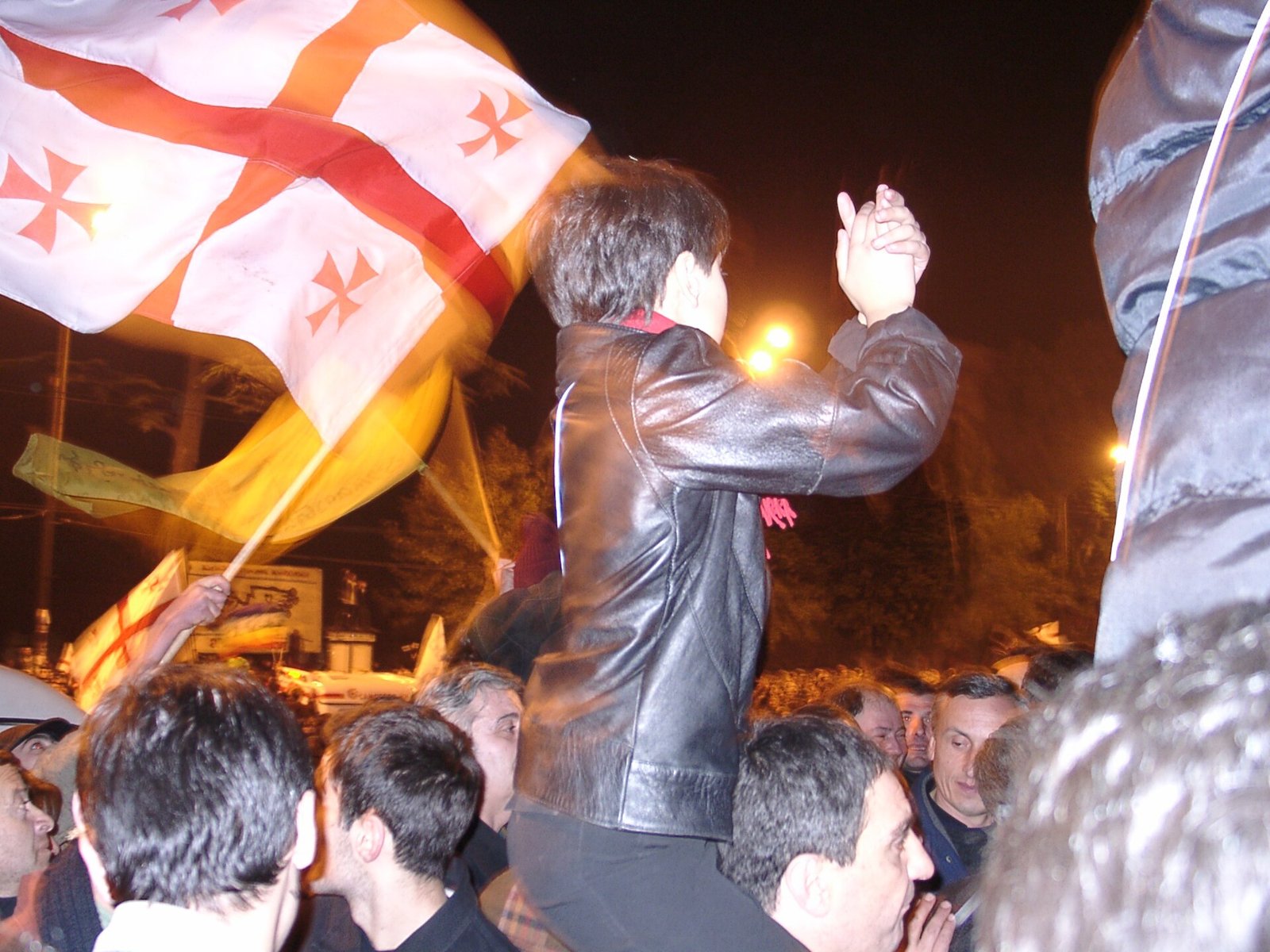
The movement takes its name from a specific scene. On 22 November, Mikheil Saakashvili and his supporters entered parliament carrying red roses. Shevardnadze was addressing the new parliament when demonstrators reached the chamber. He stopped speaking and left with his bodyguards. The following evening, he announced his resignation after talks with opposition leaders.
If you want to understand how Shevardnadze’s rule ended, follow both the street protests and the election dispute. The roses supplied the movement’s name. The contested parliamentary vote supplied its immediate trigger. Negotiations on 23 November produced the resignation that brought the confrontation to its decisive point.
The Rose Revolution in Georgia: who challenged Shevardnadze?
Shevardnadze had led Georgia since 1992 and became president in 1995. By November 2003, his principal opponents included former political allies. Mikheil Saakashvili, Nino Burjanadze and Zurab Zhvania became the leading opposition figures associated with the Rose Revolution. The challenge to his authority therefore included people who had previously worked alongside him.
The youth movement Kmara also helped organize the November protests. Its Georgian name means “Enough!” The movement’s participation brought an organized youth presence into the demonstrations. Opposition leaders and youth activists were both involved in the mobilization that centered on Tbilisi.
Television formed another part of the election dispute. Tbilisi-based Rustavi-2 broadcast an exit poll showing Saakashvili’s National Movement ahead. Meanwhile, Adjara’s leader, Aslan Abashidze, sent counterdemonstrators to Tbilisi in support of Shevardnadze. The capital thus became a meeting point for opponents and supporters of the president.
Why did the November 2003 election trigger protests?
The parliamentary election took place on 2 November 2003. About 450 international observers from 43 countries monitored it. On 3 November, the international observation mission said the election had failed to meet several international standards. Its concerns included confusion over voter lists and delays that damaged confidence in election administration.
You can connect that problem to an everyday experience: imagine checking a registration list and finding that your entry is confused or disputed. In Georgia’s election, observers identified voter-list confusion as a problem affecting confidence in the process. It concerned the administration of voting itself, before the dispute over results was resolved.
The OSCE/ODIHR’s final assessment documented widespread and systematic electoral fraud on election day and afterward. It identified Adjara and Kvemo Kartli in particular. These findings placed concrete electoral abuses behind the political confrontation. The dispute involved documented failures in the voting process as well as competing political claims.
The parliamentary vote was accompanied by a referendum. Voters were also asked about reducing the number of members of parliament from 235 to 150. That separate question appeared on the same day’s electoral agenda, even though the parliamentary election became the immediate trigger for the protests.
What happened inside parliament on 22 November?
On 22 November, demonstrators led by Saakashvili entered the parliamentary chamber while Shevardnadze was speaking. Saakashvili and his supporters carried red roses. This entry into parliament gave the Rose Revolution its enduring name and placed the opposition directly inside the institution at the center of the election dispute.
Shevardnadze broke off his address and departed with his bodyguards. After demonstrators took control of parliament, he declared a state of emergency. The declaration followed the parliamentary action. His resignation came the next day, after further intervention and talks with opposition leaders.
One small detail makes the parliamentary scene unusually tangible. According to Columbia Magazine, Saakashvili drank the tea Shevardnadze had left behind after taking the parliamentary podium. Alongside the roses and the interrupted speech, the abandoned tea belongs to the documented account of that day’s confrontation.
How did Shevardnadze’s rule end on 23 November?
Russian Foreign Minister Igor Ivanov was sent to Tbilisi on 23 November to mediate between Shevardnadze and the opposition. His arrival added a diplomatic channel to a crisis already marked by demonstrations, the entry into parliament and the declaration of a state of emergency.
That evening, Shevardnadze met Saakashvili and Zhvania at the Krtsanisi state residence. He announced his resignation after their meeting. The sequence matters: the parliamentary confrontation occurred on 22 November, while the talks and resignation followed on 23 November. The movement is commonly dated from 3 to 23 November 2003.
Parliamentary Speaker Nino Burjanadze then became interim president. Saakashvili’s election to the presidency came later. If you separate the resignation from the subsequent election, the transfer becomes easier to follow: Shevardnadze left office, Burjanadze assumed the interim presidency, and an early presidential vote followed.
What changed after the Rose Revolution?
On 25 November, the parliament elected in 1999 approved 4 January 2004 as the date for an early presidential election. Saakashvili won that election with 96.2 percent of the vote, according to results reported by the international observation mission. His electoral victory followed the interim presidency established after Shevardnadze’s departure.
The parliamentary dispute also required an electoral response. The Supreme Court annulled the proportional representation component of the November election. That component determined 150 of parliament’s 235 seats. Results for the seats elected through the majoritarian system remained in force. The ruling therefore affected part of the parliamentary election rather than every seat.
The repeat parliamentary election took place on 28 March 2004. Saakashvili’s National Movement–Democrats alliance won 135 of the 150 seats being contested again. International observers identified progress in the March election. They also said the democratic process could be fully tested only within a more competitive and pluralistic political environment.
Timeline
- 1992: Shevardnadze took the leadership of Georgia.
- 1995: Shevardnadze became president.
- 2 November 2003: Parliamentary elections and a referendum on reducing parliament’s membership took place.
- 3 November 2003: International observers reported that the election failed to meet several international standards.
- 22 November 2003: Saakashvili and demonstrators entered parliament. Shevardnadze left the building.
- 23 November 2003: Following mediation and talks, Shevardnadze resigned. Burjanadze became interim president.
- 25 November 2003: Parliament approved an early presidential election for 4 January 2004.
- 4 January 2004: Saakashvili won the early presidential election.
- 28 March 2004: The proportional representation component of the parliamentary election was held again.
Details you won’t find in guidebooks
The referendum held on 2 November proposed reducing parliament from 235 members to 150. Those same numbers also appear in the later court decision, but in a different relationship. The annulled proportional representation vote covered 150 seats within the 235-seat parliament. The referendum question and the court ruling were separate developments.
The Supreme Court left the majoritarian election results in force while annulling the proportional component. This distinction explains why the March 2004 repeat election concerned 150 seats. The National Movement–Democrats alliance subsequently secured 135 of those seats.
Burjanadze’s role also helps clarify the transition. She was both a leading opposition figure and parliamentary speaker. After Shevardnadze resigned, she assumed the interim presidency. Saakashvili’s presidential victory followed on 4 January 2004, rather than on the night the outgoing president stepped down.
FAQ
What was the Rose Revolution?
The Rose Revolution was a peaceful protest movement in Georgia in November 2003. It followed disputed parliamentary elections and ended with President Eduard Shevardnadze’s resignation on 23 November.
In which country did the Rose Revolution happen?
It happened in Georgia. The capital, Tbilisi, was the main center of protest and the transfer of power.
Why was it called the Rose Revolution?
The name came from the red roses carried by Mikheil Saakashvili and his supporters when they entered parliament on 22 November 2003.
Sources
- Vikipedi — Gül Devrimi tr.wikipedia.org
- Civil Georgia — Timeline – 2003 civil.ge
- Wikipedia — Rose Revolution en.wikipedia.org
- OSCE/ODIHR — Parliamentary Elections, 2 November 2003 odihr.osce.org
- OSCE/ODIHR — Georgian parliamentary elections marred by confusion over voter lists odihr.osce.org
- Columbia Magazine — Rose Revolutionary magazine.columbia.edu
- OSCE — Protests in Georgia after second round of parliamentary elections lead to President’s resignation osce.org
- Civil Georgia — International Observers Preliminary Statement on Elections civil.ge
- Inter-Parliamentary Union — Georgia: Elections in 2004 data.ipu.org
- Wikipedia — First Republic Square en.wikipedia.org
Image: OP13.JPG — Zaraza, CC BY-SA 3.0