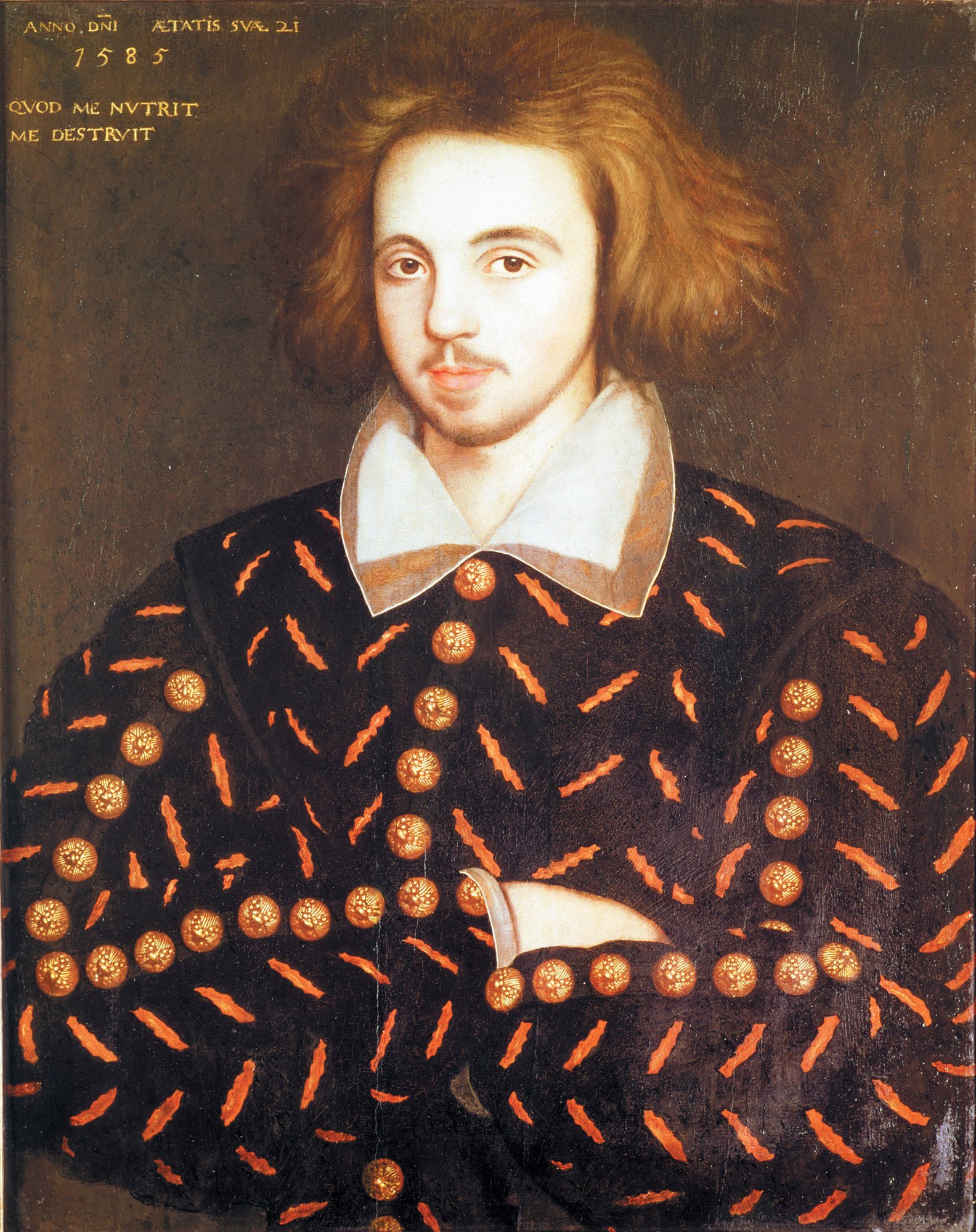
Christopher Marlowe was a Cambridge-educated playwright and Shakespeare’s contemporary, known for Tamburlaine and Doctor Faustus. Baptised in Canterbury in 1564, he helped change English theatrical verse before his death in Deptford in 1593. College accounts, a government minute and an inquest preserve evidence of his education, public service and death.
How do those records connect a student’s spending with government intervention and a fatal dispute? If you follow Marlowe through Cambridge, the theatre and Deptford, different kinds of evidence come into view. An account book records purchases. A council minute praises service. An inquest gives an official account of a killing. Each supports a different part of his story.
What records survive of Marlowe’s Cambridge education?
Marlowe was the son of John Marlowe, a Canterbury shoemaker, and Katherine. He was baptised at St George’s Church on 26 February 1564. That date marks his baptism; it should not be treated as a recorded birthday.
After attending the King’s School in Canterbury, Marlowe entered Corpus Christi College at Cambridge with a Matthew Parker scholarship. The college’s history places his arrival in December 1580. It also identifies Old Court as the place where he lived.
Marlowe received his BA in 1584 and his MA in 1587. College food and drink accounts add a less formal record of his student years. They register absences and show spending on food and wine that reached twelve pence in some weeks.
If you have ever checked a grocery receipt to reconstruct a week’s spending, these accounts offer a familiar connection to everyday life. They preserve purchases and patterns of attendance. They do not, by themselves, explain where Marlowe went during an absence or why he travelled.
His MA became a matter for government intervention. In 1587, Cambridge hesitated to award the degree because of a rumour that he intended to attend the English Catholic seminary at Reims. A surviving Privy Council minute then brought his service to Queen Elizabeth into the university’s deliberations.
How did Tamburlaine and Doctor Faustus influence English theatre?
Tamburlaine the Great was written in two parts around 1587–1588. It draws freely on the life of the fourteenth-century ruler Emir Timur. Its possible sources include Pedro Mexía’s Silva de Varia Lección, dating from around 1540, and Petrus Perondinus’s biography of Timur, published in 1553.
The play’s relationship to his life is loose. Its historical subject and possible written sources should therefore be distinguished from its dramatic treatment.
The Poetry Foundation credits Tamburlaine’s success in 1587–1588 with helping spread unrhymed iambic pentameter through English theatre. Other playwrights imitated it. This gives Marlowe’s influence a concrete form: his successful theatrical verse became a model that others used.
Marlowe wrote Tamburlaine’s leading role for Edward Alleyn, the star actor of the Admiral’s Men. The language was therefore connected to a particular performer. Later recognition came from Ben Jonson, who praised Marlowe’s powerful verse in his poem for Shakespeare’s First Folio of 1623.
Doctor Faustus changes the focus to a bargain over knowledge and power. Its central character agrees to surrender his soul in exchange for twenty-four years of what Mephistopheles can provide. The bargain gives his pursuit of knowledge a fixed term and a stated price.
The play also works with older theatrical devices. The Open University identifies the Good Angel, the Bad Angel and the Seven Deadly Sins as personifications inherited from medieval morality theatre. These figures give visible form to the moral choices surrounding Faustus.
The Poetry Foundation describes a further change. Marlowe turns the general human figure of morality drama into a protagonist with a personal history. He also disrupts the pattern in which the sinner receives salvation at the end. Doctor Faustus thus combines inherited dramatic tools with a different treatment of its central character.
When you read Doctor Faustus, the edition matters. Its early text survives in two forms: the A text, first printed in 1604, and the B text, printed in 1616. Both publication dates fall after Marlowe’s death.
What evidence underpins claims about government service and espionage?
The strongest documentary starting point is the Privy Council minute dated 29 June 1587. It records five councillors seeking to have Cambridge authorities restore Marlowe’s reputation. Their intervention praised his service to Queen Elizabeth during the dispute over his MA.
The original letter is lost. The surviving minute preserves a summary, and that summary does not explicitly mention espionage. It supports the statement that Marlowe performed government service. It does not identify a particular spying assignment.
One claim places him at the Reims seminary as a spy for Francis Walsingham. Arata Ide points out that the nature of Marlowe’s assignment is unknown. Marlowe’s name also does not appear in the seminary’s diary. The proposed Reims mission therefore goes beyond what the surviving council minute establishes.
The distinction matters because Cambridge’s concern about Reims and the council’s praise occur within the same degree dispute. Their proximity helps explain the attraction of the espionage theory. It does not turn the rumour about the seminary into a documented journey or mission.
What is known about his death in 1593?
A warrant for Marlowe’s arrest was issued on 18 May 1593. He appeared before the authorities on 20 May and was required to remain available daily. These events belong to the documented final weeks of his life.
On 30 May, Ingram Frizer fatally stabbed Marlowe at Eleanor Bull’s house in Deptford. An inquest followed on 1 June 1593. Its account describes a dispute over payment and concludes that Frizer acted in self-defence.
Leslie Hotson discovered the inquest record in 1925. The document is preserved at The National Archives. Marlowe was buried in the churchyard of St Nicholas in Deptford, giving the account of his death both a legal record and a recorded burial place.
The killing has also been interpreted as an assassination. Constance Kuriyama and J. A. Downie, however, accept the inquest’s self-defence account. The existence of a later assassination claim should be kept separate from the conclusion recorded by the investigation.
Why is the claim that he wrote Shakespeare’s works not considered established?
The Marlowe authorship theory depends on his surviving the event recorded as his death. It proposes that the killing was staged, that he escaped to Europe and that he continued writing works attributed to Shakespeare.
Charles Nicholl’s objection centres on the documents. He argues that the evidence, including the inquest, shows that Marlowe died in 1593. On that chronology, Marlowe was no longer alive when most Shakespeare plays were written. The theory therefore requires overturning the documentary account of his death.
Timeline
- 26 February 1564: Marlowe was baptised at St George’s Church in Canterbury.
- December 1580: He arrived at Corpus Christi College, Cambridge.
- 1584: He received his BA.
- 29 June 1587: The Privy Council intervened with Cambridge authorities on his behalf.
- 1587: He received his MA.
- Around 1587–1588: The two parts of Tamburlaine were written.
- 1590: Richard Jones published both parts in one volume.
- 18 May 1593: A warrant was issued for his arrest.
- 30 May 1593: He was fatally stabbed in Deptford.
- 1 June 1593: The inquest into his death took place.
- 1594: Dido appeared in print under the names of Marlowe and Thomas Nashe.
- 1604: The A text of Doctor Faustus was published.
- 1616: The B text of Doctor Faustus was published.
- 1925: Leslie Hotson found the inquest document.
Details you won’t find in guidebooks
Tamburlaine entered the Stationers’ Register in August 1590. Richard Jones published its two parts together that year. It was the only Marlowe play printed during his lifetime, yet its first editions carried no author’s name.
A different trail survives for Dido. The British Library’s Add MS 5142 describes an eighteenth-century copy made from the 1594 edition by Mr Henderson of Covent Garden Theatre. The copy comprises twenty-seven leaves. The catalogue records that the edition named Christopher Marlowe and Thomas Nashe together as authors.
Marlowe’s Westminster Abbey commemoration contains another detail about how his story has been presented. Unveiled on 11 July 2002, it includes a question mark beside his death date. The Marlowe Society, which donated the panel, requested that addition. The punctuation records the donor’s choice; the 1593 inquest remains the documentary account of his death.
FAQ
Who was Christopher Marlowe?
Christopher Marlowe was a Cambridge-educated playwright and Shakespeare’s contemporary. Baptised in Canterbury in 1564, he wrote Tamburlaine and Doctor Faustus and died in Deptford in 1593.
Was Christopher Marlowe a spy?
A surviving Privy Council minute from 1587 praises his service to Queen Elizabeth. It does not explicitly mention espionage, and the claim that he spied at Reims remains unestablished.
How did Christopher Marlowe die?
Ingram Frizer fatally stabbed him at Eleanor Bull’s house in Deptford on 30 May 1593. The inquest described a dispute over payment and concluded that Frizer acted in self-defence.
Did Marlowe write Shakespeare’s works?
The theory assumes that Marlowe’s death was staged and that he continued writing after escaping to Europe. Charles Nicholl argues that documents, including the inquest, establish his death in 1593, before most Shakespeare plays were written.
Sources
- Vikipedi — Christopher Marlowe tr.wikipedia.org
- Poetry Foundation — Christopher Marlowe poetryfoundation.org
- Corpus Christi College — College History corpus.cam.ac.uk
- Wikipedia — Christopher Marlowe en.wikipedia.org
- Arata Ide — Marlowe and the Privy Council cambridge.org
- Royal Shakespeare Company — Tamburlaine: Dates and Sources rsc.org.uk
- Open University — Doctor Faustus: The Morality Play open.edu
- British Library — Add MS 5142 searcharchives.bl.uk
- Westminster Abbey — Christopher Marlowe westminster-abbey.org
- Shakespeare Birthplace Trust — Marlowe and Shakespeare’s Authorship shakespeare.org.uk
Image: Christopher Marlowe.jpg — anonymous, Public domain