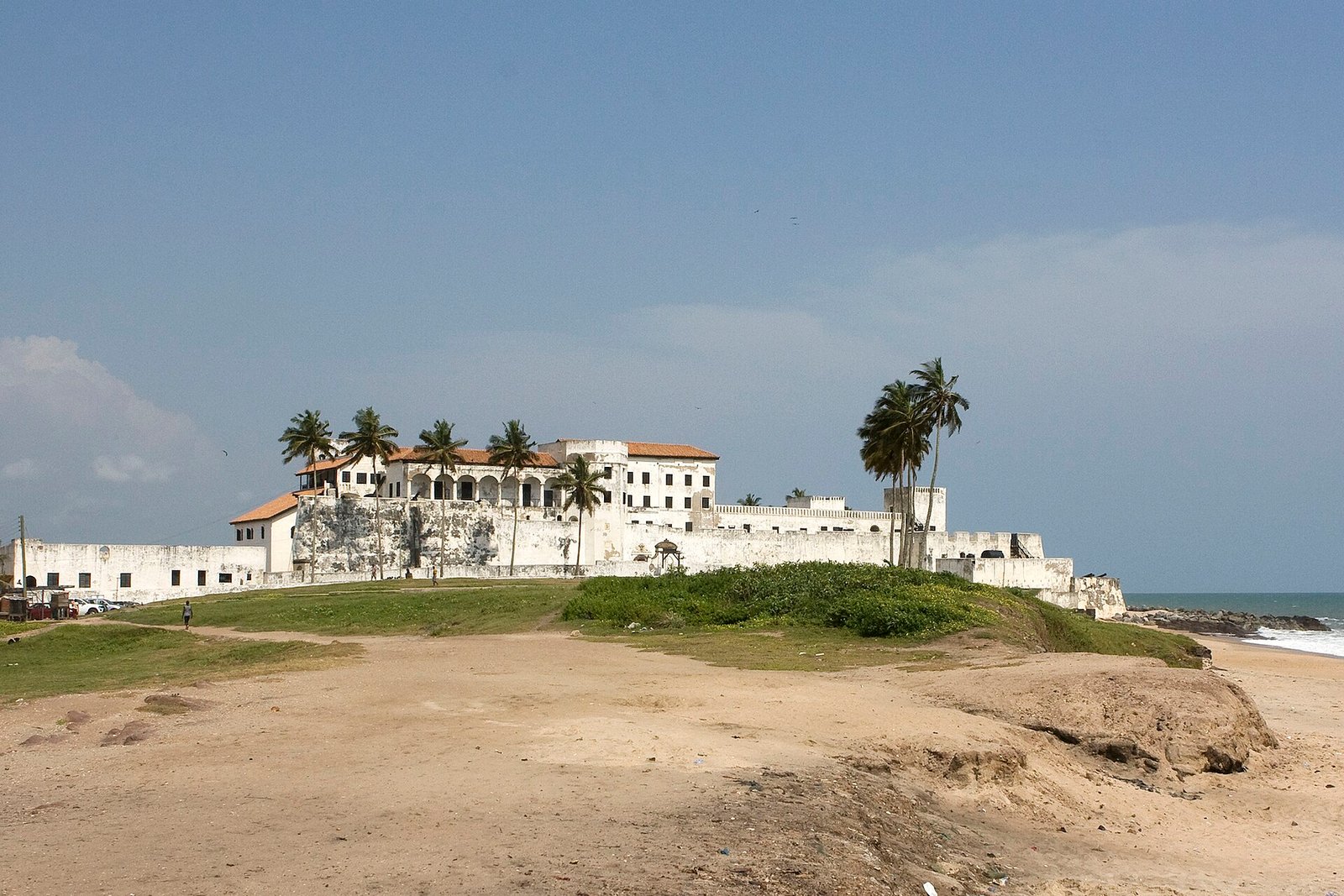
Elmina Castle is in Elmina, in Ghana’s Central Region, on the Atlantic coast. The Portuguese built it in 1482 as São Jorge da Mina to protect the gold trade. It later became a place where enslaved Africans were held before transportation to the Americas.
How did a fortified trading post become a place of imprisonment? Elmina’s converted storerooms, Dutch rearrangement and later use as a school offer ways into that history. If you follow its changing functions, the castle becomes more than a date or a coastal landmark. Its location, construction and surviving visitor route explain different parts of its past.
Where is Elmina Castle located in Ghana?
Elmina Castle stands on a narrow promontory near the Atlantic Ocean and the Benya River. This setting provided a natural harbour. Its position belongs at the beginning of its story because the Portuguese established the castle to protect trade.
For your map search, the essential location is Elmina, Central Region, Ghana. The castle’s coastal setting connects its earliest role in the gold trade with its later role in the transportation of enslaved Africans across the Atlantic. Both belong to the history of this same building.
Who built Elmina Castle, and in which year?
The Portuguese built Elmina Castle in 1482. Its original name, São Jorge da Mina, can be rendered approximately in English as “Saint George’s Castle of the Mine.” Portugal is therefore the country associated with its foundation, although Dutch and British control followed.
The decision preceded construction. In 1481, King João II of Portugal decided to establish a castle to protect trade in the area. A Portuguese fleet commanded by Diogo de Azambuja reached Elmina on 19 January 1482. The castle was founded that year.
Elmina is described as the oldest surviving European building in sub-Saharan Africa. That description concerns its surviving structure and early foundation. The building also underwent expansion and rearrangement, including work under the Dutch between 1770 and 1775.
What was Elmina Castle originally used for?
Elmina began as a fortified trading post protecting the gold trade. Its defensive purpose and commercial purpose were connected from the outset. The Portuguese established a protected place for trade beside a natural harbour on the Atlantic coast.
Gold was central to that founding purpose, but the Portuguese period also involved trade in enslaved people. By the early sixteenth century, the Portuguese were bringing enslaved people from Benin to Elmina in exchange for gold and ivory. Human trafficking therefore formed part of the castle’s history before Dutch control began.
How did Elmina Castle become a centre of the slave trade?
The Dutch West India Company captured Elmina Castle from the Portuguese in 1637. Under Dutch control, the castle was used in the slave trade supplying Brazil and the Caribbean. Enslaved Africans were held there before being placed aboard ships bound for the Americas.
As the slave trade became more important, the castle expanded. Storerooms were converted into dungeons. This change in the use of space is one of the clearest facts for understanding the building: rooms associated with storage became places where people were confined.
The Dutch rearranged the castle between 1770 and 1775 while using it for the gold and slave trades. Elmina also served as the coordinating centre for Dutch activities on the Gold Coast until 1872. Its history therefore includes imprisonment, commerce and administration within the same complex.
Elmina Castle’s Door of No Return
The Door of No Return forms part of the castle’s visitor route, alongside dungeons and punishment cells. These spaces connect a visit with the history of Africans held at Elmina before transportation to the Americas. They are central to understanding what the castle became.
When you encounter the name “Door of No Return,” keep that wider history in view. The castle held enslaved people awaiting ships, and its storerooms were turned into dungeons. The doorway belongs within that account of confinement and forced transportation.
Elmina Castle history after Dutch rule
The Dutch transferred Elmina Castle to the British on 6 April 1872. This ended its role as the coordinating centre of Dutch activities on the Gold Coast. When Ghana gained independence from Britain in 1957, the castle came under the control of independent Ghana.
The building also served as a training centre for police recruits and as a secondary school before becoming a history museum. These uses add another layer to its history. A structure founded for protected trade later housed prisoners, trainees, pupils and museum visitors.
In 1979, Elmina Castle entered the UNESCO World Heritage List as part of a serial property covering forts and castles along Ghana’s coast. Its recognition belongs to that wider group of coastal structures.
Timeline
- 1481: King João II of Portugal decided to build a castle to protect trade.
- 19 January 1482: The fleet commanded by Diogo de Azambuja arrived at Elmina.
- 1482: The Portuguese founded São Jorge da Mina.
- 1637: The Dutch West India Company captured the castle.
- 1770–1775: The Dutch rearranged the building.
- 6 April 1872: The castle passed from Dutch to British control.
- 1957: Ghana’s independence brought the castle under Ghanaian control.
- 1979: The castle became part of the UNESCO-listed coastal forts and castles property.
- 2006: The Zamani Project documented the castle spatially.
Details you won’t find in guidebooks
Construction materials arrived from Portugal already prepared, from foundation stones to roof tiles. They travelled aboard ten caravels and two transport ships. The building project therefore involved moving its materials by sea as well as bringing a fleet to Elmina.
At Elmina, the documented shipment included materials spanning the building from its foundations to its roof. That detail makes the practical work behind the 1482 foundation easier to picture.
The castle’s educational uses are another detail to remember. Before its conversion into a history museum, it housed both police recruit training and a secondary school. Its later functions extended beyond the trading and imprisonment roles that dominate its earlier history.
Where can you find Elmina Castle photos?
The Zamani Project’s Elmina Castle page offers photographs, plans, sections, three-dimensional models and a 360-degree panoramic tour. The project carried out spatial documentation in 2006. These resources provide several ways to examine the same building.
If you are preparing a visit or studying the castle, you can use the photographs alongside the plans and sections. The panoramic tour and three-dimensional models offer additional views. Together, these materials help you connect images of individual spaces with the documented layout.
Elmina Castle and Cape Coast Castle: are they different?
Elmina Castle and Cape Coast Castle are separate buildings. Together with Christiansborg, they form the three castles within the same UNESCO World Heritage property. Their shared listing does not make them different names for one site.
The wider property includes forts and castles spread across approximately 500 kilometres of Ghana’s coastline. It extends between Keta in the east and Beyin in the west. Elmina belongs to this coastal group while retaining its own foundation date and history of changing control.
Elmina Castle tickets and visiting hours
The Ghana Museums and Monuments Board publishes Elmina Castle’s opening hours as 09:00–16:30 every day. The Central Regional Coordinating Council states that a guided tour is included in the admission fee. These are useful details when organising your visit around the museum route.
The Board’s fees page lists 20 Ghana cedis for Ghanaian adults and 80 Ghana cedis for foreign adults. It explicitly identifies those figures as the tariff before the latest fee change. Treat them as an earlier price schedule, and confirm the applicable admission charge when planning your visit.
FAQ
Where is Elmina Castle located?
Elmina Castle is in Elmina, in Ghana’s Central Region, on the Atlantic coast near the Benya River.
Who built Elmina Castle, and in which year?
The Portuguese built Elmina Castle in 1482 and named it São Jorge da Mina.
What was Elmina Castle used for?
It began as a fortified trading post protecting the gold trade. It later held enslaved Africans before their transportation to the Americas, and subsequently served as a police training centre and secondary school before becoming a history museum.
Sources
- Ghana Museums and Monuments Board — St George’s Castle / Elmina Castle gmmb.gov.gh
- Turkish Wikipedia — Elmina Kalesi tr.wikipedia.org
- English Wikipedia — Elmina Castle en.wikipedia.org
- Central Regional Coordinating Council — Elmina Castle crcc.gov.gh
- UNESCO World Heritage Centre — Forts and Castles whc.unesco.org
- Zamani Project — Elmina Castle zamaniproject.org
- Ghana Museums and Monuments Board — Fees and Charges gmmb.gov.gh
Image: Elmina Castle – Ghana.jpg — Damien Halleux Radermecker, CC BY-SA 2.0