Rollo was a real Viking leader who commanded Vikings in the lower Seine valley in the early tenth century and is considered the founder of Normandy’s government at Rouen. A royal document from March 918 confirms that land had already been granted to Rollo and his companions. His agreement with Charles III is traditionally dated to 911.
If you want to understand how a Viking warrior became Normandy’s founder, follow the land grant, his baptism, and the succession of his son. These connect his military leadership with an enduring ruling family. They also help separate the documented Rollo from later stories about his birthplace, royal marriage, and dealings with the king.
Who was Rollo, and where did he come from?
Rollo’s name is generally linked to the Old Norse Hrólfr. Written forms include Rou, Rollon, Rodolfus, and Radulfus. If you encounter these names while reading about Normandy, they can refer to the same historical leader. The different spellings belong to the record of a man whose exact birth date remains uncertain.
He was born during the ninth century. Store norske leksikon gives an approximate birth year of 846. Other datings range from about 835 to 870. These estimates should not become a precise birthday in a biography. The secure outline is broader: a Viking leader later established power around Rouen.
His national origins are also disputed. Dudo of Saint-Quentin, writing between 996 and 1015, presented him as Danish. William of Jumièges associated him with Fakse. A competing Norwegian tradition identifies him with the exiled Gange-Rolv. Neither case establishes conclusively whether the founder of Normandy was Norwegian or Danish.
How did Rollo become the founder of Normandy?
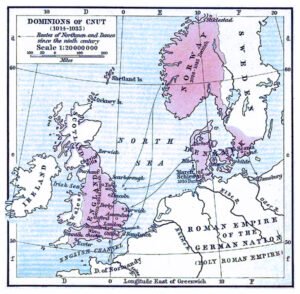
The traditional turning point came in 911. At Saint-Clair-sur-Epte, Rollo and the West Frankish king Charles III are said to have reached an agreement. In this account, Charles granted Rollo territory between the Epte River and the sea. Rollo owed loyalty and military defence in return.
The king’s purpose was practical. The coastal region suffered repeated attacks. Settling Rollo there was intended to create a buffer against other Viking raids. The arrangement gave a Viking leader territory while assigning him responsibility for protecting the kingdom. The military force that made him a threat could also make him useful to Charles.
Think of the everyday connection between receiving something and accepting responsibility for it. Rollo’s traditional bargain linked land with obligations: loyalty and defence. You can understand the political exchange without imagining that Charles simply handed over territory as a reward. Protection of the kingdom was central to the arrangement.
The familiar story also places Rollo at a defeat at Chartres in 911. That detail needs caution. Historian Robert Helmerichs states that evidence does not establish Rollo’s participation in the battle. A narrative that moves neatly from defeat to agreement is therefore more certain about his movements than the evidence allows.
What does the evidence say about the 911 agreement?
The agreement’s text has not survived, nor has a contemporary account of it. The location at Saint-Clair-sur-Epte and the date of 911 depend on Dudo’s later narrative. This makes 911 the traditional foundation date. It does not make every part of the familiar treaty story equally well documented.
A surviving original document from Charles III provides firmer ground. Dated March 918, it explicitly records that land had previously been given to Rollo and his companions for the kingdom’s protection. It confirms an earlier grant. It does not explain the boundaries of the Norman share, so it cannot independently establish the full territory described in the traditional account.
Did baptism end Rollo’s life as a Viking leader?
Rollo was baptised at Rouen in 912 and took the Christian name Robert. His conversion belongs alongside the agreement with Charles in explaining his place in Normandy’s formation. Yet baptism did not mean that every part of his earlier conduct disappeared. He continued to pursue territorial expansion as a Viking leader.
His alliance with Charles did not require him to abandon raids beyond the king’s authority. That distinction matters. Rollo could serve as a defender within the arrangement while continuing military activity elsewhere. The founder of Normandy therefore combined obligations to a king with the practices of a commander seeking more territory.
How did Rollo govern Normandy?
Rollo distributed land among commanders who owed him allegiance and used Rouen as his effective capital. His authority thus involved both a centre of government and followers holding territory. Rouen was the base around which his rule developed, rather than merely a place associated with his baptism.
Scandinavian settlers continued to arrive during his rule. Normandy’s name comes from the northerners who settled there. The region’s formation consequently involved settlement as well as a royal agreement. Rollo’s leadership, the distribution of land, and the continued arrival of settlers all belong to the explanation of how Normandy took shape.
He is frequently called the first duke of Normandy. The title needs qualification. According to Normandy Tourism, his great-grandson Richard II was the first to use it formally. Calling Rollo the founder describes his historical role more precisely than assuming he held exactly the same formal title as later rulers.
Who were Rollo’s family and successors?
Poppa of Bayeux was the mother of Rollo’s son and successor, William Longsword. Rollo’s children also included a daughter, Gerloc. William’s succession is central to the story because the government founded around Rouen passed to Rollo’s son. William’s land acquisition in 933 marks a further stage in that family’s territorial development.
The claim that Rollo married Gisela, a daughter of Charles III, is less secure. One objection concerns her possible age. A daughter born from Charles’s first marriage in 907 could have been no more than five in 911. Suggested explanations include birth outside that marriage or a diplomatic betrothal during childhood. These possibilities do not establish that the marriage occurred.
Rollo’s exact death date is uncertain. His death is generally placed between Flodoard’s last reference to him in 928 and William’s land acquisition in 933. His descendants continued to rule, and from 1066 the Norman dynasty also held the English throne. His legacy therefore extended beyond the territory first associated with his leadership.
Timeline
- Ninth century: Rollo was born; his exact birth year and Danish or Norwegian origins remain disputed.
- 911: Traditional date of the agreement with Charles III at Saint-Clair-sur-Epte.
- 912: Rollo was baptised at Rouen and took the name Robert.
- March 918: Charles III’s document recorded an earlier land grant to Rollo and his companions.
- 928: Flodoard mentioned Rollo for the last time.
- 928–933: The usual interval assigned to Rollo’s death.
- 933: William Longsword, his son and successor, acquired further territory.
- 1066: Rollo’s Norman descendants reached the English throne.
- Last quarter of the thirteenth century: Rollo’s tomb effigy at Rouen Cathedral was made.
- 2011: Preparations for the agreement’s 1,100th anniversary included repairs to Rollo’s statue in Rouen.
Details you won’t find in guidebooks
Dudo tells a striking story about an act of submission to Charles III. Rollo’s man supposedly lifted the king’s foot to kiss it and caused Charles to fall backwards. Other primary sources do not corroborate the episode. Its memorable physical detail should therefore be kept separate from the documented land grant.
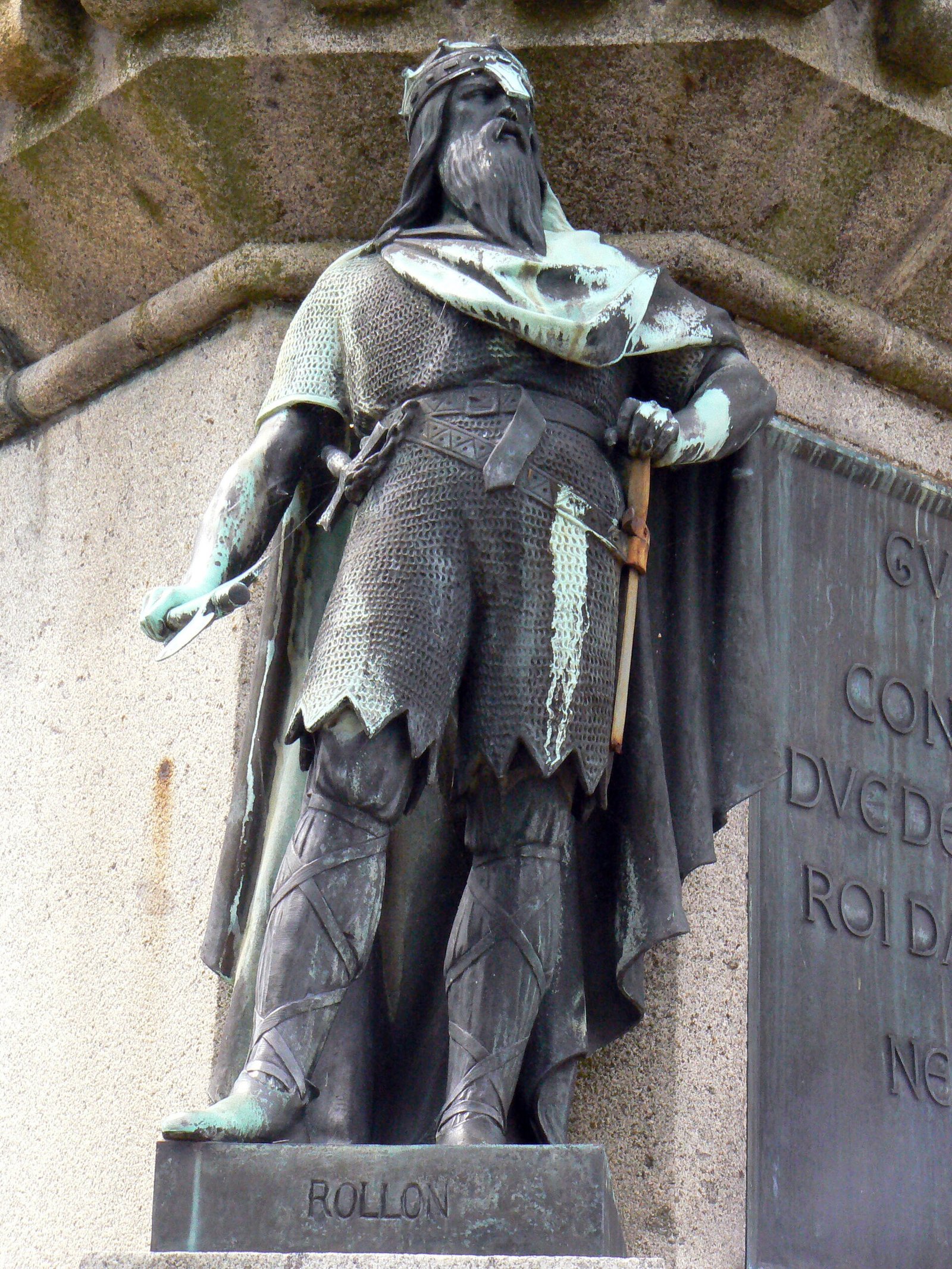
If you see Rollo’s tomb effigy at Rouen Cathedral, you are looking at a much later representation. It dates to the last quarter of the thirteenth century. The sculpture belongs to the later remembrance of Normandy’s founder. It is not an object made during his lifetime.
Another Rollo monument appears in a municipal record dated 21 January 2011. A Rouen council report addressed repairs to the broken arm of his statue in the municipal gardens. The work formed part of preparations for the agreement’s 1,100th anniversary. Even a damaged statue became part of commemorating the traditional foundation date.
FAQ
Was Rollo a real Viking?
Yes. Rollo led Vikings in the lower Seine valley in the early tenth century and is considered the founder of the Norman government based at Rouen. A royal document from March 918 confirms that land had previously been granted to him and his companions.
Was Rollo Norwegian or Danish?
His origins remain disputed. One tradition identifies him as Danish, while another connects him with the exiled Norwegian Gange-Rolv. Neither identification is conclusive.
Was Rollo the first duke of Normandy?
He is often called the first duke of Normandy. Normandy Tourism identifies his great-grandson Richard II as the first member of the dynasty to use the title formally.
When did Rollo die?
His death is generally placed between 928 and 933. Flodoard last recorded him in 928, and his son and successor William Longsword received a further land grant in 933.
Sources
- Wikipedia — Rollo en.wikipedia.org
- Cambridge Core — Early Normandy cambridge.org
- Vikipedi — Rollo tr.wikipedia.org
- Store norske leksikon — Rollo snl.no
- ORB — Robert Helmerichs, The Rollonid Principality: Rollo arlima.net
- Durham World Heritage Site — The Founding of Normandy durhamworldheritagesite.com
- Normandy Tourism — Rollo, Viking warlord en.normandie-tourisme.fr
- France’s Ministry of Culture — POP, PM76002027 pop.culture.gouv.fr
- City of Rouen — Council decision 3-2, 21 January 2011 rouen.fr
Image: Rollon Falaise (Calvados).jpg — Pradigue, CC BY-SA 3.0