No single person is proven to have discovered coffee: Kaldi, the Ethiopian goatherd, belongs to legend. Arabica’s natural range includes southwestern Ethiopia and neighboring African regions, while the early reliable history of roasted coffee drinking points to Sufi communities in fifteenth-century Yemen.
How did an Ethiopian goat story become attached to a drink documented in Yemen? The trail connects wild Arabica, competing accounts of Sufi coffee drinkers, Ottoman coffeehouses and seeds carried overseas. If you are visiting Turkey, that trail also connects Istanbul’s early coffeehouses with a London venture whose founders knew coffee culture in İzmir.
Where was coffee first discovered? Ethiopia and the plant’s origins
The botanical answer begins with a region, rather than a named discoverer. Kew records the natural range of Coffea arabica as eastern South Sudan, southwestern Ethiopia and Mount Marsabit in northern Kenya. Ethiopia therefore belongs at the center of the answer, but Arabica’s native range crosses present-day borders.
Kew places Arabica’s natural mountain forest habitats at roughly 950–1,950 meters above sea level. These habitats describe where the plant grows naturally. They do not establish who first tasted its fruit or prepared a drink from roasted coffee.
For a geographical anchor, Bonga is the center of the Keffa region in southwestern Ethiopia. It lies at approximately 7.267° north and 36.233° east. You can locate a real Ethiopian place on the coffee map without treating the Kaldi legend as a documented event.
Kaldi and the goats: what does the legend say?
In the familiar legend, Kaldi is an Ethiopian goatherd. He notices that his goats become lively after eating coffee fruit. He tries the fruit himself and recognizes its stimulating effects. The story gives coffee a memorable discoverer, but it does not establish a historical individual.
The earliest known written record of the shepherd story appears in a coffee treatise published by Antoine Faustus Nairon in Rome in 1671. That text is not contemporary evidence confirming Kaldi’s life. Its publication date also comes after the documented use of coffee by Yemen’s Sufi communities.
Michel Tuchscherer’s 2024 academic overview describes Kaldi as a myth. It also emphasizes how scarce Ethiopian written sources are before the eighteenth century. The distinction matters: a legend about discovery and a written history of drinking coffee are different kinds of evidence.
Yemen and the early history of coffee drinking
The early reliable history of the roasted coffee drink leads to fifteenth-century Yemen. Sufi communities used coffee to stay awake during nighttime worship. This gives the drink a concrete setting and purpose: wakefulness during religious practice.
Abdülkadir el-Cezîrî compiled Umdat al-Safwa fi Hill al-Qahwa in 1587. His work addressed coffee’s history and the religious arguments surrounding it. It also preserved competing accounts of how coffee entered Yemeni Sufi circles.
One account credits Cemâleddin ez-Zebhânî of Aden, who died in 1470, with introducing coffee to those circles. Another gives Ali bin Ömer, a Shadhili sheikh who had lived in Ethiopia, credit for spreading coffee in Mocha. These remain attributed accounts, rather than proof of a single discoverer.
Yemen became a principal center of coffee production and export during the sixteenth and seventeenth centuries. Mocha was the main port through which that trade passed. The history of coffee therefore connects African botanical origins with Yemeni drinking practices and commerce.
History of coffee timeline
- About 610,000–1 million years ago: Genomic modeling places Arabica’s formation through natural hybridization within this estimated period.
- Fifteenth century: Early reliable accounts describe Yemeni Sufis using coffee during nighttime worship.
- 1511: Coffeehouses in Mecca close temporarily following religious objections.
- 1554–1555: Sources give different dates for Istanbul’s first coffeehouse.
- 1587: El-Cezîrî compiles his work on coffee’s history and religious debates.
- About 1652: Pasqua Rosée opens a coffeehouse in London.
- 1671: Nairon’s Rome treatise contains the earliest known written shepherd story.
- 1727: Seeds brought from French Guiana by Francisco de Melo Palheta mark the recorded beginning of Brazilian coffee cultivation.
- 1938: Hira Giri plants coffee seeds from Myanmar at Aapchaur in Nepal.
- 2013: UNESCO inscribes Turkish coffee culture and tradition on its Representative List.
- 2024: Nature Genetics publishes a genomic study examining Arabica’s prehistoric origins.
History of coffee shops and coffeehouses: Mecca, Istanbul and London
Coffeehouses were widespread in Mecca by the early sixteenth century. People drank coffee, listened to music and played chess there. These activities place coffee within shared urban life, beyond its use during Sufi worship.
Religious objections led to the closure of Mecca’s coffeehouses in 1511. The prohibition did not last long. Coffee’s early social history therefore includes both gathering places and disputes over their activities.
Sources disagree slightly over Istanbul’s first coffeehouse. Turkish Wikipedia dates an establishment opened by two Syrian Arabs in Tahtakale to 1554. Encyclopaedia Iranica gives the date as 962 in the Hijri calendar, or 1555, and describes the founders as two men from Damascus.
Coffee also had a defined role in the Ottoman palace. The kahvecibaşı, responsible for preparing coffee, was chosen from trusted servants of the sultan or the dignitary being served. Coffee preparation could therefore be an official responsibility within an elite household.
Around 1652, Pasqua Rosée opened a coffeehouse in St Michael’s Alley, in London’s Cornhill area. Daniel Edwards, a Levant Company merchant, supported the venture. Both men had encountered coffee culture in the Ottoman port of İzmir.
If you meet someone over coffee today, the everyday connection is easy to recognize: Mecca’s early coffeehouses also combined a drink with shared activities. Music and chess give that historical scene specific details, rather than leaving coffeehouse life as an abstract idea.
History of coffee in India, Nepal and America
India’s Press Information Bureau presents the Baba Budan story as folklore. In that account, he carried seven coffee seeds beneath his clothing and planted them in Karnataka’s Chandragiri hills. The attribution should remain attached to the story whenever it is retold.
For Nepal, the National Tea and Coffee Development Board records a named planter, location and year. Hira Giri brought coffee seeds from Myanmar and planted them at Aapchaur in the Gulmi district in 1938. This account concerns the introduction of cultivation to a particular place.
In the Americas, Brazil’s recorded beginning of coffee cultivation is linked to Francisco de Melo Palheta. He brought seeds from French Guiana in 1727. This episode belongs to the movement of coffee into new growing regions, long after its early use in Yemen.
Details you won’t find in guidebooks
Nairon’s 1671 shepherd story differs from the familiar Kaldi version in important particulars. The shepherd is unnamed. The setting is Ayaman in Arabia Felix, rather than Ethiopia. The earliest written shepherd account should therefore not be treated as an exact match for the popular legend.
Yemeni coffee traditions also include qishr, prepared from the husks of coffee fruit rather than the beans. Early references can confuse this drink with bean coffee. When you read an account of early coffee drinking, the part of the fruit being used can affect what the account describes.
Arabica itself has a history far older than human coffee drinking. It is a natural hybrid of Coffea canephora and Coffea eugenioides, with two chromosome sets inherited from each parent. Modeling in the 2024 genomic study suggests that this hybridization occurred approximately 610,000–1 million years ago.
That study examined 39 Arabica varieties. It also sequenced an eighteenth-century plant specimen used by Carl Linnaeus when naming the species. The research connects a historical botanical specimen with evidence about the plant’s prehistoric formation.
History of coffee books and academic reading
For a historical text, el-Cezîrî’s 1587 Umdat al-Safwa fi Hill al-Qahwa brings together coffee history and religious debate. Nairon’s 1671 treatise matters for a different reason: it preserves the earliest known written shepherd story. Their dates and subjects help you distinguish accounts of drinking from accounts of discovery.
For an academic overview, Tuchscherer’s 2024 summary describes Kaldi as a myth and notes the scarcity of Ethiopian written sources before the eighteenth century. Its treatment of Kaldi as myth provides a useful framework for reading the legend alongside the early Yemeni evidence.
FAQ
Who discovered coffee?
No single discoverer has been established. Kaldi, the Ethiopian goatherd associated with its discovery, is a legendary figure rather than a historically verified discoverer.
Where was coffee first discovered?
Arabica grows naturally in southwestern Ethiopia, eastern South Sudan and Mount Marsabit in northern Kenya. The early reliable history of the roasted coffee drink points to fifteenth-century Sufi communities in Yemen.
When did coffeehouses open in Istanbul?
Sources date Istanbul’s first coffeehouse to 1554 or 1555. Turkish Wikipedia places it in Tahtakale in 1554, while Encyclopaedia Iranica gives 1555.
Who introduced coffee to India and Nepal?
Indian folklore credits Baba Budan with planting seven coffee seeds in Karnataka’s Chandragiri hills. Nepal’s National Tea and Coffee Development Board records that Hira Giri planted seeds from Myanmar at Aapchaur in 1938.
Sources
- Kew Science — Coffea arabica powo.science.kew.org
- Vikipedi — Kahve tr.wikipedia.org
- Wikipedia — History of coffee en.wikipedia.org
- Oxford Academic — The Ethiopian and Yemeni Roots of Coffee academic.oup.com
- Encyclopaedia Iranica — Coffee iranicaonline.org
- Encyclopaedia Iranica — Coffeehouse iranicaonline.org
- The Courtauld — From East to West sites.courtauld.ac.uk
- India Press Information Bureau — Chandragiri: Moon Mountain of Brown Gold pib.gov.in
- Nepal National Tea and Coffee Development Board — Coffee History old.teacoffee.gov.np
- University at Buffalo — Coffee’s prehistoric origin story buffalo.edu
- UNESCO — Turkish coffee culture and tradition ich.unesco.org
- Wikipedia — Bonga en.wikipedia.org
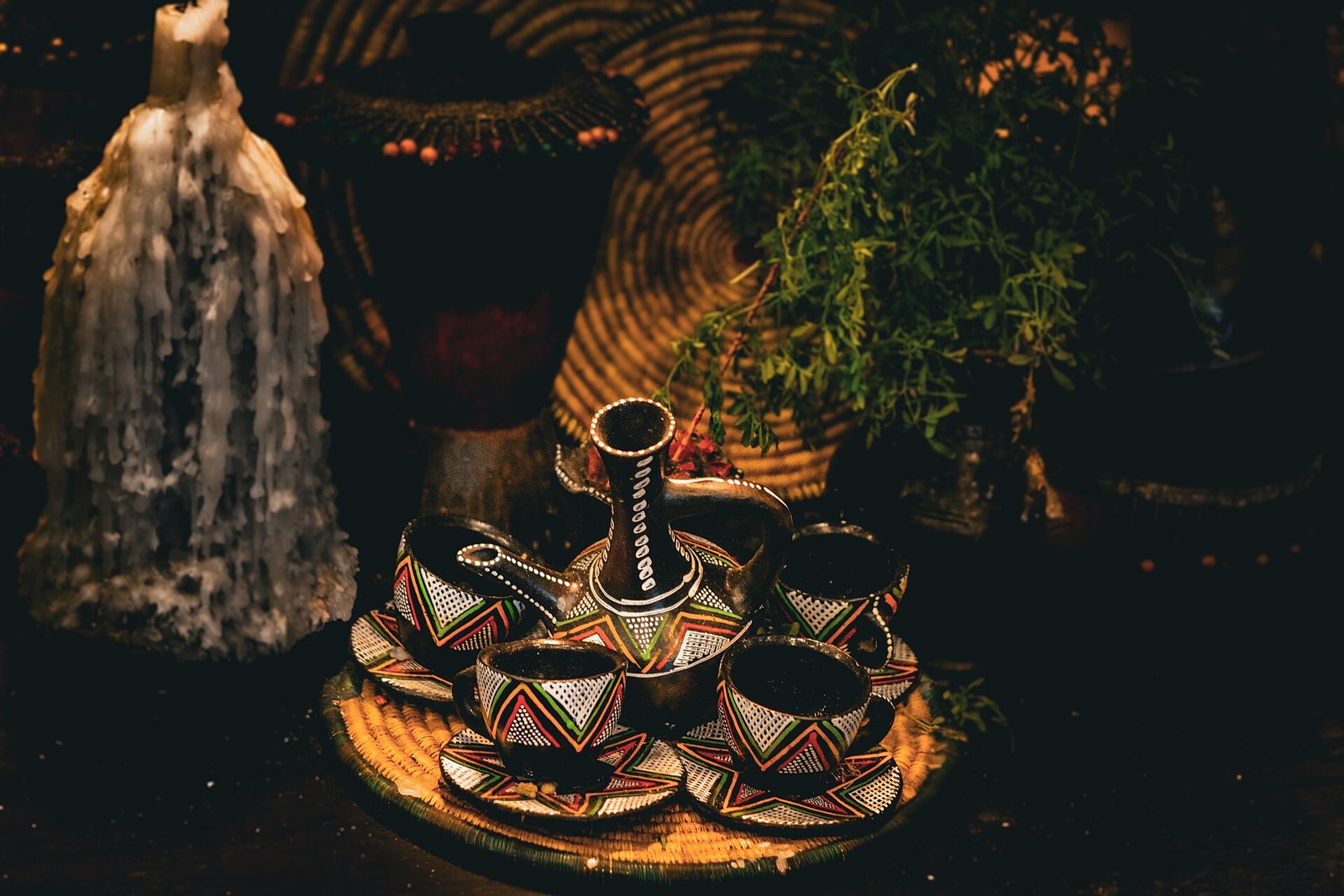
Image: Coffee ceremony of Ethiopia and Eritrea 4.jpg — ProtoplasmaKid, CC BY-SA 4.0