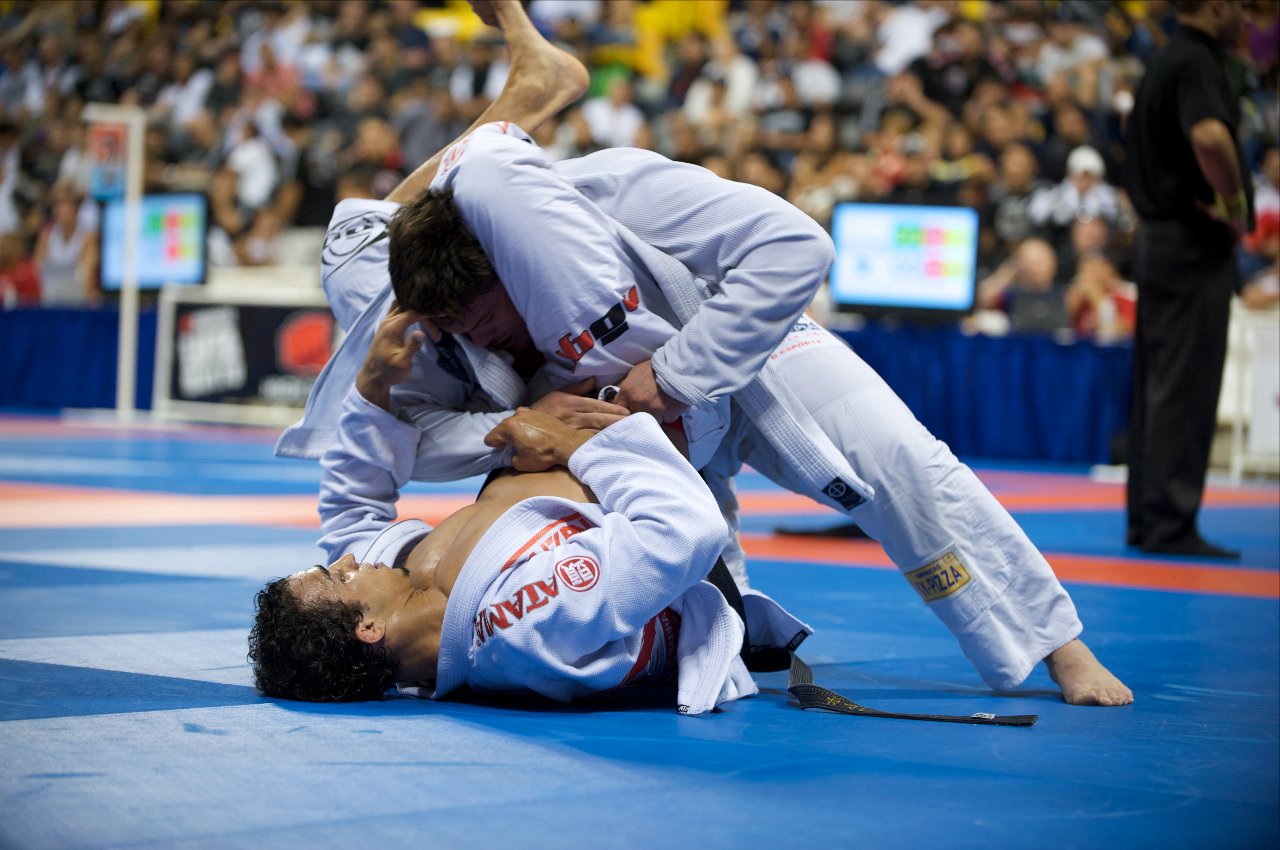
Brazilian jiu-jitsu began with Kodokan judo, which Japanese teachers, including Mitsuyo Maeda, brought to Brazil. Carlos and Hélio Gracie helped develop a Brazilian style through technical adaptations and teaching, while other instructors also shaped its beginnings. Royce Gracie won the first UFC tournament in 1993.
But Maeda’s arrival in 1914 was not the beginning of jiu-jitsu instruction in Brazil. Sada Miyako had taught the Brazilian navy in 1908. If you follow the story from Kano’s school to naval training, the Gracie academy, and tournament competition, you can see why BJJ’s origins involve several teachers and competing accounts.
How did Japanese judo provide BJJ’s foundation?
Jigoro Kano founded his Kodokan school in Tokyo in 1882. Its first home was rented space in a small Buddhist monastery. That school became the principal technical root of Brazilian jiu-jitsu, although BJJ took shape through later teaching and adaptation in Brazil.
Kano combined techniques from different Japanese jujutsu schools with new principles of training. Kodokan judo therefore grew from earlier fighting traditions. The connection between jujutsu, judo, and BJJ begins with that process of selection and reorganization.
Safety was part of Kano’s work. He improved falling techniques and removed lethal or disabling jujutsu techniques from his training system. These changes concerned how students could practice, as well as which techniques they learned. BJJ’s Japanese foundation was already a system that had undergone deliberate revision.
How did Mitsuyo Maeda carry judo abroad?
Mitsuyo Maeda was born on 18 November 1878 in Japan’s Aomori region. Known as Conde Koma, he became a Japanese judoka whose travels formed a major link between Kodokan judo and the development of BJJ.
On 16 November 1904, Maeda left Yokohama with Tsunejirō Tomita and Soshihiro Satake. They reached New York on 8 December. This journey placed Japanese judo teachers before audiences outside Japan well before Carlos Gracie opened his academy in Brazil.
Maeda arrived in Brazil in 1914. Accounts differ over whether his arrival fell in September or November. The year provides a firm marker for the story, while the competing months should not be turned into a single certain arrival date.
Belém became one of the principal centers through which Maeda contributed to BJJ’s development. He died there on 28 November 1941. His importance lies in that transmission of teaching, even though Japanese martial instruction in Brazil preceded him.
Was jiu-jitsu already being taught in Brazil?
Research by Lise and Capraro, based on newspaper documents, identifies Sada Miyako teaching jiu-jitsu to the Brazilian navy in 1908. That places documented instruction six years before Maeda’s arrival. You therefore need to distinguish Maeda’s major role from a claim that he introduced all jiu-jitsu teaching to Brazil.
The instruction also had a planned teaching chain. On 27 June 1909, Gazeta de Notícias reported that Brazilian sailors trained in jiu-jitsu would become instructors at naval schools in Bahia and the capital. Japanese instruction was being passed to Brazilian personnel who would teach others.
Public contests appeared alongside naval instruction. On 19 April 1909, O Paiz announced a ten-minute match in Rio de Janeiro between Sada Miyako and the Portuguese fighter Arnaldo José Ferreira. Such newspaper evidence places encounters between different fighting disciplines before the Gracie academy of 1925.
What did Carlos and Hélio Gracie contribute?
Carlos Gracie opened a jiu-jitsu academy in Rio de Janeiro in 1925. He taught the techniques he had learned to his brothers, including Hélio Gracie. The academy and this family teaching chain were central to the development of the Gracie branch.
The precise route of Carlos’s instruction remains disputed. The Gracie family account presents him as Maeda’s direct student. Robert Drysdale argues instead that his main teacher was Jacyntho Ferro, a student of Maeda. Both accounts connect Carlos to Maeda’s teaching, but they describe different relationships.
In the Gracie account, Hélio adapted techniques to suit his smaller build. Ground fighting and the use of leverage received particular emphasis. The Gracie-centered explanation of BJJ’s development highlights Carlos and Hélio’s adaptations as ways to reduce the strength required to apply techniques.
For an everyday comparison, think of passing a skill to a sibling. Carlos’s instruction of his brothers, including Hélio, gives you a concrete example of that process. Here, family teaching helped carry techniques into the adaptations associated with the Brazilian style.
BJJ’s basic fighting sequence links a takedown to a superior position on the ground. From there, the practitioner seeks submission through a joint lock or choke. This sequence helps explain the importance given to ground fighting in accounts of the Gracies’ technical development.
Did BJJ develop only through the Gracie family?
Oswaldo Fadda represented an important teaching branch outside the Gracie family. He was a student of Luiz França. Their place in the story means that a history focused entirely on Carlos and Hélio leaves out another significant line of BJJ instruction.
José Cairus offers a broader explanation of the Brazilian style’s formation. His 2020 study connects its development in the 1930s with rivalry between the Gracies and Japanese immigrants, alongside Brazilian nationalism. This is an interpretation of how competition and identity helped shape the discipline.
The Gracie-centered technical account places its emphasis elsewhere. It highlights Carlos and Hélio’s changes to techniques, especially their efforts to reduce dependence on strength. These explanations address different parts of BJJ’s formation: technical adaptation in one case, and rivalry and national identity in the other.
Details you won’t find in guidebooks
Maeda’s overseas demonstrations included an encounter with an American football player. At Princeton University on 17 February 1905, he used a judo throw to bring down N. B. Tooker. This episode belongs to his travels before his arrival in Brazil.
The names judo and jiu-jitsu overlapped in Brazilian publicity in 1914. Although Maeda and Satake were Kodokan judoka, the Brazilian press presented their art as jiu-jitsu in 1914. The terminology helps explain why a story rooted in judo appears under the jiu-jitsu name.
A newspaper report also records Miyako losing to a practitioner of another discipline. On 2 May 1909, Gazeta de Notícias reported that capoeirista Cyríaco da Silva defeated him in Rio de Janeiro with a rabo de arraia technique.
Lise and Capraro use the documented Miyako contests to challenge the claim that the Gracie family began Brazil’s challenges between fighting disciplines. The disagreement concerns who started those encounters. The newspaper evidence places them in 1909, before Carlos’s academy opened.
Timeline
- 1882: Jigoro Kano founded the Kodokan school in Tokyo.
- 1904: Maeda, Tomita, and Satake traveled from Japan to the United States.
- 1908: Sada Miyako taught jiu-jitsu to the Brazilian navy.
- 1909: Newspapers reported Miyako’s encounters with fighters from other disciplines in Rio de Janeiro.
- 1914: Mitsuyo Maeda arrived in Brazil.
- 1925: Carlos Gracie opened a jiu-jitsu academy in Rio de Janeiro.
- 1930s: In Cairus’s interpretation, the Brazilian style formed amid rivalry with Japanese immigrants and Brazilian nationalism.
- 1941: Maeda died in Belém.
- 1993: Royce Gracie won the first UFC tournament in Denver.
- 1996: Rio de Janeiro hosted the first World BJJ Championship.
When were the first UFC and World BJJ Championship held?
The first UFC took place on 12 November 1993 at McNichols Sports Arena in Denver. Royce Gracie won its eight-man tournament. He defeated Art Jimmerson, Ken Shamrock, and Gerard Gordeau.
The first World BJJ Championship followed on 3–4 February 1996. It took place at Tijuca Tênis Clube in Rio de Janeiro.
The official IBJJF results record Fabio Gurgel of Alliance as the black belt heavyweight champion. Amauri Bitetti, representing Carlson Gracie’s team, won the openweight title. These named results provide a concrete competitive milestone after the earlier history of traveling teachers, academies, and public challenges.
FAQ
Did BJJ come from judo or Japanese jujutsu?
Its principal technical root was Kodokan judo, which Jigoro Kano developed from techniques drawn from Japanese jujutsu schools. Japanese teachers, including Mitsuyo Maeda, carried that tradition to Brazil.
Was Mitsuyo Maeda the first jiu-jitsu teacher in Brazil?
No. Research by Lise and Capraro documents Sada Miyako teaching jiu-jitsu to the Brazilian navy in 1908, before Maeda arrived in 1914.
Did Carlos Gracie learn directly from Maeda?
The Gracie family account says he did. Robert Drysdale disputes that relationship and identifies Maeda’s student Jacyntho Ferro as Carlos’s main teacher.
Why does Royce Gracie’s 1993 victory matter?
Royce won the eight-man tournament at UFC 1 by defeating Art Jimmerson, Ken Shamrock, and Gerard Gordeau. His victory increased BJJ’s international recognition.
Sources
- International Judo Federation — Judo History ijf.org
- Wikipedia — Mitsuyo Maeda en.wikipedia.org
- Wikipedia — Brazilian jiu-jitsu en.wikipedia.org
- Revista Brasileira de Ciências do Esporte — Primórdios do jiu-jitsu e dos confrontos intermodalidades no Brasil scielo.br
- Cardiff University — Nationalism, immigration and identity: The Gracies and the making of Brazilian Jiu-Jitsu, 1934–1943 orca.cardiff.ac.uk
- Wikipedia — UFC 1 en.wikipedia.org
Image: GABRIEL VELLA vs ROMINHO 51.jpg — John Lamonica, CC BY-SA 3.0