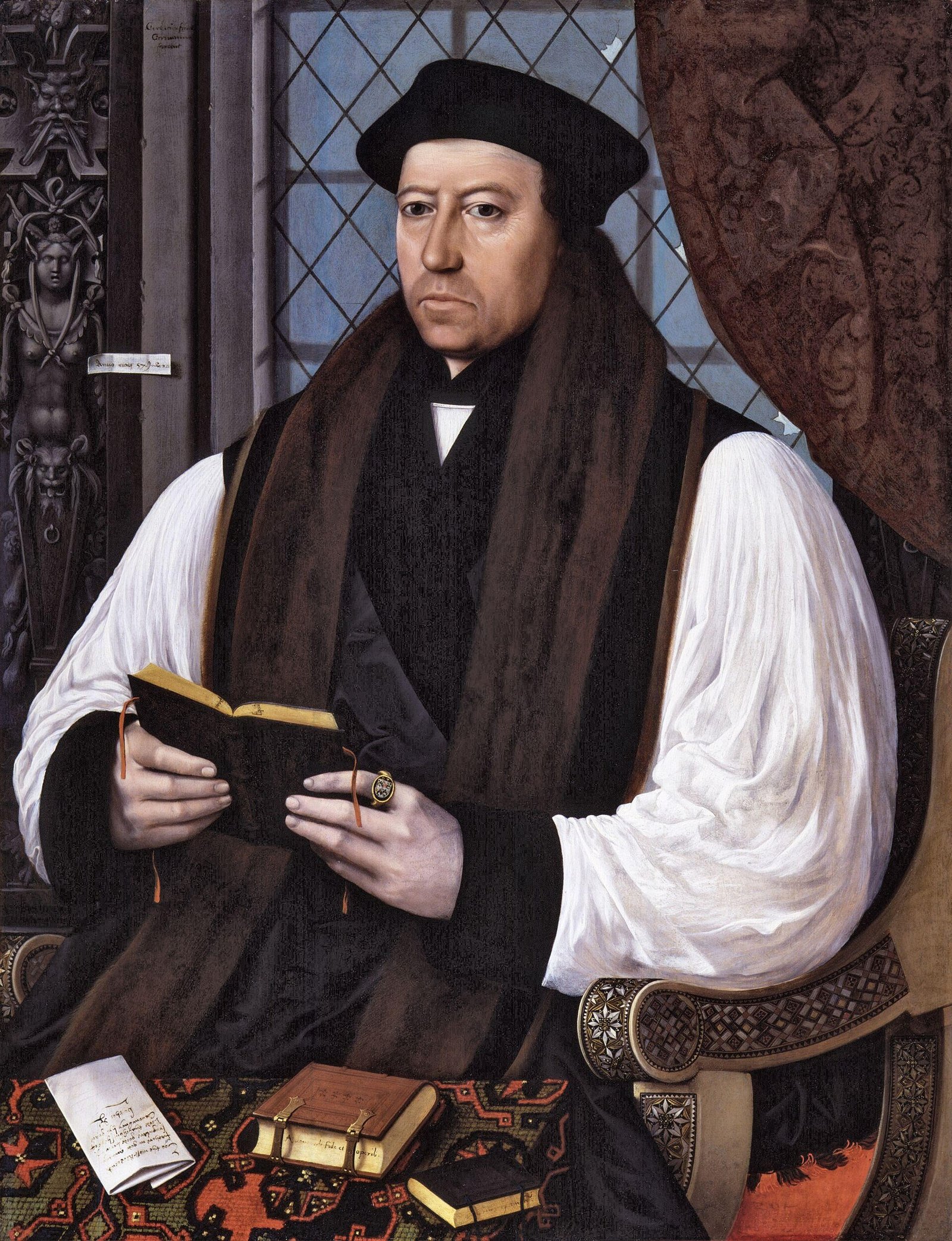
Thomas Cranmer was a leader of the English Reformation and Archbishop of Canterbury from 1533 to 1555, who supported royal supremacy and helped establish Protestant worship through the Book of Common Prayer. He was executed for heresy under Mary I in Oxford on 21 March 1556, after withdrawing his Protestant beliefs and then publicly reclaiming them.
How did the archbishop who ruled on Henry VIII’s marriage end up condemned under Mary? You can follow his changing position through three connected subjects: royal authority, worship in English, and the statements he signed during imprisonment. His career links decisions about the crown with the words used in church.
What role did Cranmer play in the annulment of Henry VIII’s marriage?
Cranmer was born on 2 July 1489 at Aslockton in Nottinghamshire, England. Between 1517 and 1528, he lived at Jesus College, Cambridge, where he taught as Rysley lecturer in divinity. His work as a theologian preceded his involvement in the king’s marriage dispute.
In 1529, Cranmer proposed collecting opinions from theologians at European universities about Henry VIII’s marriage. His suggestion brought university scholarship into a question that concerned the king. It also places his involvement several years before he became Archbishop of Canterbury in 1533.
As archbishop, Cranmer delivered two decisive judgments within days of one another. On 23 May 1533, he declared Henry’s marriage to Catherine of Aragon invalid. On 28 May, he confirmed the validity of Henry’s marriage to Anne Boleyn. These were separate rulings concerning the two marriages.
Cranmer also supported royal supremacy alongside Thomas Cromwell. This principle placed the Church within the king’s realm under royal authority. His contribution to the English Reformation therefore extended beyond the annulment: he supported a broader claim about who should govern the Church in England.
What changes did he support as Archbishop of Canterbury?
Under Henry VIII, conflict between religious conservatives and reformers limited Cranmer’s ability to introduce extensive changes. His support for royal supremacy did not give him unrestricted freedom over religious teaching. The pace of reform depended on the conditions within the king’s reign.
One concrete development came on 27 May 1544, when Cranmer’s Exhortation and Litany appeared. It was the first officially authorised worship text in English. This publication preceded the Book of Common Prayer and shows that Cranmer’s work on English worship had begun under Henry.
Edward VI’s accession in 1547 allowed Cranmer to advance Protestant reforms more quickly. During Edward’s reign, he supported marriage for the clergy. He also led changes in teaching concerning the Eucharist, religious images, and the veneration of saints. His programme addressed both worship and the lives of those who conducted it.
These subjects show the range of Cranmer’s reforms. Clerical marriage concerned the households of churchmen. The Eucharist, images, and saints concerned religious teaching and practice. You can therefore understand his work as a set of connected changes, rather than as the production of a prayer book alone.
How did the Book of Common Prayer emerge?
The Book of Common Prayer appeared in 1549 during Edward VI’s reign. Cranmer led its preparation, giving the Church of England a shared order of worship in English. The book helped establish Protestantism through the language and arrangement of worship itself.
Its relationship to the 1544 Exhortation and Litany matters. The earlier publication had supplied an officially authorised English worship text. The 1549 prayer book provided a common English order for the Church. Together, these publications trace Cranmer’s contribution from a particular text to a shared pattern of worship.
The everyday-life connection is the wording of a familiar routine. When you follow the same written instructions repeatedly, their language becomes part of the activity. Cranmer’s prayer book brought religious teaching into a common order of worship, connecting doctrine with words used in church.
Cranmer also led the preparation of the second edition in 1552. One specific change was the removal of prayers for the dead. This reflected a movement away from the doctrine of purgatory. A change in religious belief thus appeared as a concrete change in the worship text.
The two editions should therefore be read as stages in Cranmer’s reforming work. The 1549 book established a common English order. The 1552 book revised that order, including its treatment of the dead. His influence lay in both creating the shared text and changing what it expressed.
How did his position change between the reigns of Edward VI and Mary I?
Under Edward VI, Cranmer could pursue Protestant reform with greater speed. After Edward’s death in 1553, he supported the Protestant Lady Jane Grey’s unsuccessful attempt to take the throne. That decision connected his religious position with a failed claim to royal power.
Mary I’s accession brought imprisonment for Cranmer because of his support for Lady Jane Grey. On 13 November 1553, he was convicted of treason and sentenced to death. His property was confiscated by the crown, including his extensive library. The loss reached both his public position and his personal possessions.
Cranmer subsequently faced a charge of heresy. His trial under papal authority began at Oxford on 12 September 1555. The treason conviction and heresy proceedings were distinct parts of his downfall. One followed his support for Lady Jane Grey; the other concerned his religious beliefs.
In Oxford, Cranmer was held with Hugh Latimer and Nicholas Ridley in Bocardo Prison, at the city’s north gate. His imprisonment lasted more than two years. During that confinement, the reforming archbishop repeatedly withdrew the Protestant positions he had helped advance.
How did his recantations and their repudiation affect his final trial and execution?
During imprisonment, Cranmer recanted his Protestant beliefs several times and reconciled himself with the Catholic Church. A recantation was a withdrawal of his earlier religious position. These declarations matter because he did not maintain an uninterrupted public defence of Protestantism throughout his confinement.
Such withdrawals could normally have brought a pardon. Mary I nevertheless insisted that Cranmer be executed. His recantations therefore failed to prevent the sentence from being carried out. Their importance lies partly in that failure: reconciliation did not secure his survival.
On the day of his execution, Cranmer publicly rejected his earlier recantations and defended his Protestant faith again. His final declaration reversed the position he had adopted during imprisonment. On 21 March 1556, he was burned at the stake in Oxford.
If you separate the stages, the sequence becomes clearer. Cranmer received a treason conviction in 1553, faced a heresy trial beginning in 1555, and recanted during confinement. Mary insisted on execution despite those withdrawals. His public repudiation came on the day he died, after the recantations had failed to save him.
Details you won’t find in guidebooks
Cranmer was godfather to Elizabeth I, the daughter of Henry VIII and Anne Boleyn. His relationship with their family therefore extended beyond his judgment confirming the validity of the parents’ marriage. It also included this personal religious connection to their daughter.
After becoming archbishop, Cranmer sent a stag to the head of Jesus College for the college community to eat. He also promised to cover the cost of the accompanying dishes. This gift provides a tangible link between his earlier college life and his position as archbishop.
Westminster Abbey preserves an early sixteenth-century hexagonal pulpit traditionally associated with Cranmer’s use at Edward VI’s coronation. The association is a tradition, rather than a confirmed identification. The distinction matters when connecting a surviving object with a particular historical occasion.
The Ashmolean Museum holds a key from Bocardo Prison, catalogued as AN1836 p.133.351. The prison itself was demolished in 1771. The key survives as an object connected with the place where Cranmer, Latimer, and Ridley were confined.
In Oxford, a road cross on Broad Street marks the place associated with their burnings. The separate Martyrs’ Memorial, designed by George Gilbert Scott, was completed in 1843. The street marker and the memorial are two different points of remembrance.
Timeline
- 2 July 1489: Born at Aslockton in Nottinghamshire.
- 1517–1528: Lived and taught divinity at Jesus College, Cambridge.
- 1529: Proposed gathering European university opinions on Henry VIII’s marriage.
- 1533: Became Archbishop of Canterbury.
- 23 May 1533: Declared Henry’s marriage to Catherine of Aragon invalid.
- 28 May 1533: Confirmed Henry’s marriage to Anne Boleyn as valid.
- 27 May 1544: Exhortation and Litany published.
- 1547: Edward VI’s accession accelerated his reforms.
- 1549 and 1552: Led preparation of the first two editions of the Book of Common Prayer.
- 1553: Supported Lady Jane Grey; imprisoned under Mary I.
- 13 November 1553: Convicted of treason and sentenced to death.
- 12 September 1555: Heresy trial began in Oxford.
- 21 March 1556: Rejected his recantations and was executed in Oxford.
- 1843: Oxford’s Martyrs’ Memorial completed.
FAQ
Who was Thomas Cranmer?
Thomas Cranmer was an English Reformation leader and Archbishop of Canterbury from 1533 to 1555. He supported royal supremacy and led the preparation of the first two editions of the Book of Common Prayer.
What did Cranmer do about Henry VIII’s marriages?
He declared Henry VIII’s marriage to Catherine of Aragon invalid on 23 May 1533. On 28 May, he confirmed the validity of Henry’s marriage to Anne Boleyn.
Why was the Book of Common Prayer important?
The 1549 edition provided a shared order of worship in English for the Church of England. Cranmer also led the preparation of the 1552 edition, which removed prayers for the dead.
Why was Thomas Cranmer executed despite recanting?
Although his withdrawals of Protestant beliefs could normally have secured a pardon, Mary I insisted on his execution. He publicly rejected those withdrawals before being burned at the stake in Oxford on 21 March 1556.
Sources
- Wikipedia — Thomas Cranmer en.wikipedia.org
- Vikipedi — Thomas Cranmer tr.wikipedia.org
- University of Cambridge, Jesus College — Thomas Cranmer jesus.cam.ac.uk
- Historic Royal Palaces — Katherine of Aragon hrp.org.uk
- National Portrait Gallery — Thomas Cranmer npg.org.uk
- Westminster Abbey — Thomas Cranmer westminster-abbey.org
- University of Oxford, Ashmolean Museum — The Oxford Martyrs’ Material britisharchaeology.ashmus.ox.ac.uk
Image: Thomas Cranmer by Gerlach Flicke.jpg — Gerlach Flicke, Public domain