Old Dongola’s monumental church reveals the scale of Makuria’s building ambitions and the close relationship between Christian worship and royal power. Measuring approximately 47 by 57 metres, the Great Church of Jesus stood among palaces and elite residences inside the fortified capital. Paintings and inscriptions in an adjoining building connect kingship with divine protection, while the church’s proposed identification as a cathedral remains debated.
How do monumental stairs, tiny Greek letters and a portrait of King David fit together? At Old Dongola, you can follow these discoveries from the capital’s fortified centre into its religious and political world. The evidence ranges from a six-metre-wide painted apse to a prayer asking God to protect the city.
Where was Old Dongola, and why did it matter?
Old Dongola stood on the east bank of the Nile in northern Sudan. Known as Tungul in Old Nubian, it became the capital of Makuria. Makuria was one of medieval Nubia’s three Christian kingdoms, alongside Nobadia and Alodia.
The settlement began as a fortress in the fifth century. Christianity arrived in the middle of the sixth century, and Old Dongola developed as Makuria’s capital. Its origins therefore join two central themes of the later city: fortification and Christian rule.
The archaeological site covers approximately 200 hectares. The city’s greatest flourishing dates to the ninth through eleventh centuries. That wider setting matters when you consider the great church: it belonged to a substantial capital whose remains extend far beyond a single religious building.
What does the church’s size tell you about Makuria?
A report dated 5 November 2026 gives the Great Church of Jesus a width of 47 metres and a length of approximately 57 metres. Its original height is cautiously estimated at 21 metres. The height remains an estimate, while the reported dimensions establish the building’s monumental scale.
Its position strengthens the architectural evidence. The church occupied the centre of the citadel, within walls approximately ten metres high and five metres thick. Palaces and elite residences shared this monumental setting. Christian worship thus had a prominent place within the same fortified environment as royal and elite life.
The Sudanese–Polish team led by Artur Obłuski first encountered the building in 2021. Work announced in 2026 exposed monumental stairs and buttresses supporting the apse. These discoveries add specific structural features to the picture of a large church at the heart of the capital.
Think of how stairs and entrances shape your movement through a building in everyday life. At this church, the staircase also gives archaeologists a physical reference point: the November 2026 announcement reported that they had reached the original floor level there for the first time. Only a small part of the church had been investigated.
Was the Great Church of Jesus a cathedral?
Obłuski argues that the Great Church of Jesus may have been Dongola’s cathedral. An earlier interpretation gave that role to another church outside the walls. The 2026 announcement called for that earlier view to be reconsidered, keeping the building’s precise institutional identity open to debate.
The distinction matters because Dongola’s church hierarchy extended well beyond the capital. According to the excavation team’s 2021 account, the archbishopric covered approximately 1,000 kilometres along the Nile, between the first and fifth cataracts. A cathedral identification would connect this monumental building with that extensive religious hierarchy.
The apse cleared in 2021 measured six metres across. Its walls carried paintings arranged in two rows of monumental figures. These surviving images give the discussion a concrete religious setting, although the building’s size and painted decoration do not by themselves settle the cathedral question.
A neighbouring domed structure provides another clue. The excavation team interpreted it as a possible burial place for prominent people, perhaps bishops, using a comparison with Faras. The 2021 announcement presented this as a hypothesis awaiting confirmation. You should therefore keep the proposed burials and the proposed cathedral status distinct from the excavated structures themselves.
How do the paintings connect Christianity and kingship?
In a discovery announced in 2023, Lorenzo de Lellis and Maciej Wyżgoł found painted mud-brick rooms in a building beside the great church. They were investigating houses dating from the sixteenth through nineteenth centuries when they encountered the rooms beneath an opening in a floor.
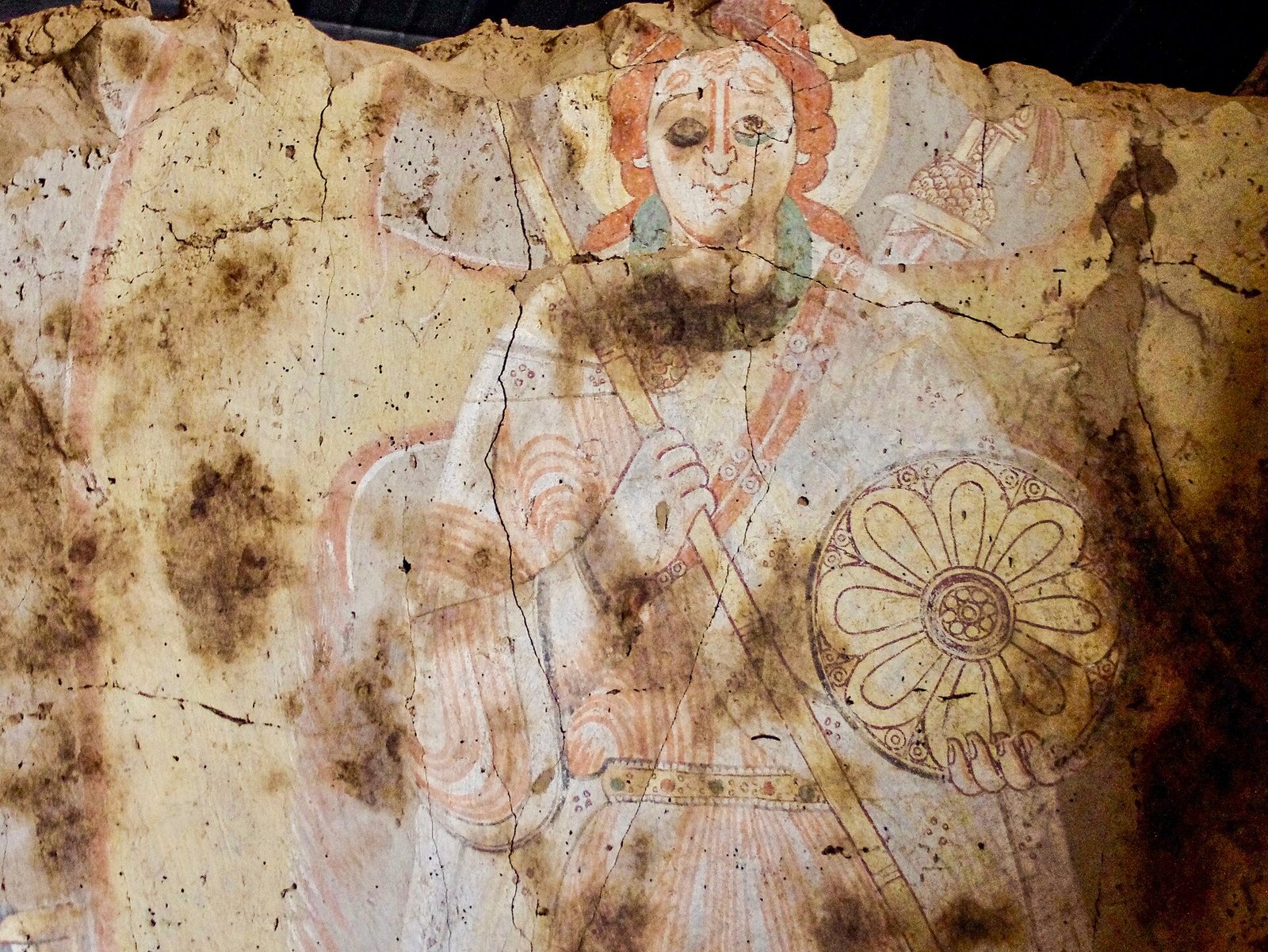
One painting shows King David of Makuria bowing towards Christ, who appears on clouds. The king appears beneath the wings of the Archangel Michael. The composition brings a named ruler into direct visual association with sacred figures, making the relationship between royal authority and Christian devotion especially clear.
An accompanying Old Nubian inscription repeats David’s name several times. It also asks God to protect the city. This gives the image a civic dimension: the prayer concerns the safety of Dongola.
The room’s position complicates its interpretation. Although it resembled a crypt, it stood seven metres above the medieval ground level. In the 2023 announcement, researchers had not resolved the building’s function. The royal image and protective prayer can be described with greater confidence than the room’s intended use.
Details you won’t find in guidebooks
The dome of the burial structure beside the great church measured 7.5 metres in diameter in 2021. The excavation announcement compared it with the 1.5-metre burial dome of Joannes, bishop of Faras. Dongola’s dome was five times that diameter. The comparison is striking, but the proposed identification of its occupants as bishops remains provisional.
The 2026 report also described a second church on the upper floor of a building adjoining the Great Church of Jesus. Its walls survived to approximately one metre high. This discovery adds another place of worship to the immediate surroundings of the monumental church.
Some evidence from the smaller church operates on a much smaller scale. Agata Deptuła examined Greek texts found in its fill, with letters approximately half a centimetre high. She identified one text as a passage from the prayer of Hannah, Samuel’s mother. Alongside the Old Nubian inscription accompanying David, it reveals religious writing in more than one language within the adjoining discoveries.
What happened to Makuria’s capital over time?
Dongola’s political history includes the siege of 651–652. Abdullah bin Sa’d, governor of Egypt, besieged the city during the reign of King Kalidurut. Relations were regulated through an agreement called the bakt in Arabic sources.
Accounts disagree about the siege’s outcome. In Geoffrey Khan’s comparison, the later account by al-Maqrizi says the Nubian king requested a truce. The earlier account by Ibn Abd al-Hakam reports a Nubian victory. That disagreement should remain visible when the siege is placed within the capital’s history.
Later changes are visible in another major building. Old Dongola’s ninth-century throne hall became a mosque in 1317 and remained in use as a mosque until 1969. The royal court left Old Dongola in 1364, but the city continued as a settlement and administrative centre in subsequent centuries.
During the nineteenth century, the population and urban centre shifted to present-day Dongola. That city lies approximately 80 kilometres downstream, on the opposite bank of the Nile. If you encounter both place names, this movement explains why medieval Old Dongola and present-day Dongola occupy different locations.
Timeline
- Fifth century: Old Dongola begins as a fortress settlement.
- Middle of the sixth century: Christianity arrives, and the settlement develops as Makuria’s capital.
- 651–652: Abdullah bin Sa’d besieges Dongola; the period is associated with the bakt agreement.
- Ninth–eleventh centuries: Old Dongola experiences its greatest flourishing.
- 1317: The throne hall becomes a mosque.
- 1364: The royal court leaves Old Dongola.
- Nineteenth century: The urban centre shifts to present-day Dongola.
- 1964: Polish archaeological investigations begin at Old Dongola.
- 2021: The team encounters the monumental building identified as the Great Church of Jesus.
- 2023: Paintings of King David and sacred figures in the adjoining building are announced.
- November 2026: New results describe monumental stairs, buttresses and access to the original floor level.
FAQ
What does Old Dongola’s monumental church reveal about Makuria?
Its size and position among palaces and elite residences show the prominence of Christianity in Makuria’s capital. Nearby royal paintings and inscriptions also connect religious devotion with kingship and the protection of the city.
How large was the Great Church of Jesus?
The November 2026 report gives a width of 47 metres and a length of approximately 57 metres. Its original height is cautiously estimated at 21 metres.
Was the Great Church of Jesus Dongola’s cathedral?
Artur Obłuski argues that it may have been the cathedral. The identification remains debated because an earlier interpretation assigned that role to another church outside the walls.
What languages appear in the discoveries beside the church?
The discoveries include Greek texts and an Old Nubian inscription accompanying King David’s image. One Greek text was identified as a passage from the prayer of Hannah, Samuel’s mother.
Sources
- Wikipedia — Old Dongola en.wikipedia.org
- University of Warsaw — Discovery of the remains of the largest church in Old Dongola en.uw.edu.pl
- Polskie Radio / PAP — Polacy odkryli kolejne elementy jednej z najważniejszych świątyń średniowiecznej Afryki polskieradio.pl
- Polish Centre of Mediterranean Archaeology, University of Warsaw — Newly discovered church in Dongola could have been a cathedral pcma.uw.edu.pl
- University of Warsaw — Odkrycie unikatowych malowideł w Starej Dongoli uw.edu.pl
- Geoffrey Khan — Arabic Documents from Medieval Nubia, Introduction books.openbookpublishers.com
Image: IMGP7495-2.jpg — Tanjagari, CC BY-SA 4.0