Majapahit was a Javanese kingdom founded in 1293 in East Java, in present-day Indonesia, with its capital at Trowulan. It rose through rice agriculture, river transport and port trade, reaching its peak under Hayam Wuruk and Gajah Mada. Dynastic conflict and competition from Melaka weakened it, while its final rulers fought Demak into the 1520s or 1530s.
How far did power from Trowulan actually reach? If you follow Majapahit through its irrigation works, trading ports and court accounts, a distinction emerges: its claims across the islands were broader than its direct administration. Its history connects a productive Javanese centre with distant relationships whose strength varied.
How was Majapahit founded, and what kind of centre was Trowulan?
Raden Wijaya founded Majapahit after a struggle involving rival Javanese rulers and an incoming Yuan force. In 1293, he allied with Yuan troops against Jayakatwang. Jayakatwang had overthrown Kertanegara, the ruler of Singhasari. The alliance formed part of the political struggle from which the new kingdom emerged.
Wijaya’s coronation provides the conventional foundation date. On 10 November 1293, he took the royal name Kertarajasa Jayawardhana. Majapahit’s beginning is therefore associated with a specific act of kingship as well as the military events of that year.
Its capital, Trowulan, was more than a royal residence. The archaeological area extends across approximately 11 by 9 kilometres within Mojokerto and Jombang. Traces of houses, markets, production areas, sacred buildings, burial grounds and rice fields reveal the range of activities around the centre.
These remains place food production beside residential, commercial and religious life. When you picture Trowulan, the rice fields matter alongside the court. Indonesia submitted the site to the UNESCO World Heritage Tentative List on 6 October 2009.
What roles did Hayam Wuruk and Gajah Mada play in its rise?
Gajah Mada became chief minister during the reign of Queen Tribhuwana Wijayatunggadewi. He was a leading figure in Majapahit’s expansion during the fourteenth century. His role connected the kingdom’s political ambitions with military action.
His Palapa oath, dated to either 1334 or 1336, is associated with the ambition to unite the archipelago under Majapahit supremacy. The uncertainty between these dates should remain visible. The oath expresses a programme of expansion; it does not establish that every island subsequently received the same form of government.
Hayam Wuruk’s reign is traditionally dated to 1350–1389. It is regarded as Majapahit’s high point, supported by Gajah Mada’s military and political contributions. The ruler and chief minister are therefore central to accounts of the kingdom’s rise, although Majapahit’s resources also depended on agriculture and trade.
The Nagarakretagama, dated to 1365, offers a court-centred view of this period. Attributed to a Buddhist court cleric, it describes the capital, royal ceremonies and the ruler’s journeys. Its accounts of sovereignty must be read alongside its purpose as praise of the court.
Did the territories listed as dependencies actually fall under direct rule?
A dependency did not necessarily receive direct administration from Trowulan. Majapahit’s relationships with outer islands could involve tribute from local rulers. That arrangement allowed recognition of Majapahit authority without requiring the court to govern those territories itself.
The scale of its power remains a point of interpretation. The summary of the 2009 exhibition catalogue Keseharian di Trowulan presents Majapahit as the only kingdom able to unite all Nusantara. That is a broader claim than the effective territorial control identified by some scholars.
Archaeologist Bambang Budi Utomo limits Majapahit’s actual sovereignty to parts of Central Java, East Java, Madura, Bali and Sumbawa. Tambiah places its effective core in East Java, with probable extensions into Bali and Madura. Their interpretations differ in extent, but both distinguish effective power from expansive court claims.
If you encounter a long list of Majapahit dependencies, ask what relationship each name represents. Tribute, political recognition and direct government describe different levels of authority.
How did trade, agriculture, and ports sustain the kingdom?
Rice supported Majapahit’s inland agricultural economy. Javanese rice also entered trade in exchange for Indian textiles and Chinese ceramics. Agriculture and overseas exchange were therefore connected: an inland crop helped sustain relationships reaching beyond Java.
Bubat, on the Brantas, was an important river port with Chinese and Indian merchant communities. Its position brings river transport into the story of Majapahit commerce. Trade serving the kingdom involved inland waterways as well as ports handling wider maritime connections.
Majapahit rulers issued authorisations for overseas trade. They also collected tolls and taxes on internal commerce. These practices show how commercial movement became a source of royal revenue. Goods circulating through the kingdom mattered to the court as well as to merchants.
Utomo identifies Kambangputih, Siddhayu, Gresik, Surabhaya and Canggu as ports whose services substantially supported Majapahit power. This dependence gives the kingdom’s strength a practical dimension. Royal authority relied partly on the places and people that kept goods moving.
The Canggu Ferry Charter of 1358 makes that connection especially concrete. It regulated the status of boatmen working at Canggu and Terung, on opposite banks of the Brantas, and their payments to the kingdom. A river crossing could thus involve both transport services and obligations to royal authority.
What factors contributed to Majapahit’s decline?
Conflict within the dynasty weakened Majapahit. In the Paregreg civil war of 1405–1406, Wikramawardhana defeated Bhre Wirabhumi. The struggle involved competing royal courts, showing that rivalry could divide the ruling house itself.
A succession crisis in the middle of the fifteenth century further contributed to the breakdown of central authority. Meanwhile, the Malay trading network centred on Melaka, under Muslim rulers, supplied commercial competition. Dynastic instability and competing trade networks both helped accelerate fragmentation.
The year 1478 is a traditional date for Majapahit’s collapse. It is associated with the capture of Trowulan and the killing of Kertabhumi. Yet this event does not establish that every remaining form of Majapahit political authority ended that year.
The Library of Congress study places the dynasty’s final end in the 1520s or 1530s. By then, its rulers controlled only part of East Java and were fighting Demak. The difference between these dates reflects the distinction between losing Trowulan and the disappearance of the remaining dynasty.
Details you won’t find in guidebooks
Trowulan’s water infrastructure gives substance to its agricultural setting. The UNESCO submission reports that investigations beginning in 1926 identified 18 large and small dams connected with irrigation channels. Rice production belonged to a landscape containing built systems for managing water.
The finds also offer an everyday-life connection you can recognise: saving money in a container. Terracotta piggy banks appear among the objects recorded at Trowulan, alongside metal-casting vessels and building water pipes. These objects bring household practices and production into the account of a royal capital.
Political separation did not always end commercial exchange. Hall notes that Tuban continued close exchanges of goods with the Majapahit court after gaining political independence and after its elites adopted Islam. Commercial relationships could survive changes in sovereignty and religion.
Hall also complicates a simple picture of fifteenth-century decline. In the limited records for that period, he finds a lively rural economy in Java’s interior, together with religious and cultural activity. The weakening of central power did not mean that every part of economic and cultural life declined together.
Timeline
- 1293: Raden Wijaya allied with Yuan forces against Jayakatwang.
- 10 November 1293: Wijaya was crowned as Kertarajasa Jayawardhana.
- 1334 or 1336: Gajah Mada’s Palapa oath is dated to these alternative years.
- 1350–1389: Hayam Wuruk’s traditional reign marks Majapahit’s peak.
- 1358: The Canggu Ferry Charter regulated boatmen and their obligations.
- 1365: The Nagarakretagama described the court and its sovereignty claims.
- 1405–1406: Wikramawardhana won the Paregreg civil war.
- Mid-fifteenth century: A succession crisis contributed to the breakdown of central authority.
- 1478: Trowulan’s capture became a traditional collapse date.
- 1520s or 1530s: The remaining Majapahit dynasty ended during conflict with Demak.
- 6 October 2009: Indonesia submitted Trowulan to UNESCO’s World Heritage Tentative List.
FAQ
Where was the Majapahit Empire located?
Majapahit was founded in East Java, in present-day Indonesia, with its capital at Trowulan. Its wider influence included relationships with island rulers that did not always involve direct government.
Who founded Majapahit?
Raden Wijaya founded Majapahit in 1293. His coronation as Kertarajasa Jayawardhana on 10 November 1293 is used as the kingdom’s foundation date.
When did Majapahit reach its peak?
Hayam Wuruk’s reign, traditionally dated to 1350–1389, is considered Majapahit’s peak. Gajah Mada’s military and political work helped drive its expansion.
When did Majapahit end?
The capture of Trowulan in 1478 is a traditional collapse date, but Majapahit rule continued afterward. The Library of Congress country study places the dynasty’s end in the 1520s or 1530s.
Sources
- UNESCO World Heritage Centre — Trowulan: Former Capital City of Majapahit Kingdom whc.unesco.org
- Tambiah — The Galactic Polity in Southeast Asia journals.uchicago.edu
- Indonesian Ministry Repository — Katalog Pameran Majapahit: Keseharian di Trowulan repositori.kemendikdasmen.go.id
- Bambang Budi Utomo — Majapahit dalam Lintas Pelayaran dan Perdagangan Nusantara ejournal.brin.go.id
- Library of Congress Country Study — Indonesia: The Spread of Indian Civilization countrystudies.us
- Hall — Maritime Trade and State Development in Fourteenth-Century Java manifold.uhpress.hawaii.edu
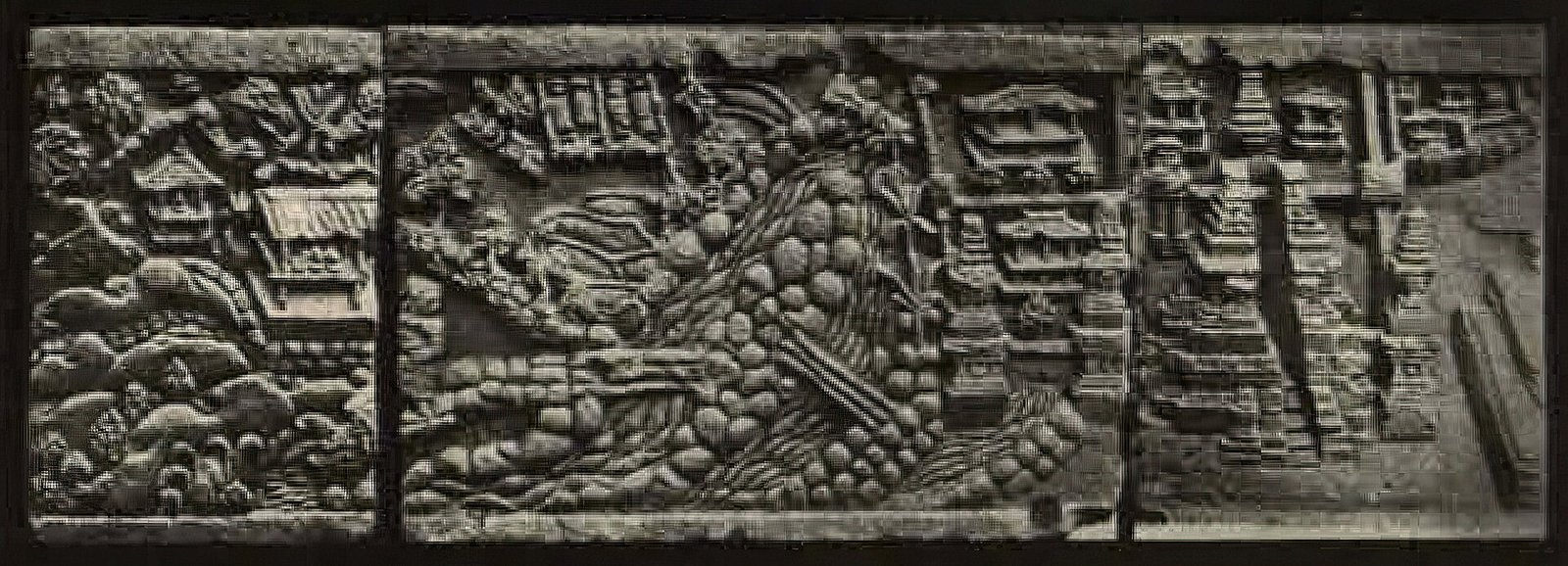
Image: Plate V No 22 Relief of Majapahit in Trowulan.jpg — Ir. H. Maclaine PontR. Ario Hoesein Djajadiningrat, CC0