Yes—parts of Arabia were once green, and Mundafan preserves evidence of a freshwater lake surrounded by open grasslands in what is now desert. Researchers associate its newly studied stone tools with a humid period around 125,000 years ago, although the tools’ precise age remains disputed.
The most revealing objects are small: stone points carrying traces of animal tissue, plant resin and fibres. If you follow those traces alongside the lake sediments and animal fossils, Mundafan becomes more than a story about changing weather. It offers evidence of toolmaking, hunting equipment and repeated activity beside freshwater.
Where is Mundafan?
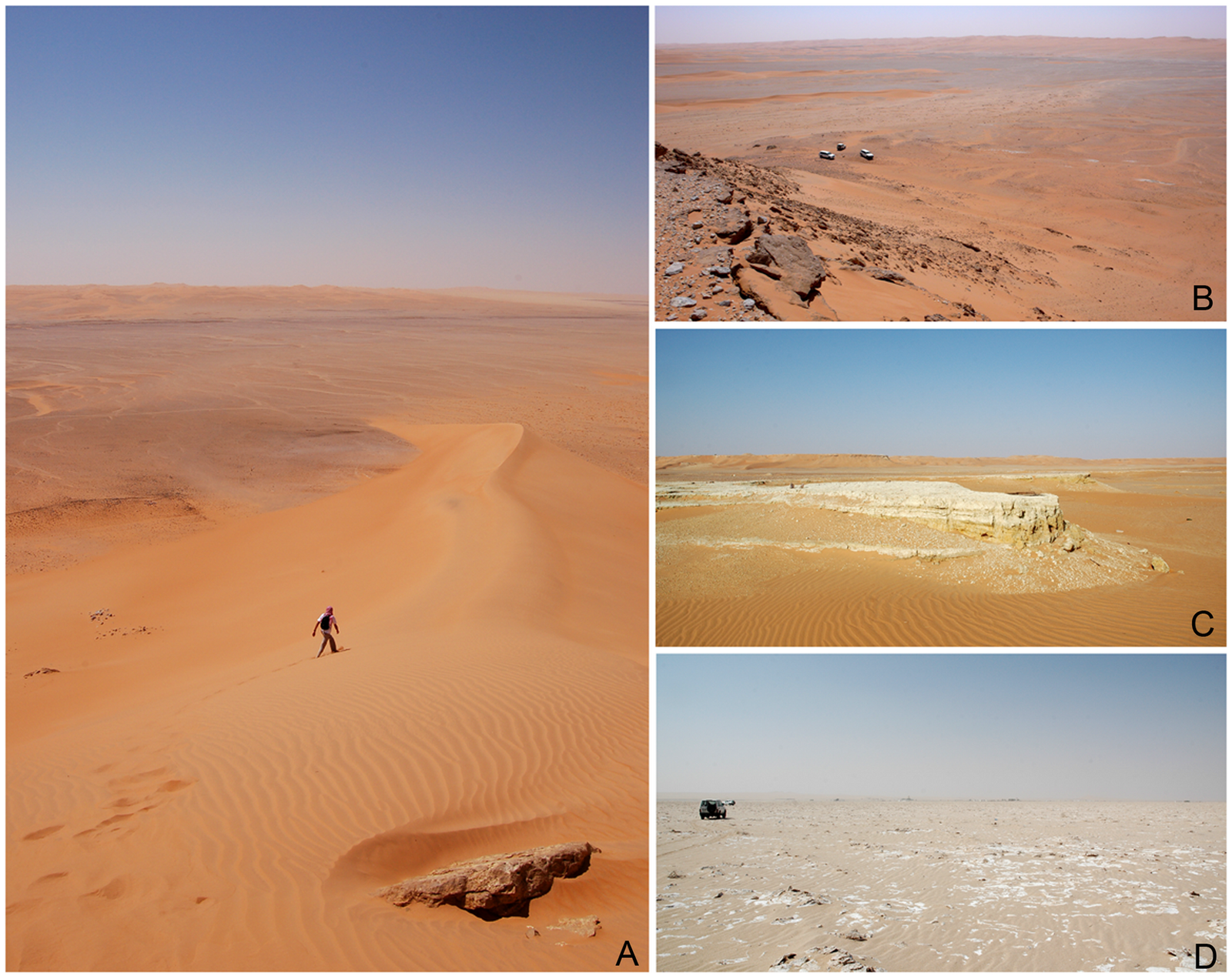
Mundafan is an ancient lake basin in Saudi Arabia’s Najran region, in the southwestern part of the Rub‘ al Khali. This desert covers roughly 650,000 square kilometres across southern Arabia. It extends into Saudi Arabia, Oman, the United Arab Emirates and Yemen.
The site central to the 2026 research is Uruq al-Julaybah, also rendered Uruq Aljelibah. It lies on Mundafan’s former lakeshore. That position connects the archaeological finds with a landscape whose water, vegetation and animals differed sharply from the desert setting today.
According to KAUST’s announcement of 13 November 2026, the Saudi Heritage Commission, KAUST and Griffith University jointly conducted the research. Their work brought together archaeological objects and environmental evidence from the former lake basin.
How did a desert basin become a lake?
Orbital climate changes strengthened monsoon rainfall during parts of the Pleistocene and Holocene. At Mundafan, those wetter conditions allowed lakes to form. The basin therefore records recurring humid periods rather than a single uninterrupted green landscape.
Satellite-based terrain modelling indicates that the ancient Mundafan lake reached about 340 square kilometres in area. Its maximum depth was approximately 29 metres. Those estimates describe a substantial body of water within today’s desert.
Sediments, landforms and remains of aquatic organisms point to a relatively stable freshwater lake bordered by open grasslands. These different kinds of evidence support the same environmental interpretation. Mundafan’s greener past rests on more than the outline of a dry basin.
Think about the water you use each day as an everyday connection to this landscape. At Mundafan, freshwater formed part of the setting for repeated tool production and animal processing. Water belongs in the explanation of those activities alongside the stone objects themselves.
What animals lived around Mundafan?
Researchers documented more than 500 plant and animal fossil specimens at over 130 find locations. The animal remains include hippopotamus, extinct long-horned buffalo, camel, Arabian oryx, gazelle and ostrich. Together, they reveal a varied animal community around the basin.
Hippopotamus fossils are especially useful for interpreting the water conditions. They support the interpretation of deep, persistent water during at least some periods. They strengthen the lake reconstruction without proving that conditions remained identical throughout its history.
The grassland interpretation comes from the broader environmental evidence, including sediments and landforms. The fossils add animals to that reconstruction. Read together, these records place the archaeological material within a freshwater and grassland setting.
What do the stone tools reveal about lakeside life?
The main research area yielded 5,511 stone artefacts longer than two centimetres. Researchers identified the Levallois technique among them. This involved preparing a stone core in advance to guide the production of flakes.
That preparation matters because the resulting flakes were connected to earlier decisions about the core. The Mundafan assemblage therefore preserves evidence of a planned production process. Its significance extends beyond the number of surviving objects.
Some stone pieces could be fitted back together. Their relationships, combined with the spatial distribution of finds, point to repeated toolmaking and animal-processing activities along the shore. Researchers could examine how pieces related to one another as well as how individual tools looked.
Some points also carried impact damage and traces of attachment to a handle or shaft. These features support their interpretation as parts of hunting weapons assembled from several materials. The surviving stone was one component of a larger object.
Do the finds show the use of poisoned weapons?
Chemical markers on some weapon points have been linked to Acokanthera schimperi. Researchers interpret these as possible evidence of plant-derived poison used in hunting. The claim concerns particular residues on particular objects.
Other traces help establish how some points may have functioned. Animal tissue occurred near their tips, while plant resin and fibres appeared around their bases. This distribution supports an interpretation involving animal contact at one end and attachment materials at the other.
Possible poison use remains a more cautious conclusion. Co-author Chris Clarkson states that the research could not demonstrate how the suspected poison was prepared or whether it was effective. Chemical traces do not resolve those separate questions.
If you encounter the finds described simply as poisoned weapons, retain that distinction. Impact damage and attachment residues support the hunting-weapon interpretation. The proposed use of plant poison depends on the chemical evidence and remains uncertain.
How secure is the 125,000-year date?
The research team associates the Uruq Aljelibah assemblage with MIS 5e, a phase of the Last Interglacial around 125,000 years ago. The chronology relies primarily on optically stimulated luminescence dating applied to sediments.
Researchers also assessed the sediment chronology through fossil hippopotamus teeth. They used combined uranium-series and electron spin resonance dating. This added another dating approach to the investigation of the basin.
Independent archaeologist Jeffrey Rose identifies a limitation in applying the chronology to the tools. The artefacts were collected from the surface, rather than excavated from the dated layers. He argues that 125,000 years can therefore represent only a maximum age for them.
The distinction concerns what was dated and how the artefacts relate to it. The team links the assemblage to the ancient humid phase. Rose questions whether that association establishes the age of the surface finds themselves.
No human fossils were found at Uruq Aljelibah. Consequently, identifying the toolmakers as Homo sapiens does not rest on direct human skeletal evidence from the site. The archaeological interpretation reaches further than the surviving human remains, because none were recovered there.
Timeline
- Around 125,000 years ago: Mundafan held a large freshwater lake during the MIS 5e humid phase associated with the assemblage by the research team. The attribution of the surface tools to this date is disputed.
- Around 100,000 and 80,000 years ago: Earlier Mundafan research identified further humid phases.
- Around 10,500–6,000 years ago: Cave formations in Oman record a wet period when monsoon rainfall could reach southern Arabia.
- 2013: A Mundafan study reported humid phases around 100,000 and 80,000 years ago and discussed evidence from Omani cave formations for a wet period around 10,500–6,000 years ago.
- 13 November 2026: KAUST published its account of the new archaeological and environmental research.
Details you won’t find in guidebooks
More than 98 percent of the 5,511 stone artefacts from the main research area were made of flint. The material overwhelmingly dominates this collection. That proportion adds a useful detail to the broader description of a stone-tool assemblage.
Of 89 tools selected for microscopic and chemical examination, 75 preserved organic residues. The residue investigation therefore covered a defined sample. Its results should be read alongside that sample size rather than applied automatically to every collected artefact.
Mundafan also preserves much later Neolithic evidence. Three obsidian artefacts had chemical compositions matching the Yafa’ source in Yemen’s highlands. These finds belong to a different period from the assemblage associated with MIS 5e.
The Neolithic obsidian points to mobility networks involving Yemeni sources roughly 400–500 kilometres away. At the same basin, researchers can therefore investigate both ancient lakeside activities and much later connections across substantial distances.
FAQ
Was Arabia once green?
Yes. Mundafan preserves evidence of a freshwater lake, surrounding grasslands and large animals during recurring humid periods in what is now desert.
Are the Mundafan tools definitely 125,000 years old?
The research team associates them with a humid phase around 125,000 years ago. Independent archaeologist Jeffrey Rose questions that attribution because the tools were collected from the surface rather than excavated from dated layers.
Did people at Mundafan use poisoned weapons?
Chemical markers associated with Acokanthera schimperi suggest possible plant poison on some stone points. The evidence does not establish how the substance was prepared or whether it was effective.
Were the toolmakers Homo sapiens?
No human fossils were found at Uruq Aljelibah. Identifying the toolmakers as Homo sapiens therefore remains an interpretation without direct human skeletal evidence.
Sources
- Wikipedia — Rub‘ al Khali en.wikipedia.org
- Wikipedia — Mundafan en.wikipedia.org
- KAUST — When the Saudi desert was green kaust.edu.sa
- Griffith University, via Phys.org — Chemical hints of poisoned weapons in Arabia phys.org
- CENIEH — Evidence of plant-derived poison in 125,000-year-old hunting weapons from Arabia cenieh.es
- Crassard and colleagues — Mundafan research, PLOS ONE, 2013 journals.plos.org
- Live Science — Researcher comments and independent assessment of the Mundafan stone points livescience.com
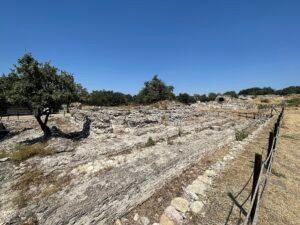
Image: Figure 5. General views of the Mundafan palaeolake.png — Rémy Crassard , Michael D. Petraglia, Nick A. Drake, , CC BY 4.0