The Column of Constantine stands beside Istanbul’s Çemberlitaş tram stop, carrying a story that reaches beneath its stone base. Byzantine writers associated the monument with Christian relics and a sacred statue brought from Rome. But are holy relics really buried beneath Çemberlitaş? Their presence has not been established. The traditions are historical evidence of what people said about the column. They do not establish what lies beneath it.
If you visit, you encounter a Roman monument commissioned by Constantine I, who ruled from 306 to 337. Completed around 328, it commemorates his dedication of Constantinople as the capital on 11 May 330. Its surviving porphyry shaft, lost statue, repairs, and relic traditions each belong to a different part of that history.
Where is the Column of Constantine in Istanbul?
The column stands in Istanbul’s Fatih district. Its modern location is where Yeniçeriler Caddesi meets Divanyolu, beside the Çemberlitaş stop on the T1 tram line. If you pass it while catching a tram, an ordinary journey takes you beside the site of Constantine’s monumental forum.
The ancient setting explains its position. The column rose at the center of the Forum of Constantine, on the city’s main road, the Mese. It was therefore connected to both a public space and a major route through the capital.
Its position has endured. Pelin Yoncacı Arslan’s 2016 academic study states that the column still stands in its original location. The monument you see occupies the place chosen for it in Constantine’s city, even though its upper features have changed.
Why is the Column of Constantine called Çemberlitaş Sütunu?
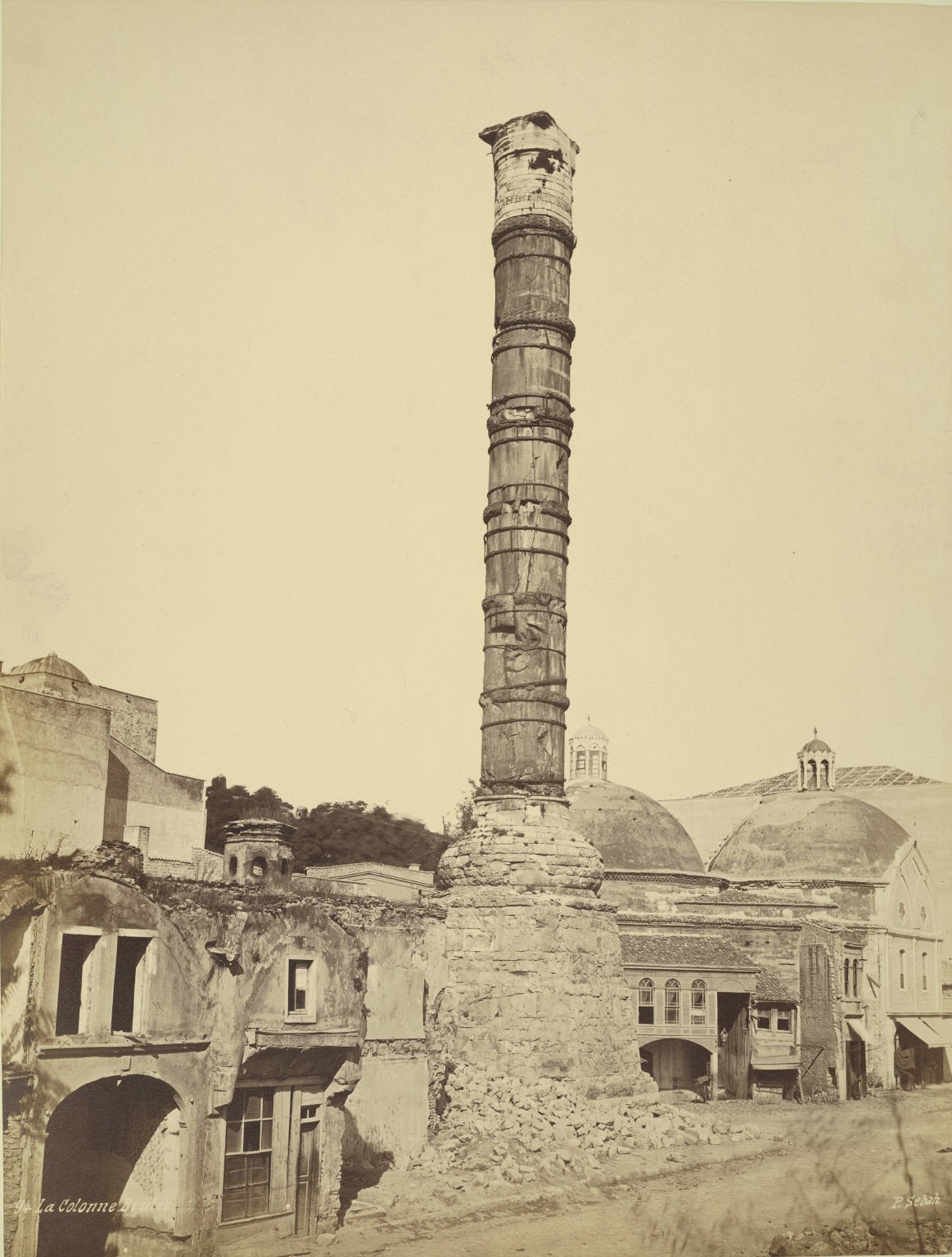
Çemberlitaş Sütunu is also known as the Column of Constantine and the Burnt Column. The name Çemberlitaş refers to the iron hoops used to strengthen its body. Those bands are part of the monument’s identity, rather than a detail separate from its history.
The reinforcement has an early recorded date. Sławomir Bralewski cites the Chronicon Paschale for metal bands applied in 416, during the reign of Theodosius II. This account places the strengthening of the shaft long before the later repairs associated with its present stone reinforcement.
The lower stone casing belongs to another repair phase. According to Columbia University’s monument study, it was added after the fire of 1779. The early metal bands and later masonry should therefore be understood as separate interventions.
What survives of the original Column of Constantine?
The shaft consists of large drums of purple porphyry from Egypt. Originally, carved laurel wreaths concealed the joints between those drums. Its construction combined separate stone sections with decoration that covered their meeting points.
Height figures need careful reading. The present height is given as 34.8 meters, while estimates for the original column without its statue range from 37 to 40 meters. The original figure is a range, and it excludes the bronze figure that once stood above the shaft.
The surviving monument also preserves a written record of repair. Its only surviving inscription states that Emperor Manuel renewed the work after time had damaged it. Original material and later intervention are therefore both part of what remains at Çemberlitaş.
What happened to the Column of Constantine statue?
The original bronze statue showed Constantine in the appearance of the sun god Helios. It wore a crown with seven rays. A spear occupied its right hand, while its left held a globe. These details give the lost summit a much more specific appearance than the bare column suggests.
According to the Byzantine dating discussed by Bralewski, a powerful south wind brought the statue down on 5 April 1106. The loss of the figure is established in that account. The extent of the accompanying damage is disputed.
Raymond Janin argued that three drums fell with the statue. Cyril Mango rejected that claim because he found no source to substantiate it. You should therefore distinguish the reported fall of Constantine’s image from the contested reconstruction of how much stone fell beside it.
During his reign from 1143 to 1180, Manuel I Komnenos repaired the column and placed a cross where the statue had stood. That cross was removed after the Ottoman capture of Istanbul in 1453. The monument’s summit thus passed through three distinct states: imperial statue, cross, and the absence of either.
Are holy relics really buried beneath Çemberlitaş?
The relic traditions name several different objects. In the ninth century, George Hamartolos described the twelve baskets associated with Christ’s miracle of multiplying the loaves beneath the column. Constantine of Rhodes also recorded this tradition in the tenth century. Their accounts establish that the basket story circulated in Byzantine writing.
Later Christian traditions associated further relics with the monument. These included a fragment of the True Cross, Noah’s axe handle, the rock from which Moses drew water, and nails from the Crucifixion. These objects belong to reported traditions. Their association with Çemberlitaş should not be presented as a confirmed inventory beneath its base.
A separate story concerns the Palladium, a statue of Pallas Athena. In the tradition transmitted by Procopius and Malalas, Constantine secretly had it brought from Rome and buried beneath the column. This account places a sacred object associated with Athena beneath the same monument linked to Christian relics.
The distinction between tradition and established presence remains essential. In a response published in the parliamentary record on 17 January 2008, the Ministry of Culture and Tourism addressed relic claims that had appeared in the press in 2007. It stated that those claims were not based on scientific research. The stories cannot therefore be treated as proof that the named objects remain beneath Çemberlitaş.
Does the column have a secret chamber?
The idea of relics beneath the monument can suggest a hidden room inside its pedestal. Research discussed by Bralewski instead describes the base as solid. That finding directly challenges an interpretation that depends on an internal chamber.
The position of the Chapel of Saint Constantine also matters. Mango located it on the northern side of the pedestal. A chapel beside the base is spatially different from a chamber within it. Keeping those locations distinct helps prevent the chapel from becoming supposed evidence for a concealed relic room.
The chapel does have a documented ceremonial role. The tenth-century Book of Ceremonies describes 68 church ceremonies, and 46 included a stop beside the column. In four ceremonies, the patriarch entered the small chapel. These details establish religious activity at the monument without establishing the burial of particular relics.
Details you won’t find in guidebooks
Before the Forum of Constantine was created, the area served as a necropolis, or cemetery. Archaeologist Murat Sav described this earlier use in an Anadolu Agency interview dated 14 June 2024. The column’s setting therefore has a history that predates the imperial forum.
The carved laurel wreaths originally did a practical visual job: they hid the joints between the porphyry drums. This detail helps you imagine the original shaft more accurately. Its sections were joined physically, while their boundaries were concealed decoratively.
The surviving inscription emphasizes Manuel’s renewal of a monument worn by time. Together with the replacement of the statue by a cross, it records a specific stage in the column’s continued use. Çemberlitaş preserves evidence of maintenance as well as Constantine’s original commission.
Timeline
- Around 328: The column was completed.
- 11 May 330: Constantinople’s dedication as the capital defined the monument’s commemorative meaning.
- 416: A Byzantine chronicle dates strengthening metal bands to this year.
- Ninth–tenth centuries: Writers recorded the tradition of twelve baskets beneath the column.
- 5 April 1106: A powerful wind toppled Constantine’s statue.
- 1143–1180: Manuel I Komnenos repaired the column and placed a cross above it.
- After 1453: The cross was removed following the Ottoman capture of Istanbul.
- After 1779: Repairs following a fire added the present lower stone reinforcement.
- 17 January 2008: A published ministry response stated that press claims about relics lacked a basis in scientific research.
Column of Constantine photos: what should you notice?
When looking at photos of Çemberlitaş, focus on the porphyry drums, the strengthening hoops, and the stone reinforcement around the lower section. Each corresponds to a specific part of its construction or repair history. The name Çemberlitaş itself directs attention to the bands.
A present-day photograph also needs the history of the summit. Constantine’s bronze image fell in 1106. Manuel’s replacement cross was removed after 1453. The column’s current appearance therefore cannot show the complete arrangement that marked either its original dedication or its later Christian form.
FAQ
Are holy relics really buried beneath Çemberlitaş?
Byzantine traditions associate the column with Christian relics and the Palladium. Their presence beneath it has not been established, and a Ministry of Culture and Tourism response published in 2008 stated that press claims lacked a basis in scientific research.
Where is the Column of Constantine?
It stands in Istanbul’s Fatih district, where Yeniçeriler Caddesi meets Divanyolu, beside the Çemberlitaş stop on the T1 tram line.
What statue originally stood on the Column of Constantine?
A bronze statue depicted Constantine I in the appearance of Helios. It wore a seven-rayed crown and held a spear in its right hand and a globe in its left.
Is the Column of Constantine still in its original location?
Yes. Pelin Yoncacı Arslan’s 2016 academic study identifies the standing column as remaining in its original location.
Sources
- Türkçe Vikipedi — Çemberlitaş Sütunu tr.wikipedia.org
- English Wikipedia — Column of Constantine en.wikipedia.org
- Columbia University — Istanbul Documentation Project, Column of Constantine mcid.mcah.columbia.edu
- Pelin Yoncacı Arslan, ODTÜ — Towards a New Honorific Column open.metu.edu.tr
- Sławomir Bralewski, Studia Ceranea — The Porphyry Column in Constantinople and the Relics of the True Cross czasopisma.uni.lodz.pl
- TBMM — Ministry of Culture and Tourism response published on 17 January 2008 www5.tbmm.gov.tr
- Anadolu Ajansı — İstanbul’un tarihine tanıklık eden Çemberlitaş sütunu 1700 yıldır ayakta aa.com.tr
Image: The Burnt Column, Constantinople.jpg — Cornell University Library, CC BY 2.0