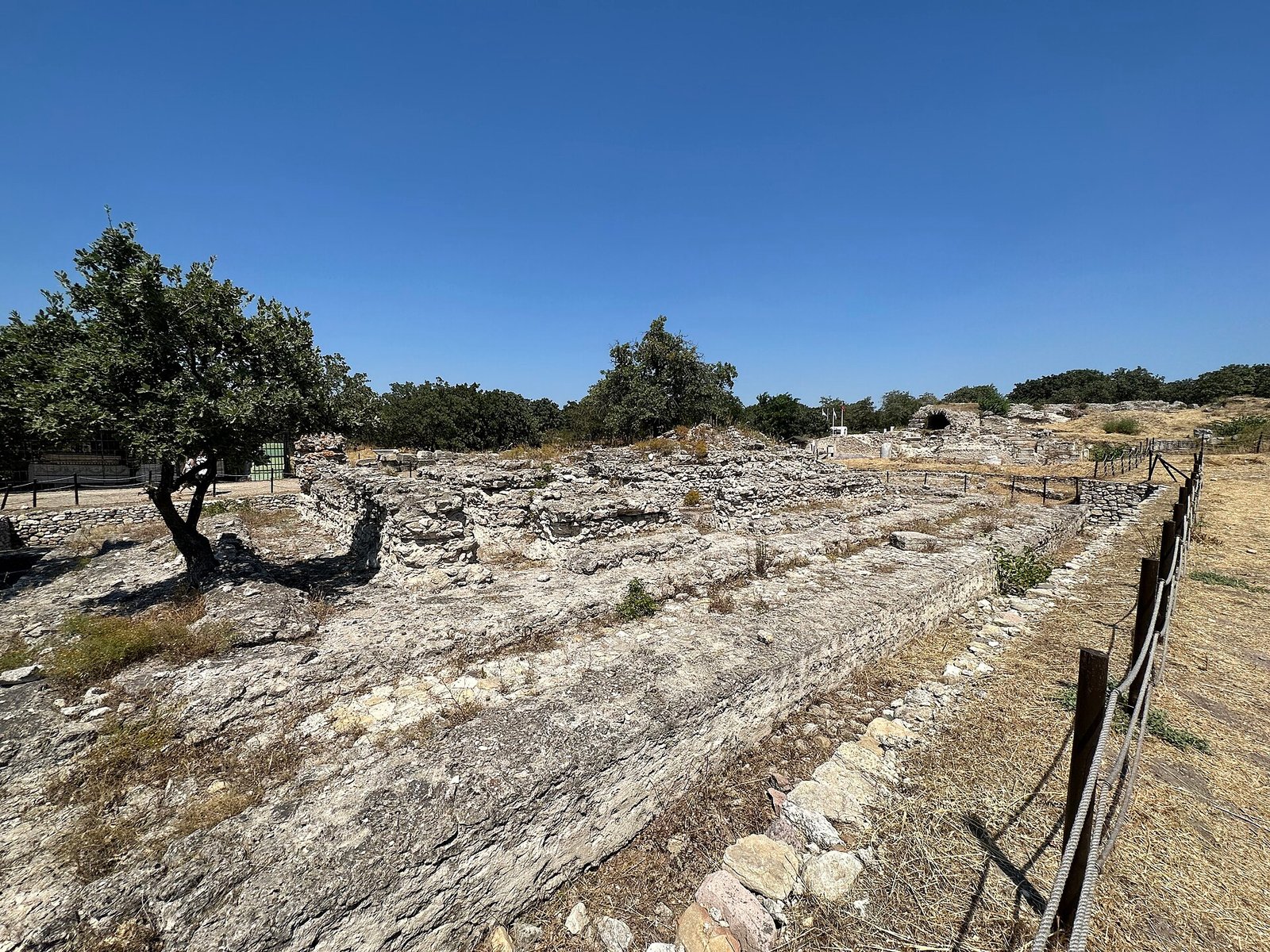
The 2024 excavations in the odeon at Alexandria Troas uncovered marble thresholds, paired marble bases, a column fragment, and carved architectural pieces. Its marble wall cladding and surviving frieze reveal an elaborately decorated complex identified as one of the forum’s grandest public buildings. An inscription found before the odeon also preserves Hadrian’s letters about artists and competitions.
How do these separate discoveries fit together? If you follow the route from the arched entrance to the stage building, the thresholds, matching bases, and decorated walls begin to form a connected picture. The finds also help distinguish surviving architecture from proposed reconstructions, including a possible second story and displays of statues.
Where is the odeon at Alexandria Troas?
Alexandria Troas lies at Kestanbolluk, within the boundaries of Dalyan village in the Ezine district of Çanakkale. The Ministry of Culture and Tourism gives the city’s planned area as 390 hectares. Its traceable walls extend for eight kilometers. These figures place the odeon within the setting of a much larger ancient city.
The 2024 excavations in areas designated ODN 5 and ODN 5.1 clarified the odeon’s entrances and marble decoration. Together with its stage building, the odeon emerged as one of the forum’s grandest public structures. That assessment rests on architectural evidence, including the treatment of doorways, wall surfaces, and carved marble elements.
Excavations at Alexandria Troas have been directed by Erhan Öztepe of Ankara University since 2011. Erdinç Buruldağ’s report on the 2024 work appeared in Troy Museum Journal on April 30, 2026. GreekReporter covered the odeon discoveries on November 13, 2026. The excavation season, report publication, and news coverage therefore belong to separate dates.
What was found in the odeon’s entrances?
The excavations documented a route through the northwestern arched entrance. From there, a turn south led toward the stage building. In ODN 5, excavators exposed marble thresholds belonging to the stage building’s western doorway. These finds establish a physical connection between an entrance route and a specific opening in the building.
At the odeon’s side entrance, Ephesus-type marble bases stood opposite one another. Their paired arrangement matters because the decoration belonged to an organized architectural setting. You can follow that relationship from the entrance itself to the matching elements placed across from each other. The evidence concerns both the route through the building and the treatment of that route.
The thresholds and bases also bring the discussion down to the scale of individual architectural parts. The western doorway had marble thresholds, while the side entrance had corresponding marble bases. Rather than treating all the recovered stone as a single collection, these locations allow particular pieces to be connected with particular parts of the odeon.
What does the marble decoration reveal?
Marble pieces recovered in ODN 5.1 carried kyma, bead-and-pearl, and acanthus decoration. These named ornamental forms give substance to the description of the odeon as richly decorated. The evidence includes carved detail as well as large architectural elements. Its visual treatment extended beyond the presence of marble alone.
The stage building’s walls had marble cladding rising approximately 100–120 centimeters above floor level. Above that cladding, rectangular and square tile slabs decorated the walls. The wall treatment therefore combined a lower marble zone with a different arrangement above it. You can picture this more clearly as a divided wall surface than as an entirely marble interior.
An everyday comparison helps explain the distinction. When you enter a building, its doorway, lower wall panels, and upper wall surfaces can shape your impression together. At the odeon, marble thresholds, paired bases, and cladding document several parts of that treatment. The comparison helps you connect the surviving pieces without assuming that every wall surface used the same material.
The excavation report’s conclusion describes the marble friezes on the western wall as approximately 2.80 meters long. In ODN 5.1, a marble frieze remained in its original position along that wall. Its survival connects decoration directly with architecture. The carving can be considered as part of a wall arrangement, rather than only as a detached object.
Taken together, the matching bases, decorated fragments, cladding, and frieze explain the importance assigned to the building in the 2024 findings. The odeon’s elaborate appearance was expressed through several architectural components. The marble evidence supports the assessment of a prominent public complex within the forum.
How large was the stage building?
The architectural reconstruction proposes a stage building approximately 25–30 meters long and 3.5–4 meters wide. It was probably two stories high. These dimensions and the proposed upper story belong to an interpretation of the architecture. They should be read alongside the excavated thresholds and wall decoration, which provide specific physical points of reference.
The researcher also proposes that statues and honorary inscriptions may have been displayed in the stage building. That possibility adds another layer to the reconstruction of its appearance. The distinction is useful: the marble thresholds and decorated pieces are excavation finds, while the proposed displays and second story describe how the building may once have been arranged.
Details you won’t find in guidebooks
The newly discovered marble base has concave and convex bands that match the workmanship and style of its western counterpart. This is a precise detail behind the broader description of paired bases. Their correspondence extends beyond position to the treatment of their profiles and the way the stone was worked.
A column fragment measuring 1.10 meters long was found in the area of the bases. Its end connecting to the base was broken. The measurement and damaged connection give the fragment a specific place in the architectural evidence. They also add a column element to the thresholds, bases, and wall pieces recovered around the odeon.
Another detail lies in the portico before the odeon. A Greek inscription found there contains three letters sent by Hadrian to the association of Dionysian artists. Its location links this evidence with the space in front of the building.
What do Hadrian’s letters reveal about artists?
The inscription dating to Hadrian’s reign records decisions about the organization, calendar, and prizes of competitions. It provides a different kind of evidence from the carved marble. The architectural pieces illuminate the building’s appearance, while the letters illuminate matters affecting an artists’ association and the management of competitions.
Öztepe suggests that the inscription’s discovery before the odeon may indicate that artists used the building as a meeting place. This remains an interpretation based on the inscription’s setting. If you are considering how the odeon was used, the letters offer a connection with organized artists, alongside the evidence supplied by its stage building.
What happened to the odeon later?
Later walls incorporated reused blocks and rubble, damaging the odeon’s earlier architecture. The remains therefore preserve evidence of alteration as well as decoration. The surviving marble elements belong within a setting that changed over time, where later construction affected the earlier building’s fabric.
Excavations also documented a Byzantine-period room built on fill in the odeon area. This records a later use of the site. The room on fill and the walls containing reused material help explain why the excavated remains cannot be read as a single, unchanged architectural arrangement.
Timeline
- 310 BC / 306 BC: Sources differ on the city’s foundation or refoundation date. The ministry gives 310 BC for its foundation; the Turkish and English Wikipedia accounts give 306 BC for its refoundation under Antigonos.
- 301 BC: According to Turkish Wikipedia, Lysimachus renamed the city Alexandria Troas in memory of Alexander the Great.
- Reign of Augustus: A Roman colony named Colonia Alexandria Augusta Troas was established in the city.
- Reign of Hadrian: Letters to the association of Dionysian artists were recorded in the inscription later found before the odeon.
- Byzantine period: A new room was constructed on fill in the odeon area.
- 2011: Erhan Öztepe took over direction of the excavations.
- 2024: Work in ODN 5 and ODN 5.1 clarified entrance arrangements and marble decoration.
- April 30, 2026: Buruldağ’s report on the 2024 excavations was published.
- November 13, 2026: GreekReporter covered the odeon findings.
FAQ
What was found in the odeon at Alexandria Troas?
The 2024 excavations revealed marble thresholds, paired Ephesus-type marble bases, a column fragment, and architectural pieces with kyma, bead-and-pearl, and acanthus decoration. A marble frieze also survived in its original position along the western wall.
What does the marble decoration reveal?
The marble thresholds, coordinated bases, wall cladding, and carved decoration show the architectural importance of the odeon and its stage building. The 2024 findings identify the complex as one of the forum’s grandest public buildings.
Did artists meet in the odeon?
Erhan Öztepe suggests that they may have done so. His interpretation draws on an inscription found in the portico before the odeon, which preserves three letters from Hadrian to the association of Dionysian artists.
Was the stage building two stories high?
An architectural reconstruction proposes a stage building about 25–30 meters long and 3.5–4 meters wide, probably with two stories. Its height and possible display of statues and honorary inscriptions remain interpretations.
Sources
- Ministry of Culture and Tourism — Alexandria Troas Archaeological Site muze.gov.tr
- Turkish Wikipedia — Aleksandreia Troas tr.wikipedia.org
- English Wikipedia — Alexandria Troas en.wikipedia.org
- Çanakkale Provincial Directorate of Culture and Tourism — Alexandria Troas Excavations canakkale.ktb.gov.tr
- Erdinç Buruldağ, Troy Museum Journal — Alexandria Troas Antik Kenti 2024 Yılı Çalışmaları dergipark.org.tr
- Erdinç Buruldağ — Full Text of the 2024 Excavation Report dergipark.org.tr
- GreekReporter — Excavations at Alexandria Troas Reveal a Lavishly Decorated Ancient Odeon greekreporter.com
- Erhan Öztepe — Epigrafik ve Arkeolojik Veriler Işığında Alexandria Troas’taki Kültler ve İkonografileri hoyuk.gov.tr
Image: Alexandria Troas – 2.jpg — Raicem, CC BY 4.0