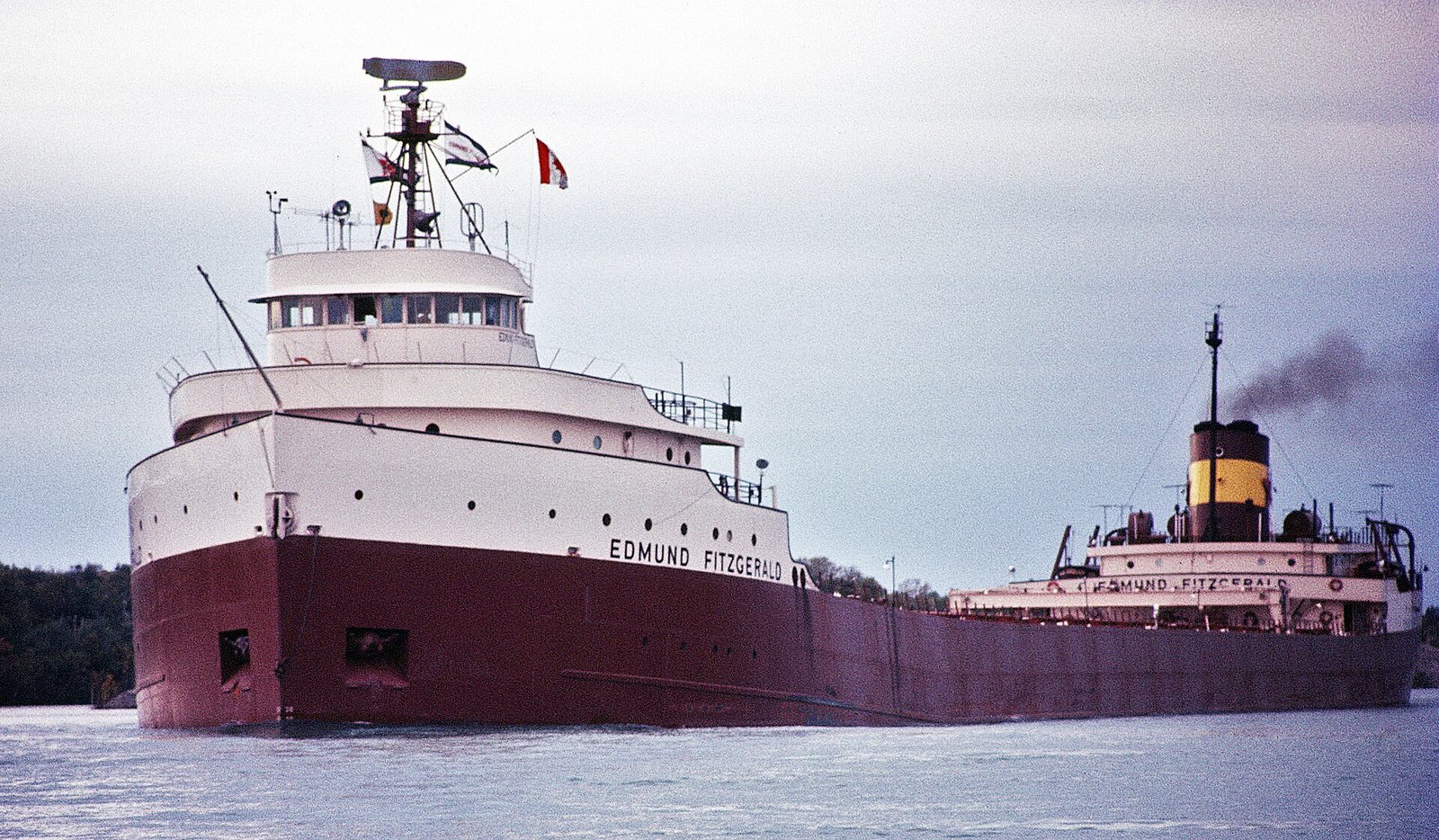
Edmund Fitzgerald sank in a severe Lake Superior storm on November 10, 1975, after flooding that official investigations linked to its cargo hatches. The Coast Guard emphasized leaking hatch closures, while the NTSB identified sudden flooding after waves collapsed one or more hatch covers. All 29 people aboard died, and the exact sequence remains unresolved.
The puzzle lies in the gap between Captain Ernest M. McSorley’s final radio message and the ship’s disappearance. At about 19:10 EST, he reported, “We are holding our own.” The sinking followed at approximately 19:15. To understand what happened, you need to follow the damage reports, the storm conditions, and the competing explanations for water entering the hold.
What was Edmund Fitzgerald carrying on its final voyage?
Edmund Fitzgerald left Superior, Wisconsin, on November 9, 1975, under McSorley’s command. Its destination was the steelmaking area at Zug Island in Detroit. The cargo consisted of taconite pellets made from processed iron ore.
That load weighed 26,116 long tons, approximately 26,535 metric tonnes. The cargo later became central to the NTSB’s explanation of how water could enter the hold without being noticed. Investigators concluded that earlier leakage had filtered downward through the pellets.
The ship measured 729 feet, approximately 222 metres, in length. When launched on June 7, 1958, it was the largest vessel on the Great Lakes. It remains the largest ship to have sunk there.
What happened before the ship disappeared?
McSorley and Bernie Cooper, captain of Arthur M. Anderson, chose a northern route as the storm approached. They sought protection from the high ground along the Canadian shore. Their route choice was therefore connected directly to the weather they expected to encounter.
During the afternoon of November 10, McSorley reported damage to Anderson. A deck railing had fallen. Two vents were missing or damaged. The ship had also developed a list, meaning it was leaning to one side.
Later that afternoon, McSorley spoke with the vessel Avafors. He reported that both radars had failed and that heavy waves were sweeping the deck. These messages establish that the ship was experiencing several problems before its final exchange with Anderson.
At about 19:10 EST, McSorley gave his last recorded reply to Anderson: “We are holding our own.” Approximately five minutes later, Edmund Fitzgerald sank in eastern Lake Superior. No distress call from the ship was heard by other vessels or shore stations.
How severe was the Lake Superior storm?
A meteorological study published in 2006 reconstructed the storm using numerical models. Its simulation calculated significant wave heights exceeding seven metres in the area occupied by Edmund Fitzgerald around the time of the sinking.
The study also examined wave direction. Large waves moving from west to east approached approximately perpendicular to the ship’s southward course. The researchers identified conditions capable of producing dangerous rolling.
These findings add more than a wave-height figure to the account. The reconstruction placed large waves across the vessel’s direction of travel. That helps you understand why the ship’s heading mattered alongside the size of the waves.
The reconstruction also had a limited set of observations from ships. Across the storm’s 42 hours, only 31 surface weather observations came from vessels on Lake Superior. The later model offered a way to examine conditions beyond those scattered reports.
Why did the official investigations reach different explanations?
The Coast Guard’s 1977 report proposed that water entered through ineffective cargo-hatch closures. In that explanation, flooding filled the hold and caused the ship to lose buoyancy. The focus was on water passing through closures that failed to keep it out.
The NTSB adopted its report on May 4, 1978. It attributed the final sinking to sudden, massive flooding after large waves collapsed one or more hatch covers. Its explanation therefore included a decisive failure during the final stage, rather than slow leakage alone.
For an everyday-life comparison, you can think of a lidded container: seepage around the closure and collapse of the lid describe different routes for water to enter. That distinction helps clarify the disagreement between the Coast Guard’s explanation and the NTSB’s account of the final flooding.
The NTSB also concluded that water had previously leaked through the hatches. It explained that this water filtered down through the cargo and escaped notice. There was no method of measuring water in the hold apart from visual observation.
Loading rules formed another part of the NTSB’s assessment. Changes in 1969, 1971, and 1973 allowed ships to load more deeply. The board concluded that this contributed to waves washing over their decks more frequently.
Both official explanations centered on flooding associated with the cargo hatches. Their difference concerned how that flooding developed, particularly at the end. The Great Lakes Shipwreck Historical Society nevertheless emphasizes that wreck investigations have not produced evidence establishing the cause conclusively.
Did the ship strike a shoal or break apart first?
The Lake Carriers Association proposed that Edmund Fitzgerald might have scraped Six Fathom Shoal near Caribou Island. This theory offered an alternative source of damage before the sinking. It placed the possible initiating event beneath the ship.
An examination of the shoal supplied evidence against that explanation. Divers who inspected Six Fathom Shoal after the disaster found no signs of a recent collision or grounding. The proposed contact therefore lacked supporting traces at the location examined.
A separate theory proposed structural failure before the ship sank. The NTSB assessed calculated stresses in the hull and concluded that they were insufficient to break the vessel before sinking. Its findings did not support that proposed sequence.
The wreck lies in two large sections, but that fact does not by itself settle when the separation occurred. You need to distinguish the wreck’s observed condition from the NTSB’s assessment of stresses before the sinking.
Timeline
- June 7, 1958: Edmund Fitzgerald was launched as the largest ship on the Great Lakes.
- November 9, 1975: The ship departed Superior with its taconite cargo.
- November 10, afternoon: McSorley reported deck damage and a list.
- November 10, about 19:10 EST: The final radio exchange with Anderson took place.
- November 10, about 19:15 EST: Edmund Fitzgerald sank, killing all 29 people aboard.
- November 14, 1975: A U.S. Navy aircraft located the wreck using a magnetic anomaly detector.
- May 20, 1976: CURV III’s underwater examination revealed the ship’s name on its overturned stern.
- 1977: The Coast Guard published its explanation involving ineffective hatch closures.
- May 4, 1978: The NTSB adopted its report emphasizing hatch-cover collapse during the final flooding.
- July 4, 1995: The ship’s bronze bell was recovered.
- 2006: The storm reconstruction was published.
Details you won’t find in guidebooks
The absence of a heard distress call is one of the starkest details in the NTSB record. Other vessels and shore stations heard no such call from Edmund Fitzgerald. Its final known reply remained the brief statement that it was holding its own.
The crew ranged in age from 20-year-old lookout Karl A. Peckol to 63-year-old Captain McSorley. Those ages put individual lives behind the total of 29 deaths. Neither man survived the disaster.
Identification of the wreck included an unusual view of its name. During CURV III’s examination on May 20, 1976, the lettering could be read on the overturned stern section. The ship’s identity was visible even in that position.
The bronze bell weighs 200 pounds, approximately 91 kilograms. Recovered on July 4, 1995, it is displayed at the Great Lakes Shipwreck Museum at Whitefish Point in memory of the crew.
Where is the wreck, and what has been investigated?
Edmund Fitzgerald rests in Canadian waters at a depth of approximately 162 metres. Its two large sections lie in eastern Lake Superior. A U.S. Navy aircraft located the wreck on November 14, 1975, using a magnetic anomaly detector.
The Great Lakes Shipwreck Historical Society conducted underwater research expeditions in 1989, 1994, and 1995. The bell recovery followed during the last of those years. Despite the investigations, the society maintains that conclusive evidence of the sinking’s cause has not been found.
FAQ
Why did the Edmund Fitzgerald sink?
Official investigations focused on water entering the cargo hold during a severe storm. The Coast Guard emphasized ineffective hatch closures, while the NTSB attributed the final sinking to sudden flooding after large waves collapsed one or more hatch covers.
Did the Edmund Fitzgerald send a distress call?
No distress call from the ship was heard by other vessels or shore stations. At about 19:10 EST, Captain Ernest M. McSorley told Arthur M. Anderson, “We are holding our own.”
Where is the Edmund Fitzgerald wreck?
The wreck lies in Canadian waters in eastern Lake Superior, at a depth of approximately 162 metres. It rests in two large sections.
Did anyone survive the sinking?
No. All 29 people aboard died when Edmund Fitzgerald sank at approximately 19:15 EST on November 10, 1975.
Sources
- NTSB — SS Edmund Fitzgerald Sinking in Lake Superior ntsb.gov
- Great Lakes Shipwreck Historical Society — The Fateful Journey shipwreckmuseum.com
- Great Lakes Shipwreck Historical Society — Edmund Fitzgerald shipwreckmuseum.com
- U.S. Coast Guard — Edmund Fitzgerald Marine Casualty Report dco.uscg.mil
- NTSB — Marine Accident Report MAR-78-03 ntsb.gov
- BAMS — Reexamination of the 9–10 November 1975 “Edmund Fitzgerald” Storm Using Today’s Technology michiganseagrant.org
Image: Edmund Fitzgerald, 1971, 3 of 4 (restored; cropped).jpg — Greenmars, CC BY-SA 3.0