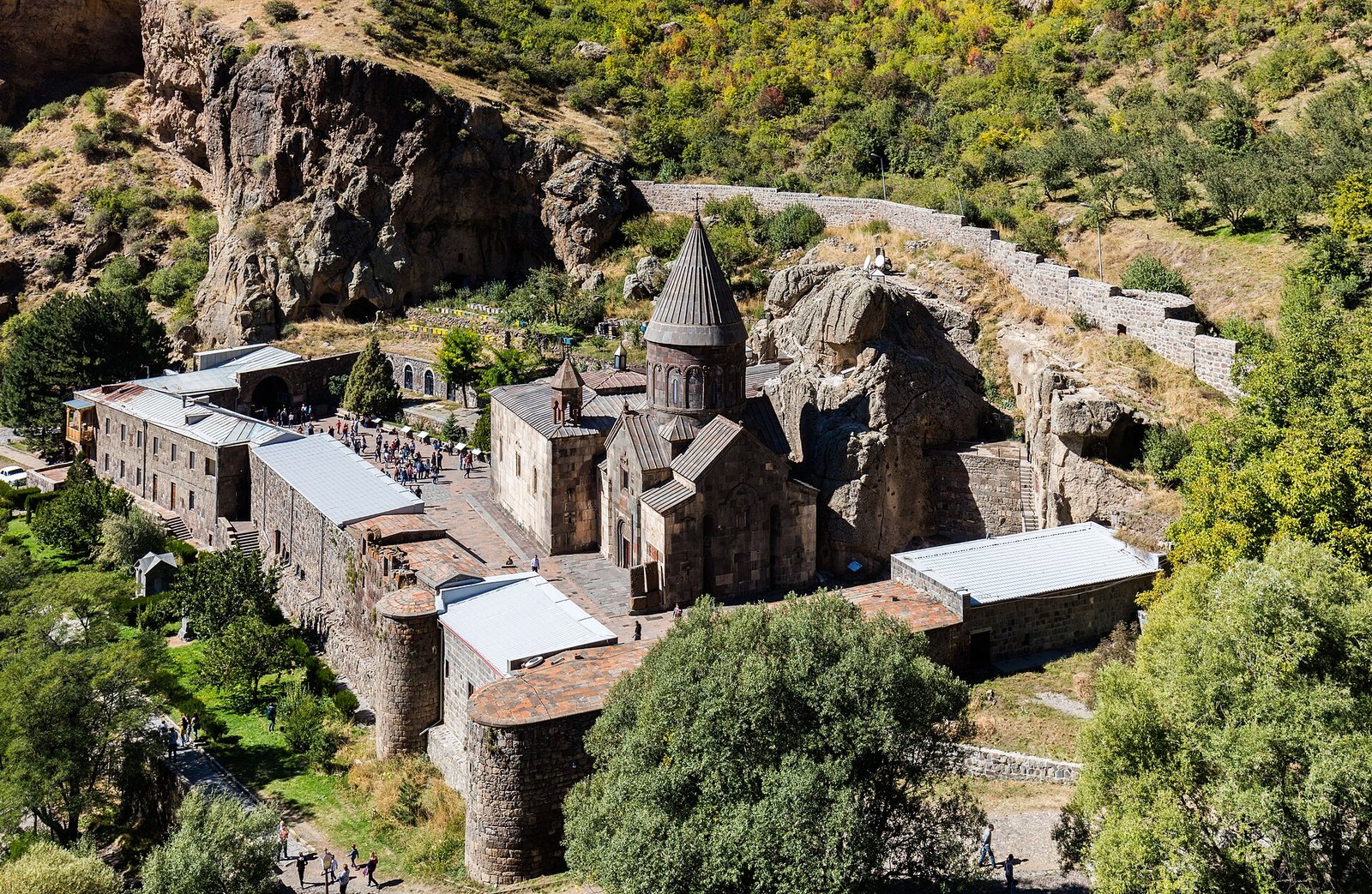
Geghard Monastery is in Armenia’s Kotayk Province, near Goght village in the Azat Valley. It is a medieval religious complex partly carved into the adjoining mountain and surrounded by high cliffs. Its churches and burial halls connect rock-cut architecture with the Holy Lance tradition behind its name.
The name Geghardavank means “Monastery of the Spear,” but the monastery also had an earlier name: Ayrivank, or “Cave Monastery.” Those names offer you two ways into its history. Follow the caves to understand the buildings, then follow the spear to distinguish religious tradition from documented dates.
Where is Geghard Monastery in Armenia?
Geghard’s setting is the Azat Valley near Goght. The mountain forms part of the monastery itself. Some spaces were built as structures, while others were excavated from the rock. More than twenty rooms occupy different levels around the principal rock-cut buildings.
The World Heritage property is listed as the Monastery of Geghard and the Upper Azat Valley. UNESCO records an area of 2.97 hectares and a buffer zone of 38.75 hectares. These figures distinguish the inscribed property from the wider area surrounding it.
The cliffs also contained the cells where most monks lived. These were outside the monastery’s main defensive wall. If you picture only the central churches, you leave out much of the residential setting that supported the religious community.
How old is Geghard Monastery?
Church tradition attributes the monastery’s foundation to Gregory the Illuminator in the fourth century. UNESCO presents that attribution as tradition. It should therefore be distinguished from the dated construction of the buildings that make up the medieval complex.
The cave spring has an even earlier religious association. The ICOMOS assessment states that it was regarded as sacred before Christianity. Water and the cave thus belong to the site’s religious history before the construction dates of its surviving principal churches.
Katoghike, the main church, was built in 1215. Its adjoining entrance hall followed between 1215 and 1225. The first rock church dates to the 1240s, while another rock church and a second rock-cut burial hall belong to the later thirteenth century. Geghard’s age therefore has several answers: a traditional foundation, an older sacred spring, and dated medieval construction.
What makes Geghard Church a rock-cut complex?
Katoghike has an equal-armed cross plan set within a square and covered by a dome. This gives you a clear starting point for reading the complex. The main church has its own defined plan, while the surrounding mountain contains further churches, tombs, and rooms.
The entrance hall attached to Katoghike is called a gavit. Four freestanding stone columns support its roof structure. An opening at the center admits daylight. The hall’s construction between 1215 and 1225 places it close in date to the main church.
Avazan, the first rock church, was carved in the 1240s into an older cave containing a spring. It was excavated entirely from the bedrock and has an equal-armed cross plan. Here, the cave’s water source and the church’s architectural form occupy the same space.
The Proshyan dynasty’s rock-cut burial chamber provides passage to the second rock church, built in 1283. A second rock-cut burial hall is reached by an external staircase. Its inscription records completion in 1288. These passages and stairs connect worship and burial spaces across different levels.
What is the Holy Lance tradition?
According to Armenian Church tradition, the Apostle Thaddeus brought to Armenia in the first century the lance that pierced Jesus’ side. This is the religious claim behind the relic’s significance. The name Geghardavank links the monastery directly to that spear tradition.
The Armenian Church’s own account also sets out the historical limits. It states that the lance is not securely mentioned before the twelfth century. It also acknowledges another object in Vienna claimed to be the true Holy Lance. The first-century account and the later documentary record should therefore remain distinct.
A dated document provides a firmer point for the monastery’s name. According to ICOMOS, Geghardavank appears in a record from 1250. Prince Prosh commissioned a special case for the lance in 1268. These dates establish medieval references to the monastery’s name and the spear’s housing without proving the tradition about its earliest journey.
In 2018, the lance was among the objects moved to the Alex and Marie Manoogian Treasury-House at Echmiadzin. The transfer took place because of construction work at the main cathedral. The object traveled with its silver case, carrying forward a material history that extends beyond Geghard itself.
Timeline
- Fourth century: Church tradition places the monastery’s foundation under Gregory the Illuminator.
- 1215: Katoghike, the main church, was built.
- 1215–1225: The gavit adjoining the main church was constructed.
- 1240s: Avazan was carved into the cave containing the spring.
- 1250: Geghardavank appears in a document, according to ICOMOS.
- 1268: Prince Prosh commissioned a special case for the Holy Lance.
- 1283: The second rock church was built.
- 1288: An inscription dates the completion of the second rock-cut burial hall.
- 1687: The lance’s case was renewed, and the earlier inscription was copied.
- 1798: According to church history, the lance was lent to the king of Georgia during a plague outbreak.
- 2000: Geghard and the Upper Azat Valley entered the UNESCO World Heritage List.
- 2018: The lance was moved to the Alex and Marie Manoogian Treasury-House at Echmiadzin.
What should you look for in Geghard Monastery photos?
Katoghike’s southern entrance carries pomegranate trees, grape motifs, doves, and a lion attacking an ox. These are specific details to identify when you examine photographs. They bring plants, birds, and animals into the decoration of the church entrance.
Khachkars appear on both rock surfaces and building walls. These carved crosses commemorate the dead or preserve the memory of donations to the monastery. Their placement connects the cliffs and constructed walls through a shared practice of remembrance.
Interior photographs can also help you distinguish the gavit from the rock churches. Look for the hall’s four freestanding columns and central daylight opening. Avazan, by contrast, was cut entirely from the bedrock around the older cave spring.
Details you won’t find in guidebooks
The gavit served lessons, meetings, and the reception of pilgrims as well as religious purposes. Think of an entrance hall in everyday life: it can also become a place to gather. At Geghard, those teaching and meeting functions were part of the hall’s recorded use.
An inscription preserves the name of Galdzak, the architect who worked on the rock churches and burial halls. The surviving name gives a human reference point for spaces otherwise described through their dates, plans, and relationship to the mountain.
The lance’s case preserves another chain of memory. When it was renewed in 1687, Prince Prosh’s inscription from the earlier case was copied onto the replacement. The container changed, while the text recording his earlier commission was retained.
According to church history, the lance was lent to the king of Georgia in 1798. It was sent in the belief that it would help plague victims. This episode records a belief about the relic’s power, rather than evidence that it treated the disease.
How does Geghard’s weather affect its preservation?
Geghard’s management plan identifies increased moisture in spring and autumn, together with summer dryness, as harmful to the historic buildings. Seasonal conditions therefore form part of the monastery’s conservation history. They affect the material setting of both built and excavated spaces.
UNESCO also identifies an active earthquake zone, rockfalls, and tourism pressure among the threats to Geghard. The cliffs are integral to the architecture, but they also form part of its conservation risks. The monastery’s relationship with the mountain requires continuing attention.
Geghard and the Upper Azat Valley entered the World Heritage List in 2000 under criterion ii, concerning cultural interchange. The designation encompasses a religious complex whose main church, rock-cut sanctuaries, burial halls, and surrounding valley must be understood together.
FAQ
Where is Geghard Monastery?
Geghard Monastery is in the Azat Valley near Goght village, in Armenia’s Kotayk Province. The medieval complex is partly carved into the adjoining mountain.
How old is Geghard Monastery?
Tradition places its foundation in the fourth century and attributes it to Gregory the Illuminator. The main church, Katoghike, dates to 1215, while the rock-cut churches and burial halls developed during the thirteenth century.
What does Geghardavank mean?
Geghardavank means “Monastery of the Spear.” According to the ICOMOS assessment, the name appears in a document dated 1250.
Is the Holy Lance still at Geghard?
The lance was among the objects moved with their silver cases to the Alex and Marie Manoogian Treasury-House at Echmiadzin in 2018 because of construction work at the main cathedral.
Sources
- UNESCO World Heritage Centre — Monastery of Geghard and the Upper Azat Valley whc.unesco.org
- ICOMOS — Geghard Evaluation, 2000 whc.unesco.org
- Turkish Wikipedia — Geğard Manastırı tr.wikipedia.org
- English Wikipedia — Geghard en.wikipedia.org
- Eastern Diocese of the Armenian Church — The Holy Lance in Armenian Tradition & Legend armenianchurch.us
- Mother See of Holy Etchmiadzin — Alex and Marie Manoogian Treasury-House armenianchurch.org
- UNESCO World Heritage Committee — Decision 24 COM X.C.1 whc.unesco.org
- UNESCO World Heritage Centre — Geghard Maps whc.unesco.org
- Historical and Cultural Heritage Research Center of Armenia — Geghard Management Plan whc.unesco.org
Image: Monasterio de Geghard, Armenia, 2016-10-02, DD 63.jpg — Diego Delso, CC BY-SA 4.0