Lake Titicaca was sacred to the Incas because their origin traditions connected it with the emergence of the Sun and the ancestors of their ruling dynasty. On Isla del Sol, the sacred rock called Titi Qala marked a place where the Sun was believed to have appeared. Temples, pilgrimage facilities and offerings placed underwater gave these beliefs a physical setting.
How did a lake become both a place of creation and a setting for imperial authority? If you follow the stories from Titi Qala to the underwater offering boxes, you encounter several overlapping answers. The evidence includes different creation accounts, an organized pilgrimage complex and ceremonies that began before the Inca Empire.
Where is Lake Titicaca on the map, and in which country?
Lake Titicaca lies on the border between Peru and Bolivia, on the Altiplano plateau in the Andes of South America. Its approximate center is 15.817° south and 69.317° west. The answer to “Lake Titicaca: Peru or Bolivia?” is therefore both countries.
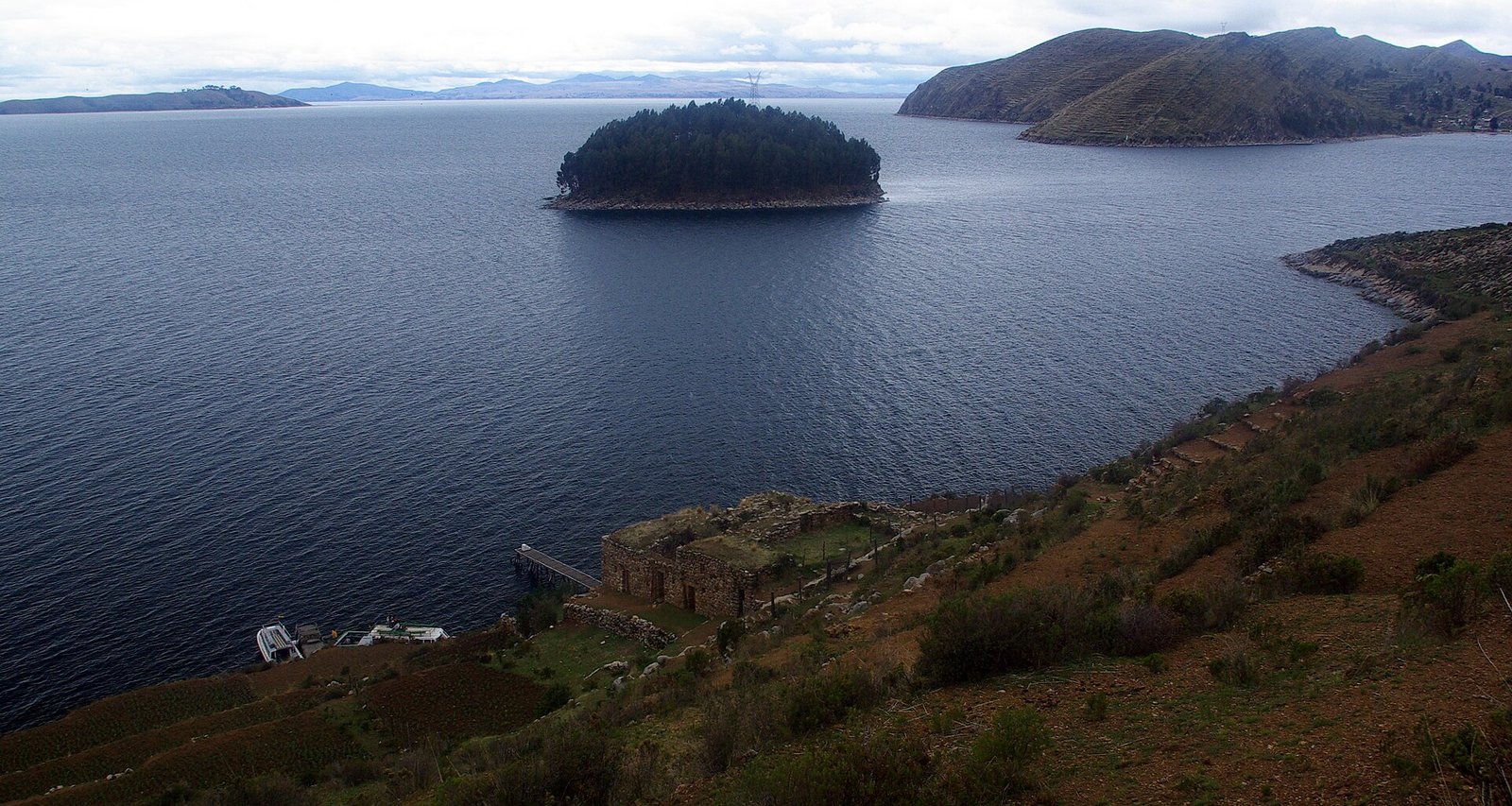
Isla del Sol lies in the southern part of the lake, within Bolivia’s La Paz department. Its Spanish name means “Island of the Sun.” For the Inca traditions associated with Titi Qala, this island was a specific sacred place within the larger lake.
Lake Titicaca elevation and size
The lake’s surface stands about 3,812 meters above sea level. It covers approximately 8,372 square kilometers and reaches a maximum depth of 281 meters. Its familiar description as the world’s highest navigable lake refers to commercial shipping; smaller lakes exist at higher elevations.
These measurements help you place Isla del Sol within a large body of water. They also give scale to the archaeological discoveries: offerings associated with sacred activity have been found at Khoa Reef and K’akaya Reef, as well as around the Island of the Sun.
Why did Isla del Sol matter to Inca origin myths?
Titi Qala was central to traditions about the Sun’s appearance. Bernabé Cobo recorded two versions. In one, the Sun emerged from the rock after a long period of darkness. In the other, it reappeared after sheltering beneath the rock during a great flood.
Both accounts connect the same rock with the return or emergence of sunlight. Their details differ, but Titi Qala remains the physical focus. The sacred landscape therefore included a named feature that people could approach, alongside a story about the Sun.
A different origin tradition, presented by the Smithsonian, concerns Manco Cápac and Mama Ocllo. They were children of the Sun god Inti. They emerged from Lake Titicaca and traveled north to establish Cusco. The account describes them as both siblings and spouses.
The lake thus carried more than one kind of beginning. The Titi Qala traditions explained the Sun’s appearance. The story of Manco Cápac and Mama Ocllo connected Titicaca with the ancestry of the Inca dynasty. Together, these accounts linked a sacred place with divine and dynastic origins.
How did Viracocha and Pacaritambo fit into the story?
Juan de Betanzos recorded another creation account in 1557. In his version, the creator Contiti Viracocha emerged from Lake Titicaca. At Tiwanaku, he created the Sun, the Moon, the stars and new people. Here, the creator’s emergence from the lake precedes those acts of creation.
Cristóbal de Molina’s account, dated 1575, arranged the events differently. The creator made the Sun, Moon and stars at Tiwanaku, then ordered them to rise into the sky from Titicaca Island. Tiwanaku and the island therefore had distinct roles within the same narrative.
Titicaca was also connected with an alternative place of ancestral emergence: the cave at Pacaritambo. Molina’s account joined the two places through an underground journey. You should read these as related origin traditions with different structures, rather than combine every episode into a single historical itinerary.
The differences matter. Betanzos’s creator emerges from the lake, while Molina’s heavenly bodies ascend from the island. The Manco Cápac and Mama Ocllo tradition emphasizes the journey toward Cusco. Each account gives Titicaca a role without making all the stories identical.
How did the Incas turn sacred geography into pilgrimage?
Túpac Inca Yupanqui, the tenth Inca ruler, expanded the temple at Titi Qala. He also established a tambo for pilgrims and a mamacona institution for selected women. The sacred rock consequently formed part of a setting with buildings and institutions serving religious activity.
A study published in Antiquity in 2020 describes Isla del Sol as a pilgrimage complex used during Inca expansion in the fifteenth and sixteenth centuries. This connects the origin traditions with an organized destination. Pilgrims came to a place whose significance was also supported by imperial construction.
There is an everyday-life link here: a journey requires somewhere to stop. The tambo provided for pilgrims shows that worship at Titi Qala involved practical arrangements as well as beliefs about the Sun. Sacred importance took shape through facilities that supported people reaching the site.
What do underwater offerings reveal about belief and power?
Inca offerings around Isla del Sol included stone boxes containing miniature objects made from gold, silver and shell. These boxes were placed in the lake. The water itself was therefore part of the ritual setting, alongside the island’s temple and sacred rock.
An approximately 500-year-old Inca offering box discovered in 2014 contained a small shell llama and a gold sheet rolled into a cylinder. Its preserved contents provide a concrete example of the miniature objects used in these deposits. The box was found at K’akaya Reef.
Delaere and Capriles interpret such offerings as political and symbolic acts that helped legitimize imperial control over sacred territory. That interpretation connects valuable deposits with Inca authority at Titicaca. It does not reduce the offerings to a single purpose.
Other possible aims include the increase of llama and alpaca herds and hopes for abundant harvests. These interpretations connect sacred deposits with animals and crops, alongside imperial legitimacy. The meanings proposed by researchers therefore include both political authority and material abundance.
A claim about blood requires a separate distinction. The seventeenth-century cleric Alonso Ramos Gavilán described child or animal blood being placed in offering boxes. No blood traces confirming that claim were detected in the box discovered in 2014. The written account and this archaeological finding provide different kinds of evidence.
Was Lake Titicaca sacred before the Incas?
Offerings at Khoa Reef near Isla del Sol date to the eighth through tenth centuries CE. They belong to Tiwanaku ritual activity and show that ceremonies in the lake preceded the Inca Empire. The Incas used a landscape with an earlier history of sacred deposits.
The Khoa finds include puma-shaped ceramic incense burners, gold ornaments and bones interpreted by researchers as those of sacrificed young llamas. These objects make the earlier ceremonies tangible. Their dates distinguish them from the later Inca stone offering boxes.
The earlier deposits establish a long ritual history, but they do not turn Tiwanaku and Inca practices into one unchanged ceremony. The Khoa assemblage and the Inca boxes belong to different periods. Their shared setting is the lake and the sacred geography around Isla del Sol.
Details you won’t find in guidebooks
Spondylus shells among the Khoa offerings came from warm seas off the Ecuadorian coast, approximately 2,000 kilometers from Titicaca. These marine objects reached a high-altitude freshwater lake. Their origin adds a long-distance connection to the material evidence of ritual at Khoa.
The andesite box from K’akaya measured 36 × 27 × 17 centimeters. Holes and grooves on its short sides may have allowed it to be lowered into the water with ropes. That interpretation concerns the practical handling of the offering, down to the shape of its container.
Its tightly fitted lid was not waterproof. Researchers found approximately six centimeters of lake sediment at the bottom of the inner cavity. A preserved lid and an intact offering therefore did not mean that the box had remained sealed against lake water.
Timeline
- Eighth–tenth centuries CE: Tiwanaku communities deposited the offerings found at Khoa Reef.
- Fifteenth–sixteenth centuries: Isla del Sol served as an Inca pilgrimage complex associated with origin traditions.
- 1557: Betanzos recorded the account of Viracocha emerging from Titicaca.
- 1575: Molina’s creation account connected Titicaca Island and Pacaritambo.
- 2012: The underwater research program led by Christophe Delaere began.
- 2014: The Inca offering box with its lid preserved was found at K’akaya Reef.
- 2020: A study published in Antiquity described Isla del Sol as a pilgrimage complex used during Inca expansion in the fifteenth and sixteenth centuries.
FAQ
Why was Lake Titicaca sacred to the Incas?
Inca traditions connected Lake Titicaca with the emergence of the Sun and the ancestors of the ruling dynasty. Isla del Sol’s sacred rock, Titi Qala, became a focus of worship and pilgrimage.
Is Lake Titicaca in Peru or Bolivia?
Lake Titicaca lies across the border between Peru and Bolivia. Isla del Sol is in the lake’s southern part, within Bolivia’s La Paz department.
Who were Manco Cápac and Mama Ocllo?
In the origin tradition presented by the Smithsonian, they were children of the Sun god Inti. Described as siblings and spouses, they emerged from Lake Titicaca and traveled north to establish Cusco.
Did sacred rituals at Lake Titicaca begin with the Incas?
No. Tiwanaku offerings from Khoa Reef date to the eighth through tenth centuries CE. They show that ceremonies in the lake preceded the Inca Empire.
Sources
- Vikipedi — Titikaka Gölü tr.wikipedia.org
- Wikipedia — Lake Titicaca en.wikipedia.org
- Wikipedia — Isla del Sol en.wikipedia.org
- Smithsonian National Museum of the American Indian — Ways of Living americanindian.si.edu
- Pärssinen and Korpisaari — Ideological and Cultural Continuities between the Ancient Tiwanaku and the Inca Empire estudioslatinoamericanos.pl
- Delaere and Capriles — The context and meaning of an intact Inca underwater offering from Lake Titicaca doi.org
- Delaere and Capriles — Full research paper dipot.ulb.ac.be
- Delaere, Capriles and Stanish — Underwater ritual offerings in the Island of the Sun and the formation of the Tiwanaku state pmc.ncbi.nlm.nih.gov
- UNESCO — Titicaca: The sacred lake reveals its secrets unesco.org
- National Geographic — Centuries-old Inca offering discovered in sacred lake nationalgeographic.com
Image: Pilka Kaina Stevage.jpg — Steve Bennett, CC BY-SA 3.0