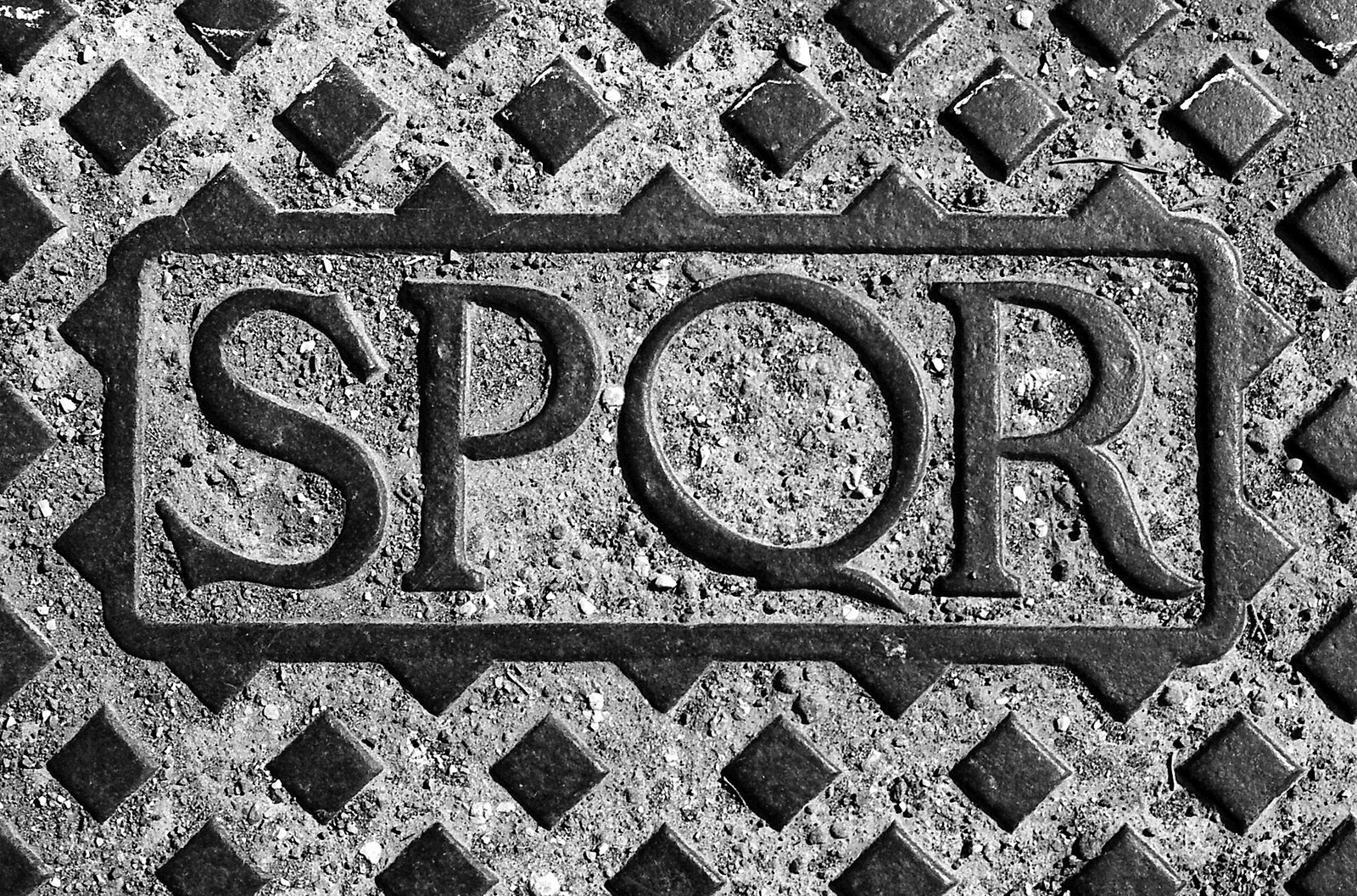
SPQR stands for the Latin Senatus Populusque Romanus, meaning “The Senate and People of Rome.” On Roman inscriptions, the letters represented the Senate and Roman people together; in the Republican context, Populus referred to the popular assembly.
One letter makes this abbreviation less straightforward than it looks: Q represents the attached Latin ending meaning “and.” If you follow the formula from Republican inscriptions to imperial coins and Rome’s municipal fountain, you can see how the same words served different political settings.
What does SPQR stand for in Latin and English?
The full Latin expression is Senatus Populusque Romanus. Its English equivalent is “The Senate and People of Rome.” The abbreviation brings together the Senate and the people in a single formula that represented the Roman state during the Republic.
The letters can be read individually. S stands for Senatus, the Senate. P stands for Populus, the people. Q represents -que, meaning “and.” R stands for Romanus, rendered as “of Rome” in the English expression.
In the Republican setting, the institutional meaning matters. Senatus referred to the Senate, while Populus referred to the popular assembly. The formula therefore named both bodies together. Reading “people” only as a general reference to Rome’s inhabitants would leave out that assembly context.
You could encounter the formula on several kinds of ancient objects. It appeared in documents announced through inscriptions on stone or metal. It also appeared in dedications on monuments and public buildings, and on some Roman coins. Its use extended beyond a single material or type of monument.
What does the letter Q represent?
Q represents -que, a Latin element attached to Populus. The resulting word, Populusque, means “and the people” within the expression. The conjunction is part of the written word, even though the abbreviation gives it a separate letter.
That explains why SPQR has four letters while Senatus Populusque Romanus has three written words. Both P and Q come from Populusque. The abbreviation separates the noun from the attached conjunction, making their different functions visible.
When you read the full phrase on an inscription, look for Populusque as one word. When you read SPQR, remember that Q supplies the connection between Senate and people. It does not introduce another institution alongside them.
What claim to political legitimacy did the Senate and Roman People express?
During the Republic, the formula represented the Roman state by naming the Senate and popular assembly together. Its political claim lay in that combined identity. The state was expressed through both institutions in the wording Senatus Populusque Romanus.
The order of the institutions was not always the familiar one. Lex dates the earliest known inscriptional example to approximately 189 BC. Its wording is Populus Senatusque Romanus: the people appear before the Senate. According to Lex, the Senate consistently comes first from the first century BC onward.
An imperial dedication shows how the formula could identify the party presenting an honour. On Trajan’s Column, the Senate and Roman people dedicate the monument to Emperor Trajan, son of the deified Nerva. They occupy the position of dedicators, while the emperor receives the dedication.
That wording gives you a precise way to understand the formula’s political role. In the Republican context, it represented the state through Senate and assembly. In the column’s imperial dedication, it named the Senate and people as the collective body addressing the ruler.
Why did SPQR remain in use under the emperors?
With Augustus’s monarchical rule, the emperor’s name and titles began replacing SPQR in official texts that expressed supreme state power. The formula’s position therefore changed as imperial authority appeared in those texts through the ruler’s own identity and titles.
Yet Senatus Populusque Romanus continued to name the state during the imperial period. This was especially true in honorary inscriptions presented to emperors. In that usage, the state could be expressed separately from the imperial office, allowing Senate and people to appear as those offering an honour.
An Augustan coin provides a dated example of the letters. The Metropolitan Museum of Art holds a gold aureus of Augustus, inventory number 99.35.6, dated to 20–19 BC. It carries SPQR alongside laurel branches surrounding a shield marked CL V.
A bronze dupondius of Trajan supplies a more explicit dedication. The Hallie Ford Museum of Art dates it to approximately AD 98–117. Its reverse reads SPQR OPTIMO PRINCIPI, expressing a dedication from the Senate and Roman people to the “best ruler.”
The same coin also carries S-C. Those letters abbreviate Senatus Consulto, meaning “by decree of the Senate.” Keeping the inscriptions separate matters: SPQR names the Senate and people, while S-C refers specifically to a senatorial decree.
How are ancient inscriptions and coins connected to its use in modern Rome?
Ancient inscriptions and coins preserve both the full expression and its abbreviation. Trajan’s Column spells out Senatus Populusque Romanus in the first line of its original dedication. The Augustan aureus and Trajan’s dupondius instead show the compact form SPQR.
Trajan’s Column was inaugurated on 12 May AD 113. Its dedication identifies the Senate and people as the dedicators. The text also states the monument’s purpose: to show the height of the hill and ground removed during the great works.
Modern Rome uses the same four letters in its municipal identity. The city’s coat of arms, officially adopted in 1884, places SPQR lettering and a gold Greek cross on a purple field. A gold crown sits above them, with five of its eight flower-shaped ornaments visible.
The fountain in Piazza della Cancelleria gives the abbreviation an everyday setting. SPQR appears on the rectangular basin into which the water flows, identifying the municipality. You can connect the inscription to an ordinary public service: the letters accompany a city fountain as well as ancient monuments and coins.
These objects share the formula, although their immediate settings differ. On Trajan’s dupondius, it belongs to an imperial dedication. On Rome’s coat of arms and the Cancelleria fountain, it identifies the modern municipality. The same abbreviation links those uses visually and verbally.
Timeline
- Around 189 BC: An early inscription recorded by Lex uses Populus Senatusque Romanus, placing the people first.
- First century BC: According to Lex, the Senate consistently takes first place in the formula.
- 20–19 BC: The Metropolitan Museum’s gold aureus of Augustus carries SPQR.
- Around AD 98–117: The Hallie Ford Museum’s Trajan dupondius carries SPQR OPTIMO PRINCIPI.
- 12 May AD 113: Trajan’s Column is inaugurated with the Senate and people’s dedication.
- 1581–1586: Ambrogio Brambilla’s print of the column abbreviates the dedication’s opening line as SPQR.
- 1884: Rome officially adopts its municipal coat of arms containing SPQR.
- 1928: Publio Morbiducci wins the municipal competition behind the SPQR fountain in Piazza della Cancelleria.
Details you won’t find in guidebooks
The familiar abbreviation can conceal a change introduced in an image of a monument. Ambrogio Brambilla’s print of Trajan’s Column, dated to 1581–1586, renders the opening formula as SPQR. The original inscription writes Senatus Populusque Romanus in full. The print and the monument therefore present the same expression in different forms.
The Trajan dupondius also combines words with a specific scene. Pax, the goddess of peace, holds a cornucopia in one hand. With the other, she sets fire to a pile of Dacian weapons. That image shares the coin with the dedication SPQR OPTIMO PRINCIPI.
The Cancelleria fountain belongs to a municipal replacement project. In 1928, Rome held a competition to replace ten small cast-iron fountains with artistic fountains. Publio Morbiducci won that competition, and the fountain in Piazza della Cancelleria is his work. Its SPQR inscription identifies the municipality on the rectangular basin.
FAQ
What does SPQR mean in English?
SPQR stands for Senatus Populusque Romanus, meaning “The Senate and People of Rome.” In the Republican context, the formula named the Senate and the popular assembly together.
What does the Q in SPQR stand for?
Q represents the Latin ending -que, meaning “and.” It attaches to Populus to form Populusque.
Why does SPQR appear on imperial coins?
The formula continued to name the state during the imperial period, especially in dedications to emperors. A bronze dupondius of Trajan carries SPQR OPTIMO PRINCIPI, a dedication from the Senate and Roman people to the “best ruler.”
Is SPQR still used in Rome?
Yes. Rome’s municipal coat of arms, officially adopted in 1884, includes SPQR. The letters also identify the municipality on the fountain in Piazza della Cancelleria.
Sources
- Wikipedia — SPQR en.wikipedia.org
- Lex — Senatus Populusque Romanus lex.dk
- The Metropolitan Museum of Art — Gold aureus of Augustus metmuseum.org
- Willamette University, Hallie Ford Museum of Art — Trajan, Bronze Dupondius library.willamette.edu
- Museo Galileo — Trajan Column museogalileo.it
- University of Chicago Library — Speculum Romanae Magnificentiae, A41 speculum.lib.uchicago.edu
- Turismo Roma — Rome in a nutshell turismoroma.it
- Turismo Roma — Fontana di Piazza della Cancelleria turismoroma.it
Image: Rome SPQR 1979-08-06.jpg — Heinrich Stürzl, CC BY-SA 4.0