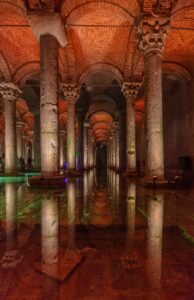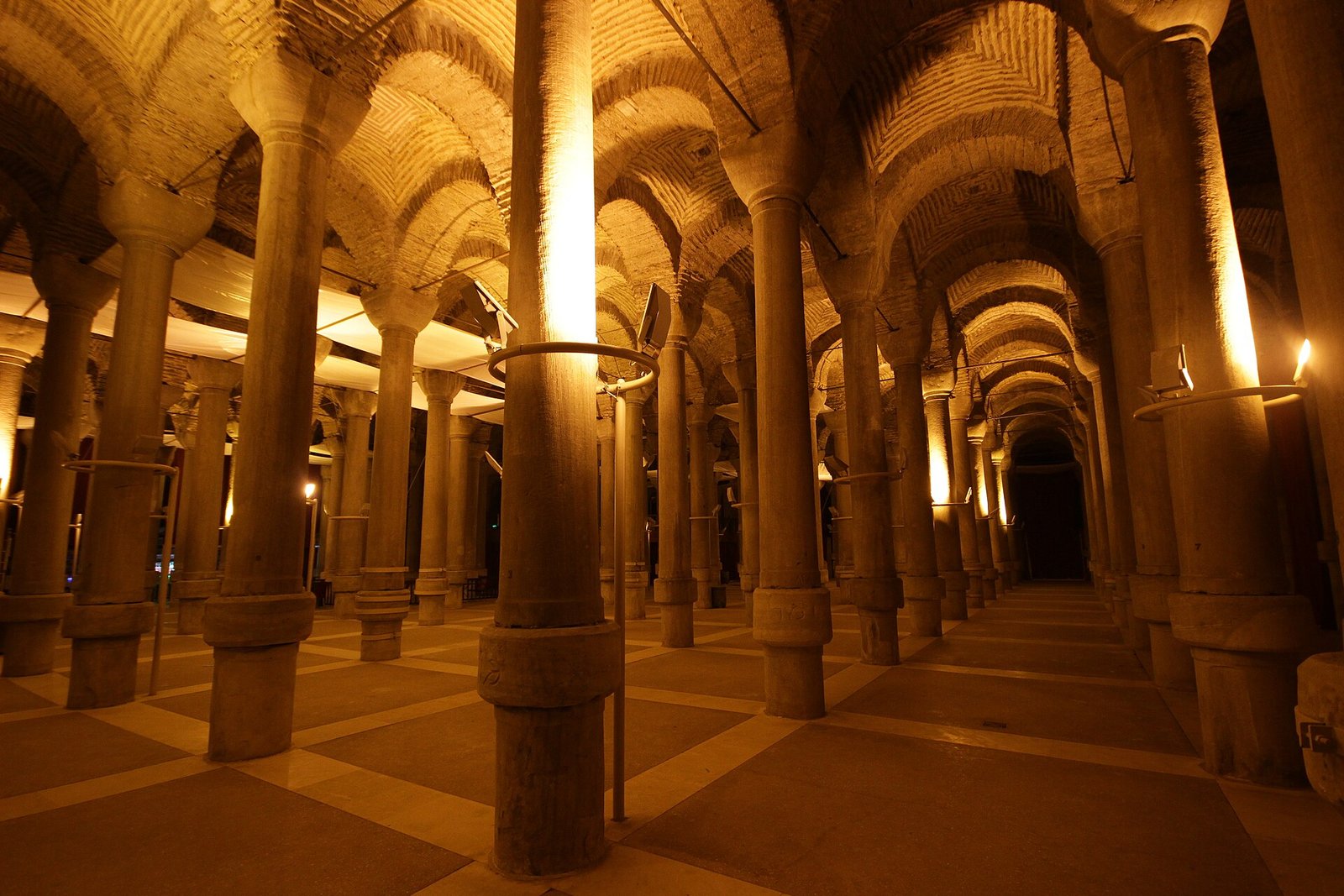
Two names, one building. Turkish speakers say Binbirdirek. English-language sources say the Cistern of Philoxenos. In Turkish it is also called the Filoksenos Cistern. If you searched for either name, you are looking for the same underground hall in Istanbul’s Sultanahmet district.
The headline claim is that it is older than the Basilica Cistern. The truth is more careful than that. This article shows what the sources agree on and where they disagree.
What is the Cistern of Philoxenos?
The cistern lies in the Fatih district of Istanbul. It is west of the ancient Hippodrome in Sultanahmet. Its address is Binbirdirek Mahallesi, İmran Öktem Caddesi No:1.
It is a covered water reservoir. The Turkish Wikipedia gives its plan as 64 by 56 metres, which makes a floor area of 3,584 square metres. English Wikipedia puts its storage capacity at about 40,000 cubic metres.
The roof rests on marble columns. English Wikipedia gives their height as 14 to 15 metres and names Marmara Island as the source of the marble. The capitals are plain. They have no carving and take the shape of a truncated pyramid.
Why is it called Binbirdirek?
Binbirdirek literally means “one thousand and one columns”. It is not a head count. English Wikipedia explains that binbir is a Turkish way of saying “very many”.
The real number is 224. The original layout had 224 marble columns in 16 rows. According to the Istanbul Metropolitan Municipality’s Visit Istanbul page, 212 of the 224 have survived.
Think of a parking garage with numbered pillars. You would never need to guess the count there, and here the real number is written down too.
Binbirdirek vs Yerebatan: two different cisterns
Many searches ask about the Cistern of Philoxenos versus the Basilica Cistern. The Basilica Cistern is known in Turkish as Yerebatan. The first fact to settle is that these are two separate structures.
The Istanbul Provincial Directorate of Culture and Tourism lists Binbirdirek as the second largest water reservoir after Yerebatan. So Yerebatan is the bigger one. Binbirdirek is the runner-up in size.
What about age? Here the sources split.
Is it really older than the Basilica Cistern?
The traditional story gives a 4th-century date. In that version, a senator of Roman origin named Philoxenos had the cistern built during the reign of Constantine I. The Directorate of Culture and Tourism repeats the tradition that it was built to supply the water needs of the Palace of Philoxenos.
The Ministry of Culture and Tourism publication Istanbul: A World Heritage Site says something different. It states that the brick stamps of Binbirdirek date its construction to the 6th century.
The Basilica Cistern was also built in the 6th century. That is the problem. If Binbirdirek belongs to the 6th century, you cannot call it clearly older than Yerebatan. If the 4th-century story is right, you can. The sources have not settled this.
So here is a safe way to phrase it. Binbirdirek may be older, but the claim is not proven. The 4th-century date is a tradition. The 6th-century date rests on brick stamps.
Timeline
- 4th century: Tradition ties the building to the senator Philoxenos under Constantine I. This dating is disputed.
- 6th century: Istanbul: A World Heritage Site dates the brick stamps to this century.
- 19th century: The dark interior is used as a silk workshop.
- 17 September 2026: The Passo visit listing shows a local ticket at 165 TL, a student or teacher ticket at 82.50 TL and a foreign visitor ticket at 660 TL.
Cistern of Philoxenos tickets and price
Tickets are sold through Passo. The listing for 17 September 2026 shows three prices:
- Local visitor: 165 TL
- Student or teacher: 82.50 TL
- Foreign visitor: 660 TL
You can buy entry tickets online. The Passo notice for 2026 also says that MüzeKart is not valid at Binbirdirek. If you plan to use a museum pass, do not count on it here.
Some visitors enter free with ID. Passo’s 2026 conditions name two groups. These are local and foreign children under 10, and local visitors over 65.
Prices change, so confirm the current figure on Passo before you travel.
Opening hours and how to get there
The Ministry of National Education’s out-of-school learning record lists visiting hours of 10:00 to 17:00, seven days a week. Plan your visit inside that window.
The cistern is in Sultanahmet, west of the old Hippodrome. Use the address above in your map app: Binbirdirek Mahallesi, İmran Öktem Caddesi No:1, Fatih.
Cistern of Philoxenos vs Basilica Cistern: how they compare
| Binbirdirek (Philoxenos) | Yerebatan (Basilica) | |
|---|---|---|
| Rank by size | Second largest | Largest |
| Original columns | 224 in 16 rows | Not covered here |
| Columns surviving | 212 | Not covered here |
| Date | 4th century by tradition, 6th by brick stamps | 6th century |
The table shows the main point. Binbirdirek is not a smaller copy of Yerebatan. It has its own plan, its own column system and its own disputed date.
Photos: what to look for
A wide shot of the column rows is the obvious picture. A few details make better photographs.
- The plain capitals. They are truncated pyramids with no carving.
- The joints in the shafts. Each support is built in two parts. More on that below.
- The excavated section. The central area with four columns shows the original height.
- Carved Greek letters. They appear on some columns and capitals.
The building also hosts events. The cistern’s own site says weddings, receptions, exhibitions, launches and fashion shows can be held there. The Visit Istanbul page adds concerts, exhibitions and private events. On some days the hall may look different from a plain visit.
Details you won’t find in guidebooks
The supports are two columns stacked. Binbirdirek’s supports are not single pieces of stone. Each one is made of two column shafts placed one on top of the other.
Marble rings and lead sheets hold the joints. Projecting circular marble rings sit between the stacked shafts. At the joints there are layers of lead. Think of a rubber ring between two pipe sections in your kitchen. The idea is similar: something soft and tight where two hard parts meet.
Greek letters are workers’ marks. Letters carved into the columns and capitals are explained as marks left by the stonemasons who worked on the building.
One section lets you see the true height. In the middle, a section with four columns has been excavated. The floor above it was raised. The dug-out part lets you see the lower portions of the columns and the original height.
It was a silk workshop. Istanbul: A World Heritage Site records that in the 19th century the dark interior served as a silk workshop. A water tank turned into a place for making cloth.
Ownership. When that publication appeared, the cistern belonged to the General Directorate of Foundations (Vakıflar Genel Müdürlüğü).
FAQ
Is the Cistern of Philoxenos the same as the Basilica Cistern?
No. Binbirdirek (the Cistern of Philoxenos) and Yerebatan are separate buildings. The Istanbul Provincial Directorate of Culture and Tourism presents Binbirdirek as the second largest water reservoir after Yerebatan.
Is the Cistern of Philoxenos in İzmir?
No. It stands in the Fatih district of Istanbul, in Sultanahmet, west of the ancient Hippodrome. The address is Binbirdirek Mahallesi, İmran Öktem Caddesi No:1.
How much is a ticket to the Cistern of Philoxenos?
In the Passo listing for 17 September 2026, a local ticket is 165 TL, a student or teacher ticket is 82.50 TL and a foreign visitor ticket is 660 TL. Check Passo again before you go, because prices can change.
Does the Museum Pass work at Binbirdirek?
No. Passo’s 2026 visit notice says MüzeKart is not valid here. You can buy entry tickets online.
How many columns does the cistern have today?
The original layout had 224 marble columns in 16 rows. According to the Istanbul Metropolitan Municipality’s tourism page, 212 of them survive.
Sources
- Türkçe Vikipedi — Binbirdirek Sarnıcı tr.wikipedia.org
- English Wikipedia — Cistern of Philoxenos en.wikipedia.org
- İstanbul İl Kültür ve Turizm Müdürlüğü — Sarnıçlar-Kemerler istanbul.ktb.gov.tr
- Kültür ve Turizm Bakanlığı — İstanbul: A World Heritage Site teda.ktb.gov.tr
- Binbirdirek Sarnıcı — official site binbirdirek.com.tr
- İBB Visit Istanbul — Cistern of Philoxenos visit.istanbul
- Passo — Binbirdirek Sarnıcı venue page ssrprod.passo.com.tr
- MEB — Okul Dışı Öğrenme Ortamları okuldisiogrenme.eba.gov.tr
Image: Cistern of Philoxenos.JPG — Bollweevil, CC BY-SA 3.0