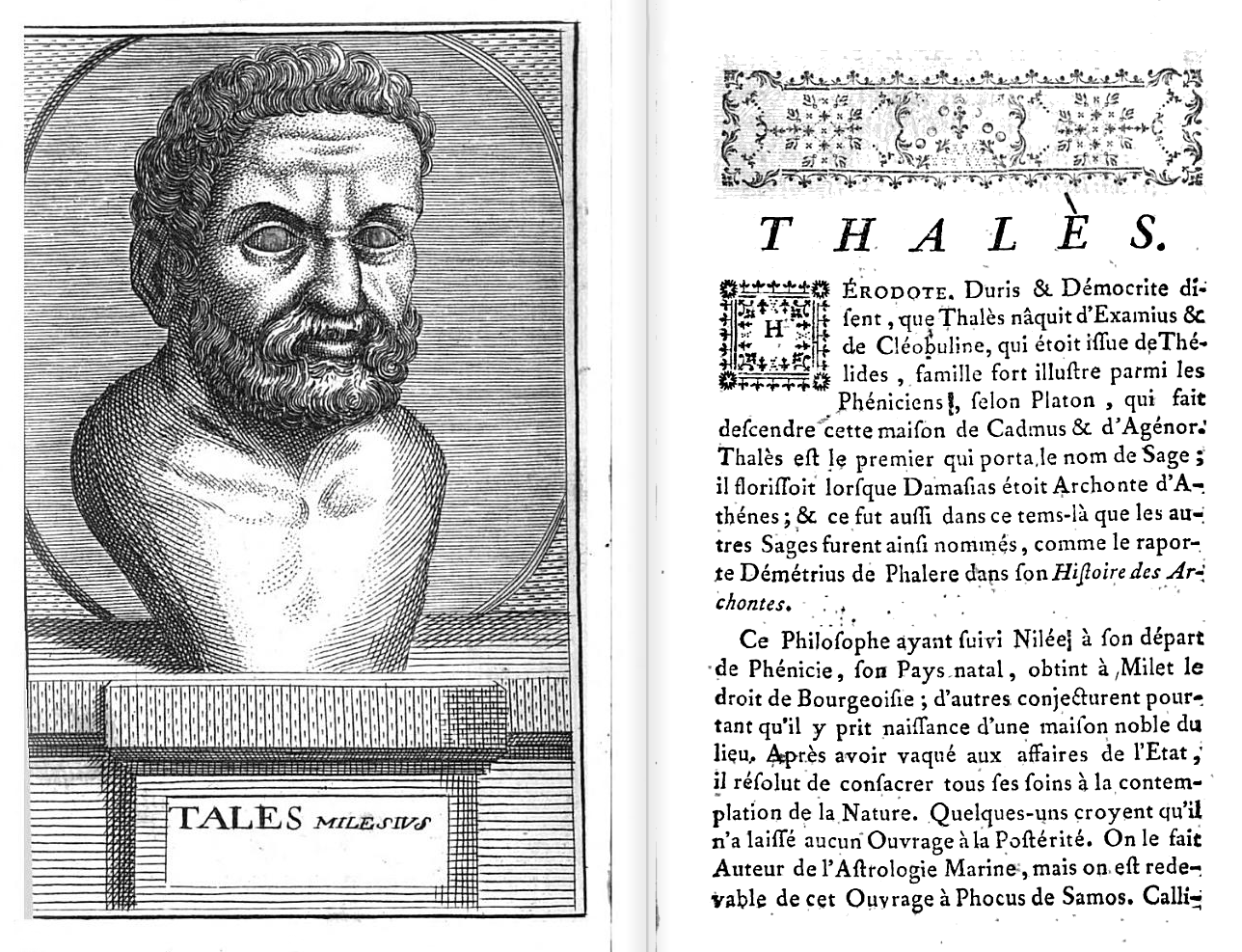
Thales of Miletus was a pre-Socratic Greek philosopher who lived in the Ionian city of Miletus during the late seventh and sixth centuries BCE. He identified water as nature’s starting principle and is associated with contributions to geometry, astronomy, and the study of magnets.
How does a thinker associated with water also become linked to triangles and an eclipse? If you are visiting Miletus or studying early philosophy, those connections offer a useful route through his story. His reputation rests on philosophical ideas, mathematical traditions, and accounts written by later authors.
Where was Thales of Miletus born, and where did he live?
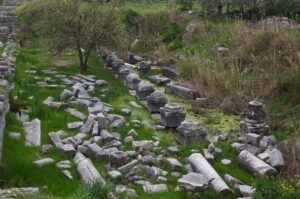
Thales was born in Miletus. The ancient city lies near Balat, in the Didim district of Aydın, Turkey. Miletus was part of Ionia, and it was the setting for the early natural philosophers Thales, Anaximander, and Anaximenes.
These thinkers are associated with the Milesian school. Thales also belonged to the Seven Sages of ancient Greek tradition. His place in that tradition connects his reputation for wisdom with his standing as an early investigator of nature.
For travelers to Turkey, the geographical connection is direct. The Miletus associated with Thales is the ancient city near modern Balat. MacTutor also records Miletus as his place of death.
Thales of Miletus: date of birth and death
Thales’ exact life dates are uncertain. One commonly given range places his birth around 626–623 BCE and his death around 548–545 BCE. The University of St Andrews’ MacTutor biography instead uses approximately 624–547 BCE.
Those estimates place him in the late seventh and sixth centuries BCE. You should read the dates as approximate markers. Choosing a single year without qualification would make his biography appear more precise than the surviving accounts support.
A later story recorded by Diogenes Laertius says Thales died from heat and thirst while watching games. It belongs to the tradition surrounding his death, rather than providing a secure account of his final moments.
Thales of Miletus pronunciation
The English pronunciation of Thales is /ˈθeɪliːz/, which can be rendered as “THAY-leez.” His ancient Greek name is written Θαλῆς. The stress falls on the first syllable in the English pronunciation.
Thales of Miletus’ philosophy: why water?
Aristotle regarded Thales as the first philosopher to investigate nature’s fundamental principles. In the theory Aristotle attributes to him, water is the arche: the beginning or underlying principle of everything. Water therefore occupies a foundational role in his explanation of nature.
The water theory concerns all things, rather than water as one substance among others. That is the central philosophical claim associated with Thales. It gives a single starting principle to the variety of things found in the world.
A related cosmological theory attributed to Thales holds that Earth floats on water. This is a separate claim about Earth’s position and support. Together, the two ideas show how broadly water figured in the explanations attached to his name.
The Oxford Classical Dictionary notes parallels with Egyptian and Babylonian creation myths. Water’s importance in Thales’ thought therefore has counterparts in those traditions. His theory should not be presented as an idea without any earlier cultural parallels.
The distinction between Thales and his interpreters matters here. Aristotle reports the water theory, while none of Thales’ own works survives. His philosophy reaches readers through later accounts of what he believed.
What were Thales’ contributions to mathematics?
Thales’ name is attached to two geometrical results. The circle theorem says that a triangle formed by joining the endpoints of a diameter to a third point on the circle has a right angle at that third point. That angle measures 90°.
If you draw this construction, the diameter forms the side opposite the right angle. The third point must lie on the circle. These details define the theorem and explain what the familiar phrase “an angle in a semicircle” refers to.
The name Thales’ theorem is also used for the intercept theorem. This concerns parallel lines crossing the arms of an angle. The resulting triangles are similar, and their corresponding lengths are proportional. It is a different result from the circle theorem.
Later ancient sources attribute several other propositions to Thales. They include the claim that a diameter divides a circle into two equal parts. They also include the equality of the base angles of an isosceles triangle and the equality of vertically opposite angles.
Whether Thales developed formal geometrical proofs remains disputed. Van der Waerden defended that view. Bertrand Russell argued that there was no evidence for proofs of the deductive kind found in later Greek mathematics. Attributing a proposition to Thales does not settle how he established it.
The circle theorem appears in Book III, Proposition 31, of Euclid’s Elements, written around 300 BCE. Its inclusion there documents the proposition in that later mathematical work. It does not, by itself, establish the details of Thales’ own reasoning.
How did Thales measure a pyramid?
Accounts of Thales measuring a pyramid preserve different methods. Hieronymus describes using the moment when an object and its shadow have equal lengths. Plutarch describes comparing the shadows of a stick and a pyramid through their proportions.
Both versions connect geometry with a practical measurement problem. The distinction lies in the procedure: one depends on equal lengths at a particular moment, while the other depends on ratios. The two accounts should therefore remain separate when explaining the story.
Astronomy and the eclipse prediction
Herodotus reports that Thales predicted a solar eclipse associated with 28 May 585 BCE. In his account, the eclipse stopped fighting between the Medes and the Lydians. This is one of the most prominent episodes attached to Thales’ astronomical reputation.
The prediction itself is disputed. James Longrigg suggested that it may have been attributed to Thales after the event. The eclipse story therefore needs two parts: Herodotus’ report and the qualification that Thales’ advance prediction is contested.
Other traditions connect Thales with timekeeping and navigation. Diogenes Laertius credits him with dividing the year into 365 days, although the Egyptians already knew that year length. A tradition reported by Callimachus says he advised Milesian sailors to navigate using Ursa Minor.
Thales of Miletus and electricity
Thales is sometimes credited with first observing amber’s electrostatic attraction. Caley and Richards challenge that attribution. They describe it as indirect and point out that the relevant passage in Aristotle does not mention amber.
A different account concerns a magnet. According to Aristotle’s report, Thales regarded the magnet as possessing a soul because it moved iron. This is a claim about motion and animation. It should be distinguished from the disputed story about amber’s electrical attraction.
Thales of Miletus’ books and quotes
No work attributed to Thales survives. Ancient sources mention texts titled On the Solstice and On the Equinox. Those titles belong to the record of works associated with him, but they cannot be read today as surviving books by Thales.
The saying “Know yourself” is also attributed to him, but its authorship is disputed. Diogenes Laertius records that Antisthenes assigned the same saying to Phemonoe. It is therefore better treated as a contested attribution than as a securely documented quotation from Thales.
Timeline
- Around 626–623 BCE: Estimated birth of Thales in Miletus.
- 28 May 585 BCE: Date associated with the solar eclipse that Herodotus says Thales predicted.
- Around 548–545 BCE: Estimated period of Thales’ death.
- Around 300 BCE: Euclid’s Elements includes the proposition that the angle subtended by a diameter is a right angle.
Details you won’t find in guidebooks
Aristotle’s Politics tells a business story about Thales. He rented olive presses in Miletus and Chios in advance, then earned money by renting them out during the harvest. For an everyday-life connection, think about paying early to secure something you expect people to need later: advance rental is the mechanism in this account.
Plato’s Theaetetus, at 174a, tells of Thales falling into a well while looking at the stars. The episode places his astronomical interest inside a story about an immediate mishap. It is an anecdote preserved by Plato, rather than a securely established incident.
Herodotus also associates Thales with a political proposal. He says Thales urged the Ionian cities to form a common political union centered on Teos. This tradition extends his interests beyond the natural and mathematical questions usually attached to his name.
What does a picture of Thales show?
One widely reproduced bust of Thales is a Roman copy dating to the second century CE. If you encounter that image, its date matters. It is a later representation of the philosopher, rather than a portrait made during his lifetime.
FAQ
Where was Thales of Miletus born?
Thales was born in Miletus, an ancient Ionian city near present-day Balat in the Didim district of Aydın, Turkey.
What was Thales’ water theory?
According to Aristotle’s account, Thales regarded water as the underlying principle, or arche, of all things. A cosmological theory attributed to him also held that Earth floated on water.
What did Thales contribute to mathematics?
Thales is associated with geometrical propositions about circles, triangles, and angles. His name is attached to both the right-angle theorem for a triangle drawn on a circle’s diameter and the intercept theorem involving parallel lines and proportional lengths.
Did Thales discover electricity?
The claim that Thales first observed amber’s electrostatic attraction is disputed. Caley and Richards describe the attribution as indirect and note that the relevant passage in Aristotle does not mention amber.
Sources
- Vikipedi — Thales tr.wikipedia.org
- University of St Andrews, MacTutor — Thales of Miletus mathshistory.st-andrews.ac.uk
- Wikipedia — Thales of Miletus en.wikipedia.org
- Wikipedia — Miletus en.wikipedia.org
- Internet Encyclopedia of Philosophy — Thales of Miletus iep.utm.edu
- Oxford Classical Dictionary — Thales of Miletus academic.oup.com
- Wikipedia — Thales’s theorem en.wikipedia.org
- J. Paul Getty Museum — The Properties of Amber getty.edu
Image: Thalès from Lives 1761.png — Flappiefh, CC0