Where is Göbekli Tepe in Turkey?
Göbekli Tepe sits in Şanlıurfa province in southeastern Turkey. The site belongs to the Haliliye district and lies near the village of Örencik. If you see the Turkish phrase “göbekli tepe nerede”, it simply means “where is Göbekli Tepe”. The answer is the same: Şanlıurfa.
UNESCO records the exact position as 37°13′23.671″ north and 38°55′20.51″ east. You can paste those coordinates into any map app. The Turkish Ministry of Culture and Tourism also keeps an official page for the site with direct links to Google, Apple and Yandex maps, plus photographs of the enclosures and pillars.
How old is Göbekli Tepe?
The “12,000 years old” line is a rounded figure. UNESCO dates the monumental buildings to between 9600 and 8200 BC. A study by Gresky and Clare published in 2026 sets the full occupation sequence at roughly 9600 to 8000 BC. That span runs from the Pre-Pottery Neolithic A into the early and middle phases of Pre-Pottery Neolithic B.
The start date of about 9600 BC is what becomes “12,000 years” in headlines. What matters more is who built it. UNESCO describes the structures as the work of hunter-gatherers in the 10th and 9th millennia BC. The site is listed as outstanding evidence for how those groups organised themselves and what they believed.
How Göbekli Tepe was found
The mound was first recorded in 1963 during a joint surface survey by Istanbul University and the University of Chicago. Nothing much followed for three decades.
In 1994 the German archaeologist Klaus Schmidt recognised the importance of the monumental remains and pushed for the site to be examined again. Excavations began in 1995 as a joint effort of the Şanlıurfa Museum and the German Archaeological Institute. In 2018 UNESCO added Göbekli Tepe to the World Heritage List as a cultural site under criteria i, ii and iv.
The Göbekli Tepe temple: what you actually see
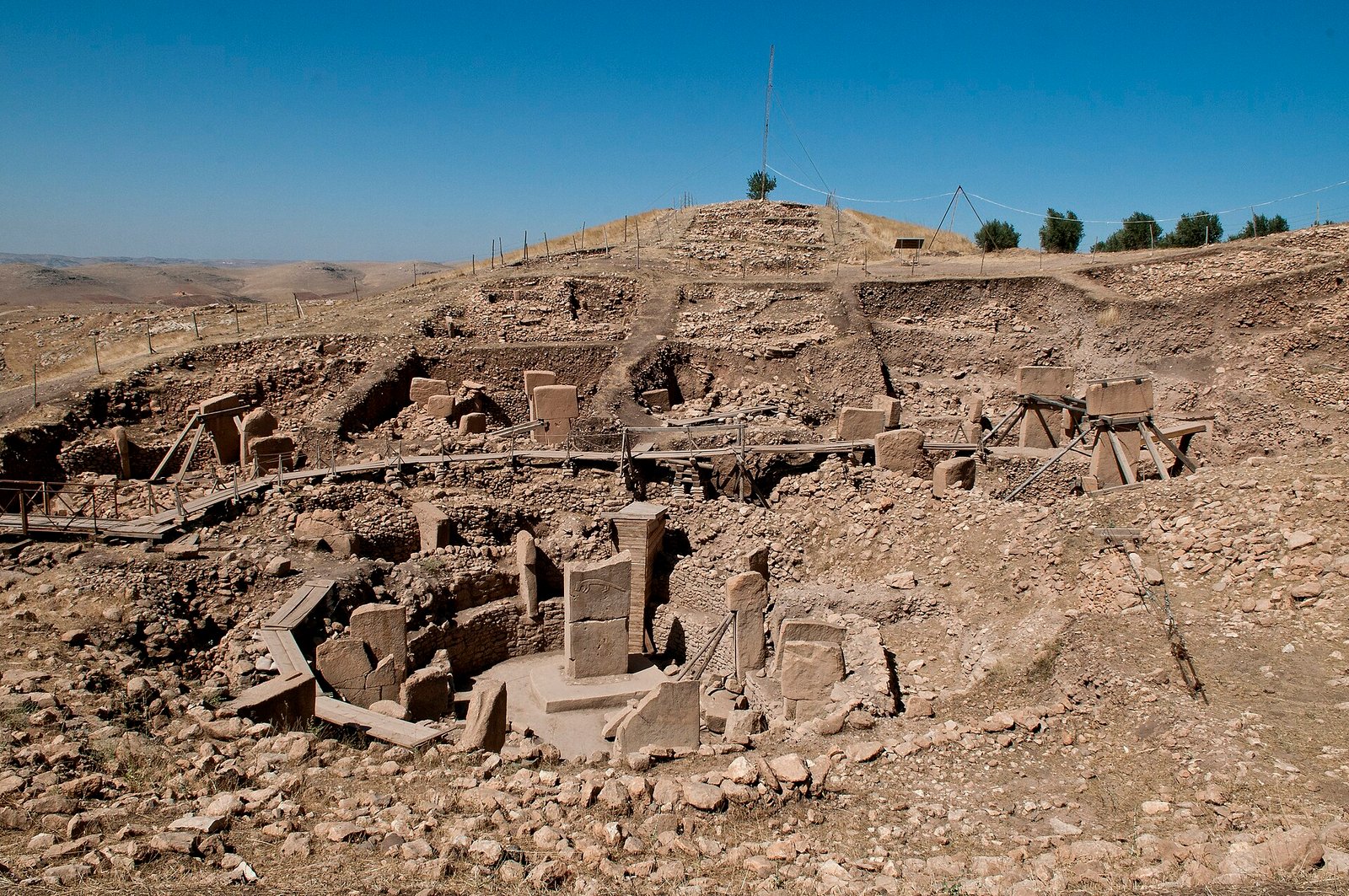
The mound measures about 300 metres across and rises 15 metres. The best-known structures inside it are circular enclosures. Each ring holds around 10 to 12 T-shaped pillars, with two taller pillars standing in the centre. The central pillars are single blocks of limestone that reach 5.5 metres in height.
Some of these T-pillars are not plain posts. Carved arms, hands and items of clothing run across their surfaces. Because of these details, archaeologists interpret the pillars as stylised human figures. When you stand in front of one, you are looking at a body, not a column.
Göbekli Tepe carvings
Animals dominate the reliefs. They show foxes, snakes, wild boar, scorpions and birds. Headless human figures appear as well.
The stone was not always bare grey. On 30 September 2023 the Ministry announced a life-size limestone statue of a wild boar found in Building D. It still carried traces of red, white and black pigment. That single find changes how you should picture the enclosures in use.
Temple or village? The debate
For years Göbekli Tepe was read as a ritual centre with no permanent settlement. The 2026 research by Gresky and Clare challenges that picture. It points to houses, everyday activities and burials beneath floors, and argues that the site also functioned as a settlement.
Research published on 22 September 2026 documented two sub-floor burials at the site. One was excavated in 2017. The other was excavated in 2022.
A second old idea is also under review. The enclosures were long thought to have been deliberately filled in as a ritual act when they went out of use. Current research stresses the role of erosion and slope slides from higher parts of the mound in filling them.
There is an everyday-life clue here too. A 2019 PLOS ONE study examined 7,268 grinding tools from the site and found that cereal processing was one of the important activities there. The next time you scoop flour in your kitchen, you are repeating a task that was already routine on this hill.
Timeline
- About 9600 BC Pre-Pottery Neolithic settlement and monumental building begin at Göbekli Tepe.
- About 8000 BC End of the Neolithic occupation sequence identified by current research.
- 1963 Istanbul University and the University of Chicago record the site during a joint survey.
- 1994 Klaus Schmidt recognises the archaeological importance of the site.
- 1995 Excavations begin.
- June 2016 Work starts on the protective roof.
- 2017 Study of three modified skulls is published; one of the sub-floor burials is excavated.
- 2018 Göbekli Tepe is inscribed on the UNESCO World Heritage List.
- 15 November 2018 Roof renovation is completed and limited visiting hours are lifted.
- 2019 The study of 7,268 grinding tools is published.
- 2022 The second sub-floor burial is excavated.
- 30 September 2023 The Ministry announces the pigment-bearing wild boar statue from Building D.
- 22 September 2026 Research documenting the two sub-floor burials is published.
Details you won’t find in guidebooks
- Carved skulls. A paper published in 2017 described fragments of three human skulls with deliberate deep grooves. One also had a drilled hole.
- Pillars with sleeves. The arm, hand and clothing reliefs on certain T-pillars are the reason they count as human figures rather than architecture.
- A grain-processing site. The 7,268 grinding tools studied in 2019 point to large-scale cereal work, not only ceremony.
- Paint survived. The wild boar statue from Building D kept red, white and black pigment for more than ten thousand years.
- Burials under floors. Two sub-floor burials, dug in 2017 and 2022, were documented in 2026 and support the idea that people lived here.
How to pronounce Göbekli Tepe
English Wikipedia gives the Turkish pronunciation in IPA as [ɟœbecˈli teˈpe]. The stress marks fall before the final syllables of both words. The name translates to “Potbelly Hill” in English.
Visiting Göbekli Tepe: hours, tickets and transport
As of 24 October 2026, the Ministry lists the site as open every day from 08:30 to 17:30, with the ticket office closing at 17:00. Foreign visitors pay 20 euros according to the official DÖSİMM price list. Holders of a Turkish ID card enter with MüzeKart. The Göbeklitepe Canlandırma Merkezi is listed separately at 3 euros for foreign visitors.
For public transport, Kültür Portalı points to municipal buses leaving from the Abide stop in central Şanlıurfa. Part of the portable finds from the excavations is displayed at the Şanlıurfa Archaeology Museum in the city, so plan time for both.
The protective roof above the enclosures was begun in June 2016. A roof renovation in 2018 forced restricted visiting hours, and those limits were lifted when the work finished on 15 November 2018.
Göbekli Tepe documentary
TRT Belgesel produced a documentary titled Gizemli Tarih: Göbeklitepe.
FAQ
Where is Göbekli Tepe?
Göbekli Tepe is in Şanlıurfa province in southeastern Turkey, in the Haliliye district near the village of Örencik. UNESCO lists its coordinates as 37°13′23.671″ N, 38°55′20.51″ E.
How old is Göbekli Tepe?
UNESCO dates the monumental buildings to 9600–8200 BC. A 2026 study by Gresky and Clare places the full occupation at roughly 9600–8000 BC. The common ‘12,000 years old’ figure is a rounded version of that start date.
Sources
- UNESCO World Heritage Centre — Göbekli Tepe whc.unesco.org
- Gresky and Clare, 2026 — PLOS ONE pmc.ncbi.nlm.nih.gov
- Gresky, Haelm and Clare, 2017 — Science Advances pmc.ncbi.nlm.nih.gov
- Dietrich et al., 2019 — Cereal processing at Early Neolithic Göbekli Tepe, PLOS ONE journals.plos.org
- Ministry of Culture and Tourism — Göbeklitepe Örenyeri muze.gov.tr
- Ministry of Culture and Tourism DÖSİMM — Şanlıurfa dosim.ktb.gov.tr
- Ministry of Culture and Tourism DÖSİMM — Museum and Site Fees dosim.ktb.gov.tr
- Ministry of Culture and Tourism — Tarihin Sıfır Noktasında İlk Boyalı Heykel Bulundu engelsiz.ktb.gov.tr
- Kültür Portalı — Göbeklitepe Nerededir? kulturportali.gov.tr
- Anadolu Ajansı — Göbeklitepe tüm gün ziyaret edilebilecek aa.com.tr
- English Wikipedia — Göbekli Tepe en.wikipedia.org
- Turkish Wikipedia — Göbeklitepe tr.wikipedia.org
- TRT Belgesel — Gizemli Tarih: Göbeklitepe trtbelgesel.com.tr
- Ministry of National Education — Göbeklitepe Anadolu Lisesi gobeklitepeanadolulisesi.meb.k12.tr
Image: Göbekli Tepe, Urfa.jpg — Teomancimit, CC BY-SA 3.0