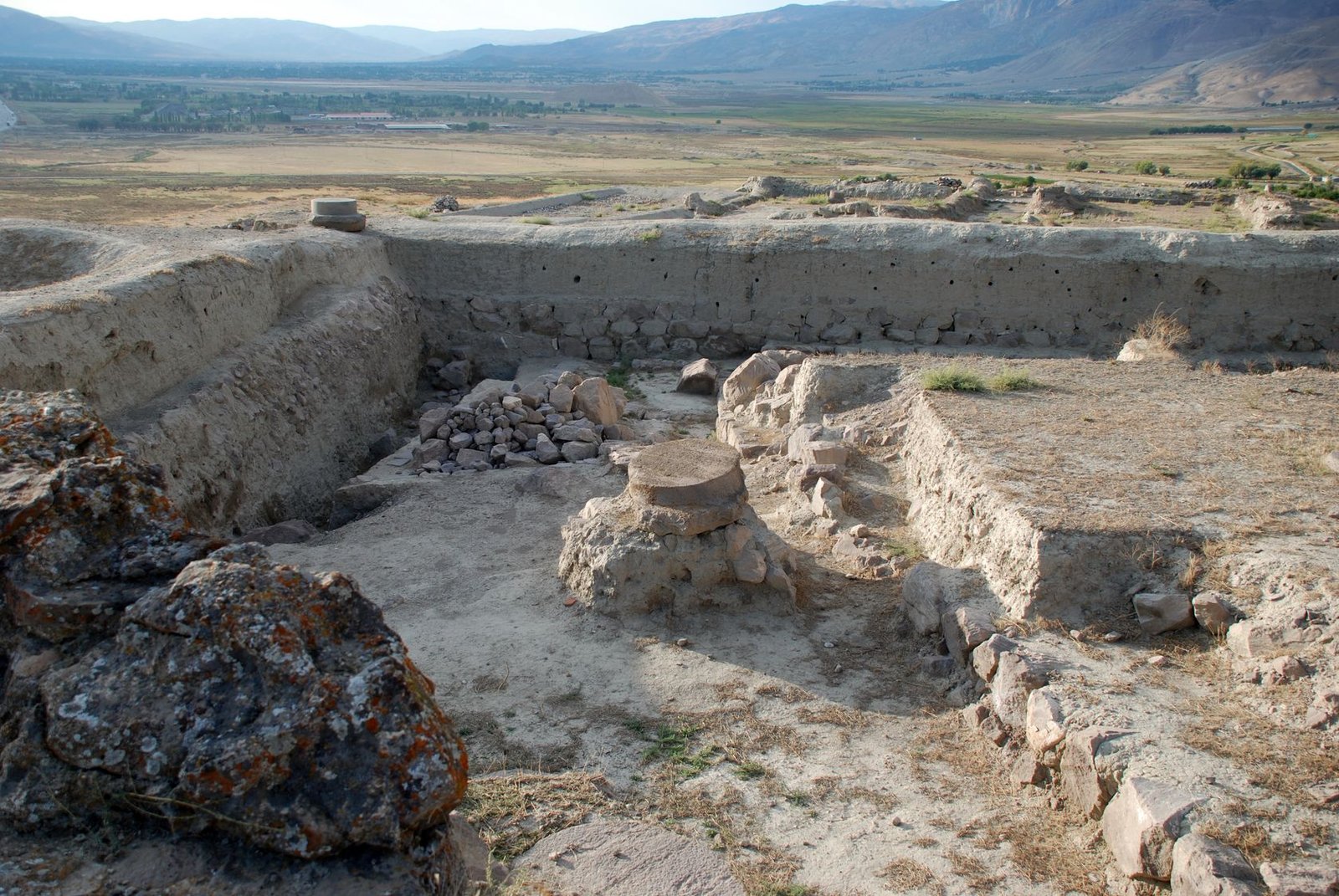
Excavations at Altıntepe uncovered an Urartian temple-palace complex, two defensive walls, a columned reception hall, food stores, residential remains and three underground tombs. Finds include stone sarcophagi, ivory objects, helmets, shields, pottery, wall paintings and inscribed bronze objects. Drains, a kitchen wastewater channel and a stone toilet also preserve evidence of everyday life.
How did these buildings fit together? At Altıntepe, a temple stood within a colonnaded courtyard, while underground tombs occupied a terrace on the southern slope. You can follow that arrangement from the fortified complex to the burial chambers, then turn to the [evidence of everyday life](#everyday-life-storage-kitchens-and-drains): storage jars, kitchen connections and wastewater systems.
Where is Altıntepe?
Altıntepe is an Urartian fortress and temple settlement in Üzümlü district, Erzincan province, in eastern Anatolia. Its remains occupy a natural volcanic hill rising about 60 metres above the plain. That elevated setting places the temple, defensive walls and other excavated buildings above the surrounding ground.
The Erzincan Provincial Directorate of Culture and Tourism places Altıntepe 15 kilometres from the city centre. It lies 100 metres north of the Erzincan–Erzurum road. If you are locating the archaeological site, the useful geographical connection is Erzincan’s Üzümlü district.
What did excavations reveal inside the fortress?
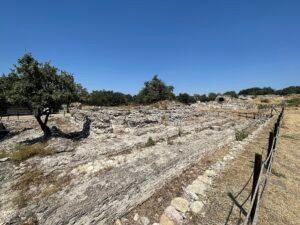
Two enclosing defensive walls protected the temple-palace complex. Excavations also exposed residential remains, a columned reception hall, an open-air sanctuary, three tombs and a storage building. The architectural discoveries therefore cover religious space, reception rooms, burial places and facilities for keeping provisions.
Scientific excavations under Tahsin Özgüç ran from 1959 to 1968. A second excavation campaign began in 2003 under Mehmet Karaosmanoğlu. The third underground tomb was among the discoveries of the first campaign, appearing in September 1959.
The columned reception hall is also described as an apadana. Its early phase included a kitchen with a wastewater channel. That connection gives you a practical detail to place alongside the hall’s columns: food preparation had its own route for draining wastewater beyond the defensive wall.
How was the Urartian temple built?
The temple stood within a colonnaded courtyard measuring 27.20 by 30 metres. Its square central building measured 13.80 by 13.80 metres externally. Inside was the cella, or sacred chamber, measuring 5.20 by 5.20 metres.
These measurements distinguish three parts of the religious complex. There was the surrounding courtyard, the square temple building and the smaller sacred room within it. You can use those dimensions to understand the building’s arrangement without treating the entire enclosure as a single room.
The entrance was in the southeastern wall. Two steps led up to it, with stone bases on either side for erecting spears. The doorway therefore had a specific architectural setting: steps at the approach and paired fittings beside them.
The temple walls combined worked stone and mudbrick. Three courses of carefully dressed stone supported the mudbrick construction above. Stone foundations and mudbrick upper walls were separate elements of the same building.
What was found in the underground tombs?
Three underground tombs stood on a cemetery terrace along the hill’s southern slope. Their walls were built from carefully worked stone. Two were exposed through illicit digging; the third was uncovered during Tahsin Özgüç’s scientific excavations.
The third tomb contained three chambers. In the second chamber, excavators found two stone sarcophagi. One stood before a short wall, while the other stood before a long wall. Their recorded positions preserve a concrete detail of how the burial room was arranged.
In her 1965 examination, Refakat Çiner dated this third tomb to the late eighth to early seventh century BCE. That dating applies specifically to the tomb.
The underground chambers and stone sarcophagi form the clearest architectural evidence for burial at Altıntepe. Beside the tombs, a separate open-air sanctuary adds another element to the cemetery’s layout: an area furnished with four standing stones.
What were the four standing stones beside the tombs?
An open-air sanctuary lay east of the first tomb. It measured 7.75 by 11.70 metres. Within it were four stone stelae, each mounted on a base, with curved tops.
Each stele measured 2.30 metres high and 0.50 metres wide. Their height, narrow shape and individual bases are recorded features of the sanctuary. Together, the four stones formed a different architectural arrangement from the enclosed sacred chamber of the main temple.
Karaosmanoğlu and Korucu associate this sanctuary with a cult of the dead. That is an archaeological interpretation of the four-stela setting beside the tombs. The distinction matters: the stones and their location are physical discoveries, while their connection with funerary worship is the researchers’ explanation.
Everyday life: storage, kitchens and drains
The storage building’s northern room contained 60 large provision jars. They stood in ten rows of six, buried in the floor up to their shoulders. The count and arrangement reveal an ordered storage space, with the jars set into the ground rather than standing entirely above it.
These large jars are also called pithoi. Some carried incised hieroglyphs and raised crescent motifs. Storage vessels at Altıntepe therefore preserve both practical arrangements inside a building and markings on the vessels themselves.
Two sewer systems were identified, running eastward and westward. One channel began southwest of the temple. In a trapezoidal courtyard, it became a main drain measuring 40 centimetres wide and 50 centimetres deep.
The kitchen belonging to the apadana’s early phase had a wastewater channel connected to the main sewer outside the defensive wall. This is a direct everyday-life link between an interior activity and the settlement’s infrastructure: wastewater from the kitchen entered a drainage route beyond the fortification.
A courtyard west of the temple complex contained a stone squat toilet. Its dimensions were 88 by 66 centimetres. Alongside the kitchen channel and the two sewer systems, it provides specific evidence for sanitation within the settlement.
A separate stone above the main drain measured 80 by 65 centimetres. It had a central hole 13 centimetres across. A researcher interpreted it as a possible bathing stone; the proposed function remains an interpretation of that particular find.
Which objects were found at Altıntepe?
Finds dated to the eighth century BCE include ivory objects, metal items, helmets, shields, ceramics and wall paintings. These discoveries add portable objects and interior decoration to the evidence supplied by walls, chambers and courtyards.
Bronze objects bearing cuneiform inscriptions carry the names of Urartian kings. Here, writing survives on excavated metalwork. The inscribed bronzes form another part of the material record alongside the ivory pieces, pottery and painted wall remains.
A bull-headed cauldron, gold buttons, earrings and furniture fittings from Altıntepe are displayed at the Museum of Anatolian Civilizations in Ankara. For you, these objects provide a connection between the excavated settlement near Erzincan and its museum displays in Ankara.
Details you won’t find in guidebooks
The temple had bronze disks placed in sockets cut into foundation stones at all four corners. Each disk measured 8 centimetres in diameter and 0.8 centimetres thick. These small metal pieces belonged to the building’s foundations.
The third tomb was discovered in September 1959 only 1.50 metres below the surface soil. That shallow depth is a precise detail of its discovery, separate from the arrangement of its three chambers and two sarcophagi.
Some storage jars combine incised hieroglyphs with raised crescent decoration. These marks occur on vessels in a building whose northern room held 60 jars in regular rows. The details connect individual objects with their excavated storage setting.
Timeline
- Late eighth–early seventh century BCE: Refakat Çiner’s dating for the third chamber tomb.
- 1959: Scientific excavations began under Tahsin Özgüç. The third tomb was discovered in September.
- 1968: The first excavation campaign ended.
- 2003: The second campaign began under Mehmet Karaosmanoğlu.
FAQ
What was found at Altıntepe?
Excavations uncovered a temple-palace complex, two defensive walls, a columned reception hall, three underground tombs, storage buildings and residential remains. Finds also include ivory objects, metalwork, helmets, shields, pottery and wall paintings.
Where is the archaeological site of Altıntepe?
Altıntepe is in Üzümlü district, Erzincan province, in eastern Anatolia. The provincial culture and tourism directorate places it 15 kilometres from Erzincan city centre and 100 metres north of the Erzincan–Erzurum road.
What was inside Altıntepe’s third tomb?
The third tomb has three chambers. Its second chamber contained two stone sarcophagi, one positioned before a short wall and the other before a long wall.
What evidence of everyday life survives at Altıntepe?
Finds include 60 food-storage jars in a storeroom, a kitchen wastewater channel, two sewer systems and a stone squat toilet. These remains show arrangements for storing provisions and removing wastewater.
Where are some objects from Altıntepe displayed?
A bull-headed cauldron, gold buttons, earrings and furniture fittings from the excavations are displayed at the Museum of Anatolian Civilizations in Ankara.
Sources
- Wikipedia — Altıntepe en.wikipedia.org
- Erzincan Provincial Directorate of Culture and Tourism — Müzeler ve Örenyerleri erzincan.ktb.gov.tr
- Karaosmanoğlu and Korucu — Erzincan Altıntepe Kalesi dergipark.org.tr
- Erzincan University — Uluslararası Erzincan Sempozyumu, Cilt 1 ebyu.edu.tr
- Refakat Çiner — Altıntepe (Urartu) İskeletlerine Ait Kalıntıların Tetkiki dergipark.org.tr
- Mehmet Ali Yılmaz — Urartu Yerleşimlerindeki Kanalizasyon Sistemleri dergipark.org.tr
- Anadolu Ajansı — Tarihi Altıntepe Kalesi turizme kazandırılacak aa.com.tr
Image: Altintepe-apadanaW.jpg — Bertramz, CC BY-SA 3.0