Human remains found at Westerplatte on 5 November 2026 may belong to Mieczysław Krzak, a Polish soldier missing after the 1939 defence. IPN proposed that identification because of the discovery location and accompanying objects, but genetic examination must confirm or exclude it.
The discovery beside the Fort position connects a missing soldier with a search that began in 2021. To understand what the new evidence establishes, you need to separate the excavation findings from the proposed name. The earlier recovery of nine defenders in 2019 also provides an important comparison: by October 2022, seven had been identified.
What was found beside the Fort position?
Archaeologists from the Museum of the Second World War in Gdańsk discovered the remains beside Westerplatte’s Fort position. IPN’s statement presented Krzak as a possible identification.
The skeleton lay approximately 2.5 metres below the present ground surface. It was about half a metre from the northern wall of the shelter. Those measurements locate the discovery beside a specific structure used during the defence, rather than merely somewhere on the Westerplatte peninsula.
The reinforced-concrete shelter was built in 1911. Polish defenders used it in September 1939. Its construction therefore preceded the Polish Military Transit Depot, which began operating at Westerplatte in January 1926.
Objects beside the remains included a Polish wz. 1929 bayonet and its scabbard. Archaeologists also recovered remnants of the leather attachment used to carry the scabbard on a belt. Two military buttons lay beside the skeleton as well.
IPN cited the location and objects when proposing Krzak’s name. These finds support an identification hypothesis. The announced test of that hypothesis is genetic examination.
Who was Mieczysław Krzak?
Mieczysław Krzak belonged to the 4th Legions Infantry Regiment. At Westerplatte, he served with the mortar crew and at the Fort position. His service at Fort is directly relevant to the location of the November 2026 discovery.
Krzak was listed as missing after the fighting. His grave location was unknown. The museum’s excavation report of 28 October 2022 stated that work to find his remains had begun in 2021.
That report proposed that Krzak most likely died near Fort during the night of 2–3 September 1939. This is a probable account of his death, rather than a confirmed date. It must also remain separate from the question of whether the newly recovered remains are his.
In November 2026, IPN requested information about Krzak’s family or relatives for the identification investigation. You can therefore read the announcement as both a report of a discovery and an investigation into a particular missing soldier.
Why does genetic examination matter?
The distinction between a possible identity and a confirmed one is central to the Westerplatte discovery. IPN explicitly made confirmation or exclusion of Krzak’s identity dependent on genetic examination. Neither the bayonet nor the discovery beside Fort settled the name on its own.
Think of trying to return a lost coat: its buttons can provide a clue to an owner, while the owner’s identity remains a separate question. At Westerplatte, the two military buttons were of a type used by Polish enlisted soldiers in the 1920s. Their description concerns a class of military object; IPN’s proposed personal identification still requires genetic testing.
Earlier Westerplatte identifications show how relatives have contributed to this work. The first five names announced in 2020 were established through forensic genetics using comparison samples from living relatives. Andrzej Ossowski led the genetic team responsible for that work.
The institutions involved in identifying the defenders were the Museum of the Second World War in Gdańsk, the Pomeranian Medical University in Szczecin and IPN’s Gdańsk branch. Their earlier collaboration provides the background to the November 2026 appeal for information about Krzak’s relatives.
Whose remains had already been identified?
Excavations in autumn 2019 recovered the remains of nine Westerplatte defenders. On 1 September 2020, IPN announced the first five identities: Adolf Petzelt, Bronisław Perucki, Jan Gębura, Władysław Okrasa and Józef Kita.
The museum reported a further identification milestone on 26 October 2022. Seven of the nine defenders recovered in 2019 had then been identified. That figure belongs to the earlier excavation group, while the possible Krzak discovery dates to November 2026.
If you encounter both announcements, keep their dates and groups together. The nine recovered defenders belong to the autumn 2019 excavations. The seven confirmed identities were reported in October 2022. The remains beside Fort were found on 5 November 2026.
What happened at Westerplatte in September 1939?
Westerplatte is a peninsula on the harbour channel at Gdańsk, on Poland’s Baltic coast. The battle there lasted from 1 to 7 September 1939. German forces fought the garrison of the Polish Military Transit Depot.
The depot had begun operating in January 1926. According to the Polish History Museum, five guardhouses were built in 1933–1934. New barracks followed in 1934–1936. These buildings formed part of the site defended in September 1939.
Major Henryk Sucharski commanded Westerplatte in 1939. Captain Franciszek Dąbrowski was his deputy. Accounts differ over the garrison’s size: English Wikipedia gives a range of 182–240 soldiers, while the Polish History Museum presents a calculation of 201 soldiers and seven civilian employees.
The defence began with bombardment by the German battleship Schleswig-Holstein. On 2 September, an air attack struck the site. According to the Polish History Museum, a bomb directly hit Guardhouse No. 5 and killed seven defenders.
The Polish garrison surrendered on 7 September 1939. The museum’s proposed account places Krzak’s death near Fort during the night of 2–3 September, within that period of fighting. The November 2026 identification investigation concerns the soldier who remained listed as missing afterward.
Timeline
- 1911: The reinforced-concrete shelter beside the 2026 discovery site was built.
- January 1926: The Polish Military Transit Depot began operating at Westerplatte.
- 1933–1936: Five guardhouses and new barracks were constructed.
- 1 September 1939: Schleswig-Holstein’s bombardment opened the Battle of Westerplatte.
- 2 September 1939: An air attack hit Guardhouse No. 5.
- 7 September 1939: The Polish garrison surrendered.
- Autumn 2019: Excavations recovered nine defenders’ remains.
- 1 September 2020: IPN announced the first five identified soldiers.
- 2021: Work began to find Krzak’s remains.
- 26 October 2022: The museum reported that seven of the nine defenders recovered in 2019 had been identified.
- 5 November 2026: Archaeologists discovered human remains beside Fort.
- November 2026: IPN proposed Krzak’s identity, subject to genetic examination.
Details you won’t find in guidebooks
The new skeleton’s position was recorded in relation to both the present surface and the shelter wall: approximately 2.5 metres down and half a metre from the northern wall. These are separate measurements. Together, they describe precisely where the remains lay beside the 1911 structure.
The bayonet discovery included more than the weapon. Its scabbard and remnants of the leather belt attachment were also present. Alongside the two military buttons, these objects formed part of the evidence cited in IPN’s proposed identification.
Earlier excavation work also recovered objects associated with particular Westerplatte buildings. In 2022, three bomb craters near the cemetery contained items from the officers’ villa and Guardhouse No. 5. The ninth excavation stage ended on 27 October 2022, after detailed documentation of 860 square metres and the recovery of more than 1,500 finds.
Even the opening bombardment has several distinct times in historian Jarosław Tuliszka’s account. The planned attack time was 04:45. The order to fire came at 04:47, and the guns actually fired at 04:48. Each time refers to a different step in the attack.
FAQ
Whose remains were found at Westerplatte in November 2026?
IPN suggested that the remains discovered beside the Fort position on 5 November 2026 could belong to Mieczysław Krzak. Genetic examination must confirm or exclude this identification.
Who was Mieczysław Krzak?
Krzak belonged to the 4th Legions Infantry Regiment. He served with Westerplatte’s mortar crew and at the Fort position, and was listed as missing after the fighting.
What objects were found beside the new remains?
Archaeologists found a Polish wz. 1929 bayonet, its scabbard, remnants of a leather belt attachment and two military buttons of a type used by Polish enlisted soldiers in the 1920s.
How many earlier Westerplatte discoveries had been identified?
Nine defenders’ remains were recovered in autumn 2019. On 26 October 2022, the Museum of the Second World War reported that seven had been identified.
Sources
- IPN — Discovery announcement ipn.gov.pl
- Museum of the Second World War — IX etap badań archeologicznych muzeum1939.pl
- Museum of the Second World War — Meet the Defenders of Westerplatte muzeum1939.pl
- IPN Gdańsk — Identification of five Westerplatte defenders gdansk.ipn.gov.pl
- Polish History Museum — Obrona Westerplatte muzhp.pl
- Wikipedia — Westerplatte en.wikipedia.org
- Wikipedia — Battle of Westerplatte en.wikipedia.org
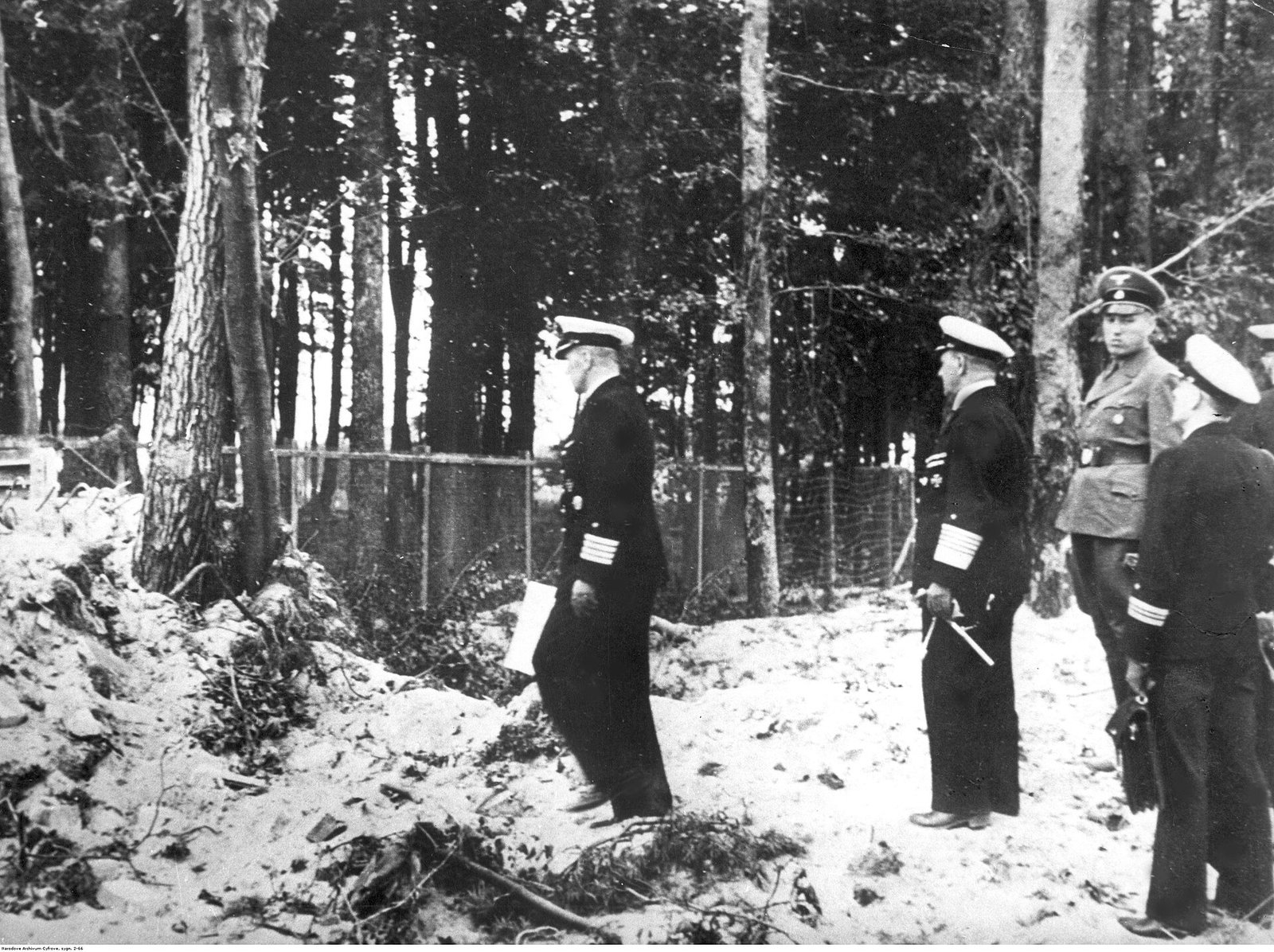
Image: Admirał Erich Raeder na Westerplatte (2-66).jpg — Unknown photographer, Public domain