The gold bear found in Almaty reveals how Saka burial culture brought animal-shaped gold ornaments into the grave, possibly as decoration sewn onto a headdress. Discovered in 2026 at Karagaily cemetery, it came from a mound provisionally dated to the fourth–third centuries BCE, where researchers also identified a possible burial of four adults and three children.
How does a small gold animal help you understand a much larger burial mound? At Karagaily, the clues include casting, attachment holes, pottery, human bones, and an ancient robbery pit. Together, they connect the ornament with Saka dress and burial practices, while leaving room for careful interpretation of the bear’s meaning.
Where was the gold bear found in Almaty?
The figure emerged at Karagaily cemetery in Almaty’s Nauryzbay district, Kazakhstan. The Almaty Museums Association carried out the rescue excavation with support from the city administration. Its setting matters: the bear was recovered during work on a burial mound, alongside human remains and fragments of Saka pottery.
The excavated kurgan measures 25–26 metres across and approximately 2.5 metres high. Its preliminary date falls within the Early Iron Age, in the fourth–third centuries BCE. You therefore need to distinguish the date of discovery, 2026, from the proposed date of the burial itself.
Karagaily had already been disturbed in antiquity. Looters left an approximately three-metre robbery pit. That disturbance forms part of the archaeological context, alongside the surviving gold figure, pottery fragments, and bones. The excavation is examining a burial that had already undergone substantial interference.
What does the burial reveal about the people inside?
Researchers currently consider the possibility that four adults and three children were buried in the mound. The number of individuals has not yet been confirmed. This possible group burial is one of Karagaily’s most significant features because it concerns how several people may have shared the same funerary monument.
Archaeologist Marat Nurpeisov explained that kurgans of comparable size generally held one or two people. Against that comparison, the possible presence of seven individuals deserves close attention. The mound’s dimensions alone do not explain its burial arrangement; the human remains must also be examined.
Further investigations involving anthropologists are planned to clarify the burial conditions and the number of individuals. For now, four adults and three children should remain a provisional assessment. If you describe Karagaily for a class or a history discussion, that distinction keeps a promising interpretation from becoming a fixed claim.
The gold object was found with human bones and Saka ceramic fragments. These finds place the ornament within a wider burial assemblage. A reading of Karagaily must account for the pottery and the people as well as the precious metal, particularly because ancient looting disturbed the mound.
Why might the gold bear have decorated a headdress?
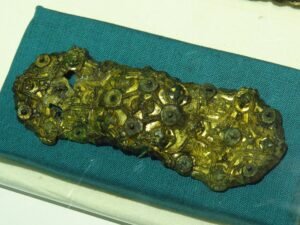
The small figure, interpreted as a bear, was made by casting. Small holes in its plate provide the physical basis for suggesting that it could have been sewn onto a headdress. The proposed function follows from those attachment features, rather than from the animal’s appearance alone.
The everyday-life connection is sewing: when you attach a decoration to clothing, the places where thread passes through help explain how it stays in position. At Karagaily, the small holes similarly direct attention toward fastening. They support a possible use on headwear without establishing exactly how the complete headdress looked.
The Almaty city administration offered a comparison with the Golden Man’s headdress. That headwear carries a gold crest ornament shaped like an argali, a wild mountain sheep. The comparison places Karagaily’s possible bear ornament beside another example of an animal-shaped gold element associated with headwear.
A broader clothing context comes from the Gylym Ordasy Archaeology Museum. It describes Saka gold ornaments from the Issyk, Talgar, and Tenlik cemeteries as decorations for garments, headdresses, belts, and horse harnesses. Karagaily’s proposed headdress attachment fits within this wider range of decorated surfaces.
How does the bear fit into Saka animal art?
The Saka were historical communities of the Eurasian steppes and the Tarim Basin. Their languages are classified within the Eastern Iranian group. The Fitzwilliam Museum explains that modern usage generally applies the name Saka to communities in the eastern part of the Great Steppe.
The Fitzwilliam Museum defines animal style through depictions of deer, bears, wild sheep, and members of the cat family. Flowing lines and abstract forms characterize this steppe art. The bear at Karagaily can therefore be considered within an established artistic vocabulary that included several kinds of animals.
Gold animals also appeared elsewhere in Almaty. According to Almaty Museums Association director Lyazzat Sagyndykova, excavations at Kok-Kainar in 2014 produced ornaments shaped like leopards and birds of prey. Those finds provide a local comparison for animal-shaped decoration, although they depict different creatures.
Sagyndykova stated that a bear figurine of this kind had not previously been found in Kazakhstan. Her assessment concerns this particular type of object. The wider artistic tradition already included bears, as the Fitzwilliam Museum’s description of animal style makes clear.
What can the bear tell us about belief and cultural connections?
The Fitzwilliam Museum presents animal style as a possible visual language connected with mythology and religion. It also offers another explanation: sustained observation of the natural world may have helped maintain these animal forms. Both approaches give you ways to think about the imagery without assigning the bear a fixed message.
The precise meanings of Saka animal motifs remain uncertain. Calling the Karagaily bear a particular deity, or giving it a definite protective function, would go beyond what its form establishes. The attachment holes offer firmer evidence for a possible practical use than the animal shape offers for a specific religious identity.
Sagyndykova interpreted the Karagaily discovery as a useful example for exploring Eurasian cultural similarities stretching from the Black Sea region to the Altai. That gives the figure a wider geographical context. Its importance extends beyond identifying an animal: it also lies in comparing artistic forms across this broad area.
For readers familiar with the Turkish term Sakalar, the Turkish-language account describes Saka and Scythian communities as closely related within a shared Scytho-Siberian culture. This provides a point of connection between familiar terminology and the Karagaily find. The specific excavation, however, remains a Saka burial context in Almaty.
Timeline
- Fourth–third centuries BCE: Preliminary dating places the excavated Karagaily mound in this period.
- Antiquity: Karagaily was looted, leaving an approximately three-metre robbery pit.
- 2014: Excavations at Kok-Kainar in Almaty produced leopard-shaped and bird-of-prey ornaments.
- 2026: A rescue excavation at Karagaily uncovered the cast gold figure interpreted as a bear.
- 5 November 2026: An announcement reported plans to display valuable finds at the Almaty Museum after scientific work was completed.
Details you won’t find in guidebooks
Nurpeisov told Khabar that the gold figure weighs 7–8 grams. That small weight helps bring the object into focus beside the much larger mound. The excavation concerns a monument approximately 2.5 metres high, yet one of its central finds is a lightweight ornament with tiny attachment holes.
The Fitzwilliam Museum describes Saka craftspeople making hundreds or thousands of similar animal ornaments by hand. Loops on their backs indicate that they were sewn onto clothing. Those loops provide a broader comparison for understanding attachment, while the Karagaily interpretation rests specifically on holes in the figure’s plate.
The Kok-Kainar comparison also concerns the choice of animals. Its 2014 finds included leopards and birds of prey, according to Sagyndykova. Beside those forms, Karagaily adds a figure interpreted as a bear. Comparing the creatures helps place the discovery within Almaty’s wider record of animal-shaped ornaments.
FAQ
What does the gold bear found in Almaty reveal about Saka burial culture?
It connects a Saka burial with cast gold animal ornamentation and possibly decorated headwear. The mound may also contain four adults and three children, making its burial arrangement especially significant.
How old is the Karagaily gold bear?
The burial mound containing the figure has been provisionally dated to the fourth–third centuries BCE. This is a preliminary archaeological assessment.
Was the gold bear attached to a headdress?
Small holes in the figure’s plate support the interpretation that it could have been sewn onto a headdress. This remains an interpretation of its attachment features.
Where will the gold bear be displayed?
An announcement dated 5 November 2026 reported plans to display valuable finds at the Almaty Museum after scientific studies are completed.
Sources
- Qazinform — Rare Saka-era gold bear figurine unearthed at archaeological site in Almaty qazinform.com
- Almaty City Administration — Karagaily excavation announcement gov.kz
- Khabar — Gold bear figurine found in Almaty khabar.kz
- Wikipedia — Saka en.wikipedia.org
- Vikipedi — Sakalar tr.wikipedia.org
- Fitzwilliam Museum — Gold of the Great Steppe exhibition labels steppe-gold.fitzmuseum.cam.ac.uk
- Gylym Ordasy Archaeology Museum — Golden Hall gylymordasy.gov.kz
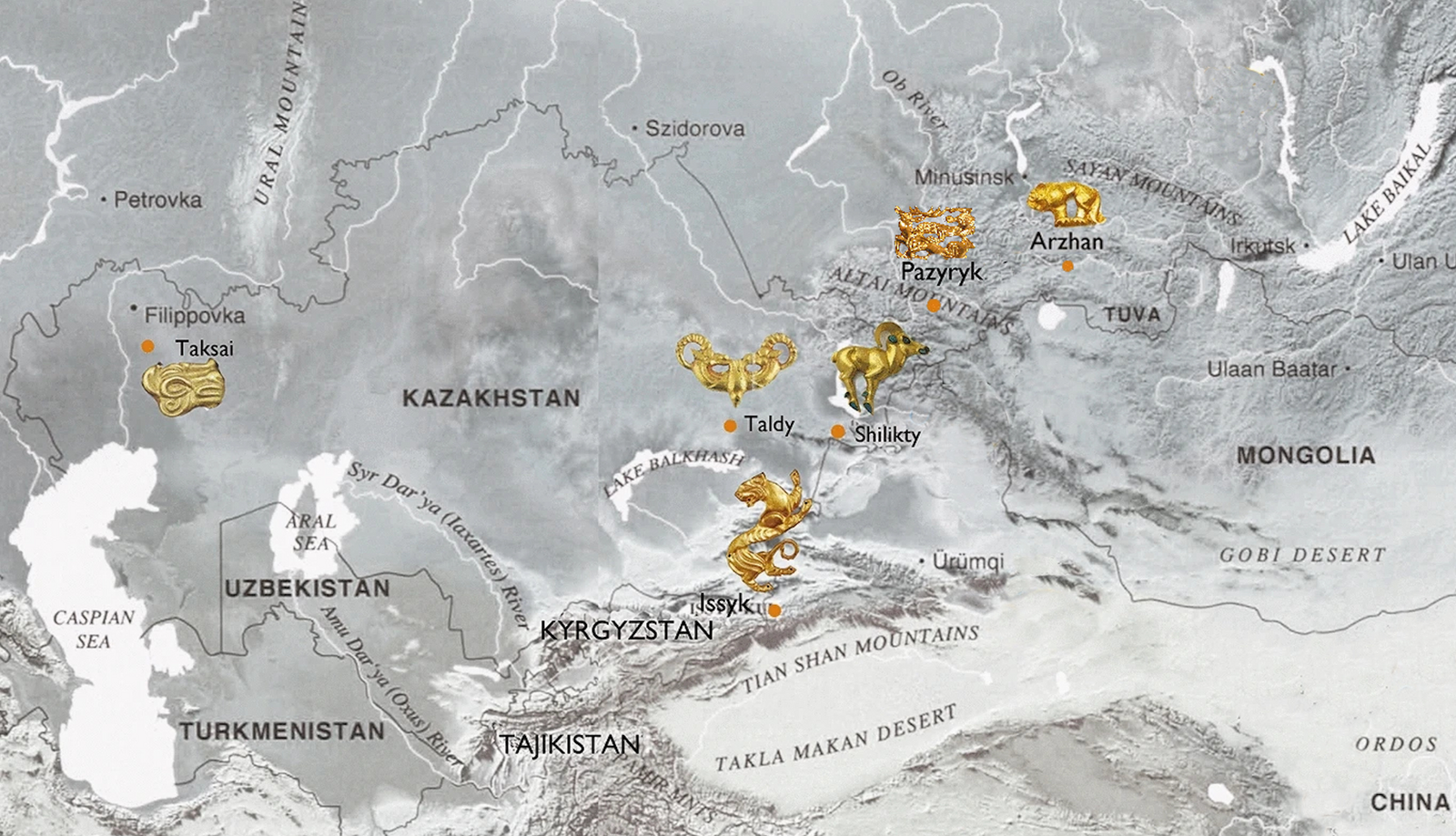
Image: Saka gold.png — Yan Liu, Rui Li, Junchang Yang, Ruiliang Liu, Guoxing Zhao &, CC BY-SA 4.0