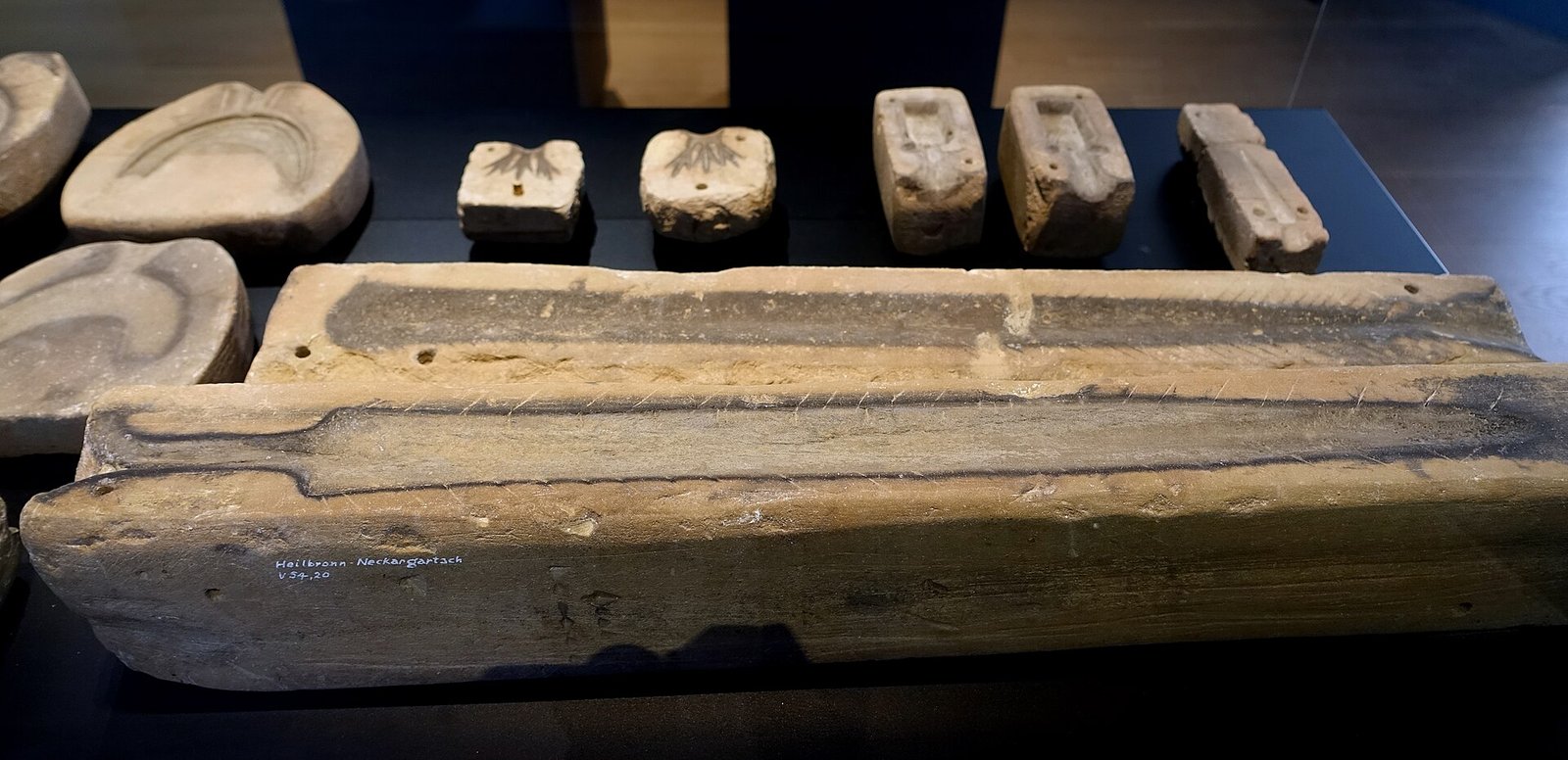
Bronze Age swords were made by pouring molten bronze into a mould, then heating, hammering and finishing the cast weapon. A completely preserved sandstone mould half found at Großeibstadt in Bavaria shows the casting stage directly and provides evidence of sword production there around 3,000 years ago.
The Großeibstadt discovery connects a finished weapon with the equipment behind its manufacture. If you picture sword making as a single pour of metal, the mould tells only the beginning of the story. Comparable finds and replication experiments reveal the work that followed, from straightening blades to cutting small surface details.
What does the stone mould from Bavaria reveal?
The sandstone mould was found during excavations in summer 2025 at Großeibstadt, in Bavaria’s Lower Franconia region. It came from a lowland settlement belonging to the Urnfield period, dated to 1300–800 BCE. That settlement context places the object within a community where bronze working took place.
The surviving object is one completely preserved half of a sword casting mould. It was intended for a sword with a tang, the part extending into the grip. The distinction matters: archaeologists recovered equipment used to make a weapon, rather than the weapon itself.
A second mould from the same period was used for casting jewellery. Together with other archaeological structures, it led specialists at BLfD to identify the site as a place where a bronze caster worked around 3,000 years ago. Sword production therefore sits within broader evidence of metalworking at Großeibstadt.
HeritageDaily published its report on 11 November 2026. The report also covered a bronze hoard found near Grabenstätt, dated to approximately 880–800 BCE. That hoard was a separate discovery from the Großeibstadt mould.
How did makers turn bronze into a sword?
Bronze is an alloy made by combining copper with other elements, including tin or arsenic. Its composition is part of the manufacturing story. Cristiano Iaia’s study of Terramare metalworking highlights a copper alloy averaging about 10 percent tin in Naue II-Cetona swords.
That figure belongs to the swords discussed in the Terramare research. It should remain attached to those examples when you compare them with Bavaria’s sandstone mould. The mould records the intended form of a casting; the alloy research addresses the material used in a particular group of swords.
Sasja van der Vaart-Verschoof’s Fragmenting the Chieftain describes molten metal being poured into a mould to make a bronze sword. At Großeibstadt, the surviving sandstone half preserves physical evidence of that shaping equipment. The sword’s form depended on a prepared cavity before the metal was poured.
For an everyday comparison, think of using a baking mould: the prepared cavity gives material its initial outline. In bronze sword production, that outline still required extensive work after casting. The research describes heating to homogenise the newly cast bronze, followed by hammering.
Stone moulds could be reused, according to Fragmenting the Chieftain. The same study explains that an existing bronze sword could serve as a model for a new clay mould. These were different ways of preparing the form into which molten metal would be poured.
What happened after the sword left the mould?
Casting produced a shape that still needed work. In the Cetona sword replication experiments discussed by Iaia, shaping the hilt, making holes with bronze punches and straightening the blade were separate production stages. Each addressed a different part of the emerging weapon.
The blade edges also demanded attention. Iaia’s Terramare study emphasises intensive cold working along the cutting edges of Naue II-Cetona swords. Casting and subsequent metalworking therefore belong together in an explanation of how these weapons were made.
The broader production sequence included surface finishing as well as hammering. When you look at the sandstone mould, you are seeing evidence for one stage within that sequence. The mould supplied the cast form; later operations worked on its shape, edges and surface.
Replication experiments give a striking measure of the labour involved. The Cetona sword experiments associated with Markus and Markus Binggeli showed that post-casting work alone could exceed 100 hours. That result describes those experiments, rather than a standard timetable for every ancient sword.
Were sword moulds always made of stone?
Stone and clay both appear in the archaeological evidence. Luca Pellegrini and colleagues date the sandstone sword mould from Castione Marchesi to approximately 1650–1450 BCE. It offers an earlier comparison for the use of sandstone documented at Großeibstadt.
The London Museum holds clay sword mould fragments dated to 900–700 BCE. They were used to produce a sword with a leaf-shaped blade. These fragments demonstrate another mould material within the wider history of bronze sword casting.
Researchers writing in EXARC also discuss possible sand mould use in northern Italy. They propose it as one explanation for the small number of surviving sword moulds there. Their article also documents stone and ceramic moulds, so the discussion includes several possible manufacturing approaches.
Successful experimental casting in sand does not directly establish that ancient makers used the same method. That boundary matters when interpreting production evidence. The Großeibstadt sandstone mould is a surviving archaeological object, while the proposed use of sand addresses a question through experimental work.
How does the Bavarian find fit the wider Bronze Age?
Bronze Age dates vary by region. For Anatolia, the Turkish Wikipedia overview places the beginning at approximately 3000 BCE. If you are exploring ancient history before travelling to Turkey, that regional chronology helps place the later Bavarian evidence within a much longer period of bronze use.
Bronze Age swords also varied in size. The English Wikipedia overview gives a typical length of 60–80 centimetres and notes examples exceeding 100 centimetres. Those measurements describe the broader category of Bronze Age swords, rather than the Großeibstadt casting.
The same overview dates the appearance of the Naue II sword type, also called Griffzungenschwert, to around the 13th century BCE. It continued into the 6th century BCE. The Großeibstadt mould’s settlement context, dated to 1300–800 BCE, overlaps part of that long span.
Timeline
- Around 3000 BCE: The Bronze Age begins in Anatolia according to the regional chronology given by Turkish Wikipedia.
- Around 1650–1450 BCE: The sandstone sword mould from Castione Marchesi is dated to this period.
- 1300–800 BCE: The Urnfield settlement that produced the Großeibstadt mould belongs to this span.
- Around 1150–950 BCE: The multi-faced soapstone sword mould from Piverone is dated to this period.
- 900–700 BCE: The London Museum’s clay mould for a leaf-bladed sword belongs to this span.
- Summer 2025: Excavators find the sandstone sword mould at Großeibstadt.
- 11 November 2026: HeritageDaily publishes its report on the Großeibstadt mould and the separate Grabenstätt hoard.
Details you won’t find in guidebooks
The Piverone soapstone mould had cavities cut into three faces for producing Erbenheim-type tanged swords. Dated to approximately 1150–950 BCE, it shows how several faces of a stone block could be prepared for sword manufacture.
The London Museum’s clay fragments preserve traces of plant fibres used to bind the inner mould halves together. The object’s inventory number is RNH96[5034]<18>a. Alongside its leaf-shaped blade cavity, those fibre traces preserve evidence of how the mould was held together.
Small details could demand unexpected tools. In the Cetona replication experiments, attempts to cut channels along the blade edges with metal chisels failed. A small stone scraper worked. The experiment provides a concrete example of stone serving a role in the finishing of a bronze weapon.
Casting flaws did not always lead to a sword being melted down. Fragmenting the Chieftain discusses small casting cavities in some bronze swords that also carry traces of use. Those objects show that a weapon with such imperfections could still enter service.
FAQ
How were Bronze Age swords made?
Makers poured molten bronze into a mould, then worked the casting through heating, hammering and finishing. Experiments also document separate stages for shaping the hilt, making holes and straightening the blade.
What was found at Großeibstadt in Bavaria?
Excavations in summer 2025 uncovered one completely preserved sandstone half of a mould for casting a sword with a tang. A second mould, used for jewellery, supports evidence of local bronze working.
Were all Bronze Age sword moulds made of stone?
Both stone and clay sword moulds are documented. Researchers have also explored sand moulds experimentally, but successful experiments do not directly prove their historical use.
How long could finishing a bronze sword take?
Cetona sword replication experiments showed that work after casting alone could exceed 100 hours. This is an experimental result, rather than a fixed production time for every Bronze Age sword.
Sources
- BLfD and Archäologische Staatssammlung — Joint press release blfd.bayern.de
- HeritageDaily — Rare Bronze Age finds reveal ancient metalworking in Bavaria heritagedaily.com
- Sasja van der Vaart-Verschoof — Fragmenting the Chieftain rmo.nl
- Cristiano Iaia — Smiths and Smithing in Bronze Age Terramare iris.unito.it
- London Museum — Mould, sword mould londonmuseum.org.uk
- Luca Pellegrini and colleagues, EXARC Journal — Observations on Italian Bronze Age Sword Production exarc.net
- Wikipedia — Bronze Age sword en.wikipedia.org
- Vikipedi — Tunç Çağı tr.wikipedia.org
Image: Molds for bronze swords and other items, from the Nordheimer Hohl, Neckargartach, Stadt Heilbronn, c. 800 BC, Lettenhohl sandstone – Landesmuseum Württemberg – Stuttgart, Germany – DSC02772.jpg — Daderot, Public domain