Archaeologists identified the lost sanctuary of Asclepius in Epidaurus by matching Pausanias’s description of statues standing outdoors with an excavated open-air enclosure near the Little Theatre. A pottery fragment preserving part of Asclepius’s name provided direct support for the match. The site is the city sanctuary, separate from the famous Asklepieion outside Epidaurus.
The clue that names the god is only part of the story. Pausanias also described his wife, Epione, and specified the marble used for their statues. If you follow the evidence from his account to the enclosure, water system and sculpture, you can see how the identification works—and why some proposed connections remain uncertain.
Where was the lost sanctuary found?
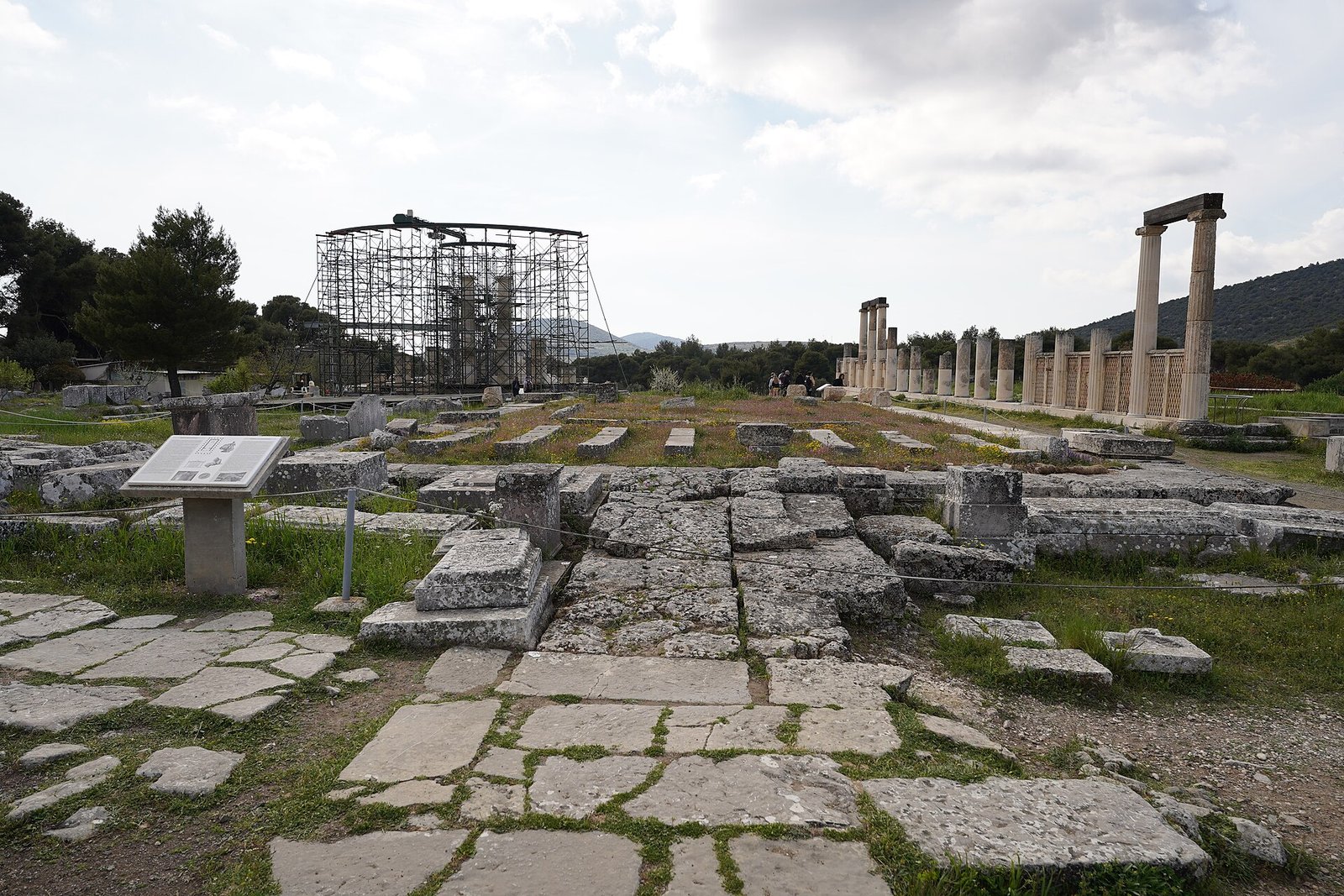
The sanctuary lies within ancient Epidaurus, at the coastal settlement now called Palaia Epidavros in Greece’s Argolis region. To Vima’s November 2026 report places the excavations about 20 metres from the Little Theatre. This is the urban sanctuary of Asclepius, also described as his temenos. It must be distinguished from the better-known Asklepieion outside the city.
That distinction matters when you read about the discovery. Both places belong to the study of Asclepius at Epidaurus, but the identification discussed here concerns the city enclosure. The Little Theatre provides its nearby landmark. The famous sanctuary outside the city is a separate location, rather than another name for the newly identified remains.
The excavation project is directed by Vasilis Lambrinoudakis of the University of Athens, working with the Ephorate of Antiquities of Argolis. Its findings combine buildings, inscriptions and smaller objects. Together, these allow the city sanctuary to be assessed against an ancient description. Archaeology in Greece Online records the project and its findings.
What did Pausanias describe?
Writing in the second century AD, Pausanias described the sanctuary in section 2.29.1 of his Description of Greece. He placed statues of Asclepius and his wife, Epione, outdoors in the city sanctuary. His account therefore offered a specific architectural clue: the figures stood in the open air.
Pausanias also recorded their material. Both statues were made of Parian marble. This detail gives his description a second point of comparison with excavated sculpture. The location of the statues and the stone from which they were carved are separate observations. Each matters when considering whether surviving remains correspond to what he saw. Pausanias, Description of Greece, Book II
The open-air setting is central to the identification. Excavation revealed an enclosed outdoor area measuring 100 square metres. Its arrangement could be compared with Pausanias’s description. That architectural correspondence gained greater weight when considered alongside the pottery carrying part of Asclepius’s name.
How did the pottery and architecture establish the match?
The most direct evidence for the sanctuary’s association with Asclepius is a ceramic fragment with an incised inscription. It preserves part of the god’s name. The fragment connects Asclepius with the excavated site through a written trace, adding evidence beyond the appearance or arrangement of its buildings.
The identification rests on the combination. Pausanias described an outdoor setting for the divine statues. Archaeologists uncovered an open-air enclosure. The inscribed pottery supported its attribution to Asclepius. Read together, the text, architecture and inscription explain why these remains were matched with the sanctuary in his account.
The excavated complex contains more than the enclosure. Archaeologists identified a 220-square-metre section comprising a fountain and cistern, along with a stoa measuring 128 square metres. These measurements establish the scale of the surviving facilities. They also show that the sanctuary included water infrastructure and a substantial additional building. Greece’s Ministry of Culture announced these remains and the inscribed pottery in January 2024.
How old was the sanctuary?
The city sanctuary’s facilities date to the fourth century BC. Its surviving architectural arrangement, however, reflects an extensive renovation during the second century AD. The date of the sanctuary’s earlier facilities and the date of its visible layout therefore refer to different phases of the same place.
That second-century renovation has been tentatively connected with Hadrian’s visit to Epidaurus in AD 124. The proposed link remains a possibility. The visit supplies a potential context for the rebuilding, but the connection between the two has not been established.
Pausanias also wrote during the second century AD. His description and the major renovation thus belong to the same broad period. This helps place his account alongside the surviving layout. It does not establish the suggested connection with Hadrian, which remains a separate interpretation.
Timeline
- Fourth century BC: The facilities of the city sanctuary of Asclepius date to this period.
- AD 124: Hadrian visits Epidaurus. The sanctuary’s later renovation has been tentatively associated with this visit.
- Second century AD: Pausanias records statues of Asclepius and Epione standing outdoors in the city sanctuary.
- 2021: A marble female statue is discovered in ancient Epidaurus. It is later proposed as a possible representation of Epione.
- 11 January 2024: Greece’s Ministry of Culture announces the city sanctuary and the finds supporting its identification.
- 9 November 2026: A University of Athens programme lists Lambrinoudakis’s talk on the cult of Asclepius, drawing on recent work in the city and Asklepieion.
- November 2026: To Vima reports the identification of the sanctuary described by Pausanias.
Details you won’t find in guidebooks
A well in the centre of the enclosure supplied the fountain through an underground masonry tunnel. The tunnel had a pointed arch. This detail connects the open enclosure with the water facilities through an actual supply route. The fountain and well formed parts of a linked arrangement.
The fountain’s first phase had an Ionic façade. Three columns stood between piers. These architectural details give a more precise picture of the water installation than its floor area alone. Alongside the cistern, the façade forms part of the evidence for the sanctuary’s developed water facilities.
Steps against the enclosure’s eastern wall preserve sockets used to secure stelae or other offerings. These small cuttings record where objects could be fixed in place. They add another layer to the architectural evidence: the enclosure contained arrangements for displaying offerings as well as its central well.
The finds include lamps and fragments of terracotta hot-water bottles. The latter provide an everyday-life connection. If you reach for a hot-water bottle for comfort, the name of this ancient object is immediately familiar. At Epidaurus, its surviving pieces belong to the material recovered from the city sanctuary.
Pausanias’s silence offers another striking detail. When describing the city’s temples and harbour during his second-century travels, he did not mention the Little Theatre. Yet that theatre now serves as the landmark used to locate the nearby excavation. The ancient description and the modern location reference therefore focus on different features. Athens Epidaurus Festival
Was the female statue really Epione?
The female statue found in Epidaurus in 2021 is made of Parian marble. It wears a chiton and himation. Its material corresponds to the marble Pausanias specified for the statues of Asclepius and Epione. This correspondence has encouraged the proposal that the figure could be the Epione he described.
The proposed identity remains unconfirmed. The sanctuary also yielded small terracotta discs bearing reliefs of female busts, together with larger figurine fragments carrying similar imagery. These female representations have been associated with a goddess connected to motherhood and nature’s renewal. A possible local identification with Epione has been suggested, but it is not established. To Vima distinguishes these proposals from confirmed identifications.
Other interpretations also require care. The Roman-period stoa may have accommodated sleeping in the sanctuary for healing purposes. Bronze medical instruments found during earlier excavations in the nearby theatre’s orchestra may have come from this sanctuary. Both connections remain proposals. Neither the stoa’s suggested use nor the instruments’ origin has been confirmed.
FAQ
How was the lost sanctuary of Asclepius identified?
Pausanias’s description of statues standing outdoors was compared with an excavated enclosure near the Little Theatre in Epidaurus. A pottery fragment preserving part of Asclepius’s name supplied direct evidence supporting the identification.
Where is the sanctuary?
It is in ancient Epidaurus, at modern Palaia Epidavros in Greece’s Argolis region. The excavations lie about 20 metres from the Little Theatre, separate from the famous sanctuary outside the city.
Was the sanctuary first announced in November 2026?
No. Greece’s Ministry of Culture had already announced the city sanctuary and supporting finds on 11 January 2024. Reports published in November 2026 brought renewed attention to the identification.
Has the marble statue been identified as Epione?
The female statue discovered in 2021 has been proposed as Epione. Its Parian marble matches the material Pausanias described, but the identification remains unconfirmed.
Sources
- Greece’s Ministry of Culture — Epidaurus excavation announcement culture.gov.gr
- Fordham University — Pausanias, Description of Greece, Book II sourcebooks.web.fordham.edu
- École française d’Athènes / British School at Athens — Archaeology in Greece Online chronique.efa.gr
- To Vima — Ancient Epidaurus Steps Out of the Asklepieion’s Shadow tovima.com
- Athens Epidaurus Festival — Little Theatre of Ancient Epidaurus aefestival.gr
- University of Athens, Department of History and Archaeology — Event programme arch.uoa.gr
Image: Sanctuary of Asclepius at Epidaurus – Temple of Asclepius – 52042443674.jpg — TimeTravelRome, CC BY 2.0