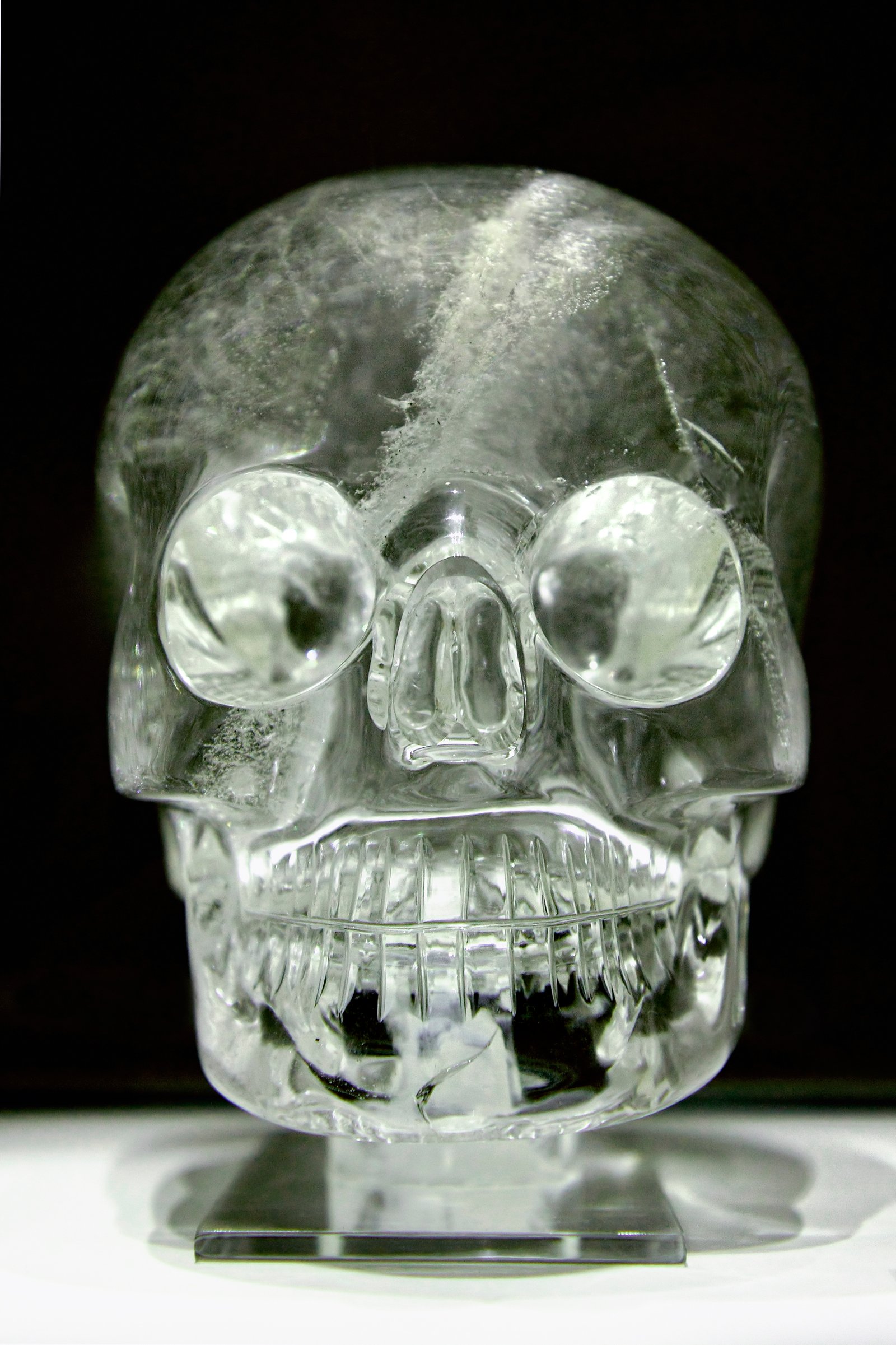
Scientific examinations have not confirmed that the tested crystal skulls are ancient pre-Columbian objects. According to the Smithsonian’s 2008 statement, none submitted for scientific examination came from a documented archaeological excavation, while tests on major museum examples supported more recent manufacture.
The revealing evidence sits in wheel marks, abrasive residues and hydrogen beneath carved surfaces. If you want to understand why Aztec or Maya attributions failed these examinations, follow the objects from dealers and museum collections to the microscopic traces left by their manufacture.
What are crystal skulls, and why were they called ancient?
Crystal skulls are sculptures carved into the shape of human skulls from transparent or milky-white quartz blocks. Large examples began appearing in public and private collections during the second half of the 19th century. Their presence in those collections is documented; an excavated ancient origin is not.
Some skulls have been attributed to the Aztec, Toltec, Mixtec or Maya. These labels are claims about their makers. The Smithsonian reported that scientific examination had not confirmed those attributions for the examples investigated. You therefore need to distinguish an object’s traditional description from evidence establishing when and how it was made.
The British Museum acquired its nearly life-size skull in 1897 as an example of pre-Columbian workmanship. Its documented trading history reaches back to the French antiquities dealer Eugène Boban, who obtained it shortly before 1881. It also passed through the New York jewellery company Tiffany & Co. before reaching the museum.
What did scientific examinations reveal about the crystal skulls?
A comparative study of the London and Washington skulls appeared in volume 35 of the Journal of Archaeological Science in 2008. Its authors were Margaret Sax, Jane Walsh, Ian Freestone, Andrew Rankin and Nigel Meeks. They examined manufacturing traces and compared them with quartz objects from reliable archaeological contexts in Mesoamerica.
The team used scanning electron microscopy to examine tool marks. Their comparison objects included a Mixtec quartz goblet and Aztec/Mixtec quartz beads. Those objects showed no traces indicating the use of rotary stoneworking wheels. The British Museum and Smithsonian skulls, by contrast, showed evidence of rotary-wheel working.
The comparison matters because it tests a specific claim about craftsmanship. The skulls and the securely contextualised objects were all worked quartz, but their manufacturing traces differed. The finding challenged the proposed connection between the museum skulls and pre-Columbian production rather than relying on how convincingly ancient the sculptures looked.
Think of checking the wear on an everyday possession before accepting a seller’s description of its condition. With these skulls, you can follow a similar line of questioning: does the physical surface support the accompanying story? Microscopy supplied that physical evidence through traces of the tools used to shape the quartz.
Why did abrasive residues matter?
Marks on the British Museum skull indicated working with hard abrasives such as corundum or diamond. This finding added detail to the evidence for rotary-wheel manufacture. The researchers were examining both the movement of the tools and the abrasive materials involved in cutting the surface.
The Smithsonian skull supplied another clue. Analysis of its residues by X-ray diffraction identified carborundum, or silicon carbide, written chemically as SiC. This is a modern synthetic abrasive. Its presence provided direct material evidence that conflicted with the skull’s claimed Aztec origin.
These findings should remain attached to the objects actually tested. Rotary-wheel traces were identified on both the British Museum and Smithsonian skulls. Silicon carbide residues were identified on the Smithsonian example. Combining the results does not mean that every skull contained the same abrasive or had precisely the same manufacturing history.
Could the quartz reveal where a skull came from?
Researchers examined fluid and solid inclusions inside the British Museum skull’s quartz using microscopy and Raman spectroscopy. Their analysis linked the material with Brazil or Madagascar as possible sources. It did not identify a particular quarry with certainty.
That distinction separates the origin of the raw material from the history of the finished sculpture. You can treat Brazil and Madagascar as proposed geological connections for the London skull’s quartz. Neither possibility establishes who carved the skull, while the tool marks address the separate question of how its surface was worked.
How did scientists examine the Paris skull?
Thomas Calligaro and colleagues investigated a crystal skull and a small human head from the quai Branly collection in Paris. Their study appeared online on 18 December 2008. Alongside optical and scanning electron microscopy, they used an ion-beam method called ERDA to measure hydrogen distribution beneath the surfaces without damaging the objects.
The Paris skull showed shallower hydrogen penetration than a comparison quartz object known to have been cut in 1740. This supported a more recent working date for the skull. Considering the hydrogen profiles together with the tool marks, the researchers concluded that it was probably carved in the 18th or 19th century.
The small human head produced different results. It showed traces of hand working and a deeper hydrogen profile. The team therefore considered it a possible pre-Columbian object. This contrast is central to the study: two quartz carvings from the same collection did not receive the same assessment.
Was the Mitchell-Hedges skull discovered at Lubaantun?
Anna Mitchell-Hedges was said to have found the famous skull at Lubaantun, in present-day Belize, in 1924. Records from participants in the excavation confirm neither the discovery nor Anna’s presence there. The claimed find therefore lacks confirmation in those excavation records.
A documented purchase provides a firmer point in the object’s history. Frederick A. Mitchell-Hedges bought the skull from Sydney Burney at Sotheby’s in London on 15 October 1943. He described the purchase in a letter to his brother that same year. That transaction is distinct from the earlier discovery claim.
Timeline
- Second half of the 19th century: Large quartz skulls began appearing in public and private collections.
- Shortly before 1881: Eugène Boban obtained the skull that would later enter the British Museum.
- 1897: The British Museum bought its crystal skull as pre-Columbian workmanship.
- 1924: The claimed date of Anna Mitchell-Hedges’s Lubaantun discovery, unconfirmed by excavation records.
- 15 October 1943: Frederick A. Mitchell-Hedges purchased his skull at Sotheby’s.
- 1992: A large quartz skull arrived at the Smithsonian by post with an unsigned letter.
- 2008: Sax and colleagues published their comparative study of the London and Washington skulls.
- 10 July–1 September 2008: The Smithsonian first publicly displayed its skull in The Truth About Crystal Skulls.
- 18 December 2008: The Paris study of tool marks and hydrogen profiles appeared online.
Details you won’t find in guidebooks
The Smithsonian skull arrived in 1992 with an unsigned letter claiming that it had been bought in Mexico in 1960 and was Aztec. The sculpture weighs approximately 14 kilograms and stands 25 centimetres high. Its size is measurable; the letter’s account of its origin remained a claim.
The Smithsonian’s first public presentation took place at the National Museum of Natural History in Washington during its 2008 exhibition. Visitors could see scanning electron microscope images magnified between 50 and 500 times. These images brought the manufacturing traces into the exhibition alongside the object itself.
The Smithsonian’s 2008 announcement also recorded public displays of famous examples at the British Museum in London and the Musée du quai Branly in Paris. Those are historical display references. The examinations discussed here concern particular collection objects, including the London and Washington pair and the separately studied Paris carvings.
FAQ
Are crystal skulls really ancient?
According to the Smithsonian’s 2008 statement, none submitted for scientific examination had been confirmed as pre-Columbian. None came from a documented archaeological excavation.
What did scientists find on the museum skulls?
The British Museum and Smithsonian skulls showed rotary-wheel working. The Smithsonian example also contained residues of the modern synthetic abrasive silicon carbide.
How old is the Paris crystal skull?
Researchers concluded that it was probably carved in the 18th or 19th century. Their assessment combined microscopic tool marks with hydrogen profiles beneath its surface.
Was the Mitchell-Hedges skull discovered at Lubaantun?
Excavation records do not confirm the claimed 1924 discovery or Anna Mitchell-Hedges’s presence. Frederick A. Mitchell-Hedges purchased the skull from Sydney Burney at Sotheby’s on 15 October 1943.
Sources
- Smithsonian Institution — Mysterious Crystal Skull si.edu
- British Museum — Rock crystal skull artsandculture.google.com
- Margaret Sax and colleagues — The origins of two purportedly pre-Columbian Mexican crystal skulls doi.org
- Thomas Calligaro and colleagues — Dating study of two rock crystal carvings link.springer.com
- Wikipedia — Crystal skull en.wikipedia.org
Image: Crystal skull british museum random9834672.jpg — Wikimedia Commons, CC BY 3.0