Eastern Catholic churches developed through separate unions with Rome, patriarchal disputes, and local religious and political changes across many centuries. They retained Eastern rites because communion with Rome allowed their liturgies and church disciplines to continue alongside acceptance of papal authority. Today, they comprise 23 self-governing churches representing five historical ritual traditions.
A union could begin with a disputed patriarchal election, as in the Chaldean and Melkite cases. It could also include explicit demands to preserve worship and dioceses, as in the Malankara negotiations. If you follow these different paths, you can see why Eastern Catholic history includes both the preservation of traditions and pressure to change them.
Why did the Eastern Catholic churches not originate in a single founding event?
The 23 Eastern Catholic churches are described as sui iuris, meaning that each has its own law. Their shared relationship is full communion with the bishop of Rome. Their histories reach that relationship through different events. The Maronites formally reaffirmed communion in 1182. The group associated with Mar Ivanios entered Catholic communion in 1930.
The wider Latin–Byzantine division also developed over time. Mutual excommunications in 1054 became its symbolic marker. According to CNEWA, the Crusaders’ sack of Constantinople in 1204 made the separation decisive in the minds of Eastern peoples. These events provide the background to later reunion efforts.
Attempts at general reunion did not produce lasting unity. The Second Council of Lyon in 1274 and the Council of Ferrara–Florence in 1438–1439 failed to establish enduring communion between the Latin and Byzantine churches. Later local unions therefore followed their own courses.
The Maronite sequence shows why one founding date cannot cover every community. After the formal affirmation of communion in 1182, Patriarch Jeremias II al-Amshiti attended the Fourth Lateran Council in 1215. That history belongs to a different setting from the unions at Brest or Uzhhorod.
Under what political and religious conditions did unions with Rome occur?
Disputes over leadership could open a path to Rome. In 1552, bishops opposing hereditary patriarchal succession in the Church of the East elected Yuhannan Sulaka. He sought communion with Rome. Pope Julius III consecrated him as a bishop in St Peter’s Basilica on 9 April 1553.
In Ukrainian territories, union developed amid competing religious priorities after the Polish–Lithuanian union of 1569. Jesuits supported communion with Rome as a means of limiting Protestant expansion. Some Orthodox Christians saw the same proposal as a way to improve the clergy’s position and protect Byzantine traditions.
The Brest process of 1595–1596 proclaimed communion between the metropolitan province of Kiev and Rome. Acceptance was contested. Violent clashes followed between supporters and opponents. Protecting Eastern traditions could be an argument for union, while the union itself divided communities.
Catholic Hungary supplied another political setting. Missionary activity supported among its Orthodox population formed the background to the reception of 63 Rusyn priests into Catholic communion at Uzhhorod on 24 April 1646. Here, too, a local setting shaped the agreement.
The Melkite separation involved competing ecclesiastical and political recognition. In the Antioch patriarchal election of 1724, Catholic supporters in Damascus elected Cyril VI. Ottoman authorities recognized his rival, Sylvester. Pope Benedict XIII recognized Cyril in 1729, formalizing the Melkite Catholic division. For readers interested in Turkey’s Ottoman history, this case connects church allegiance directly with imperial recognition.
Negotiations could also make preservation an explicit condition. Malankara Orthodox bishops who began talks with Rome in 1926 requested protection for their rites and dioceses. On 20 September 1930, two bishops, including Mar Ivanios, and three other people entered Catholic communion.
How do Eastern Catholic, Eastern Orthodox, and Church of the East traditions differ?
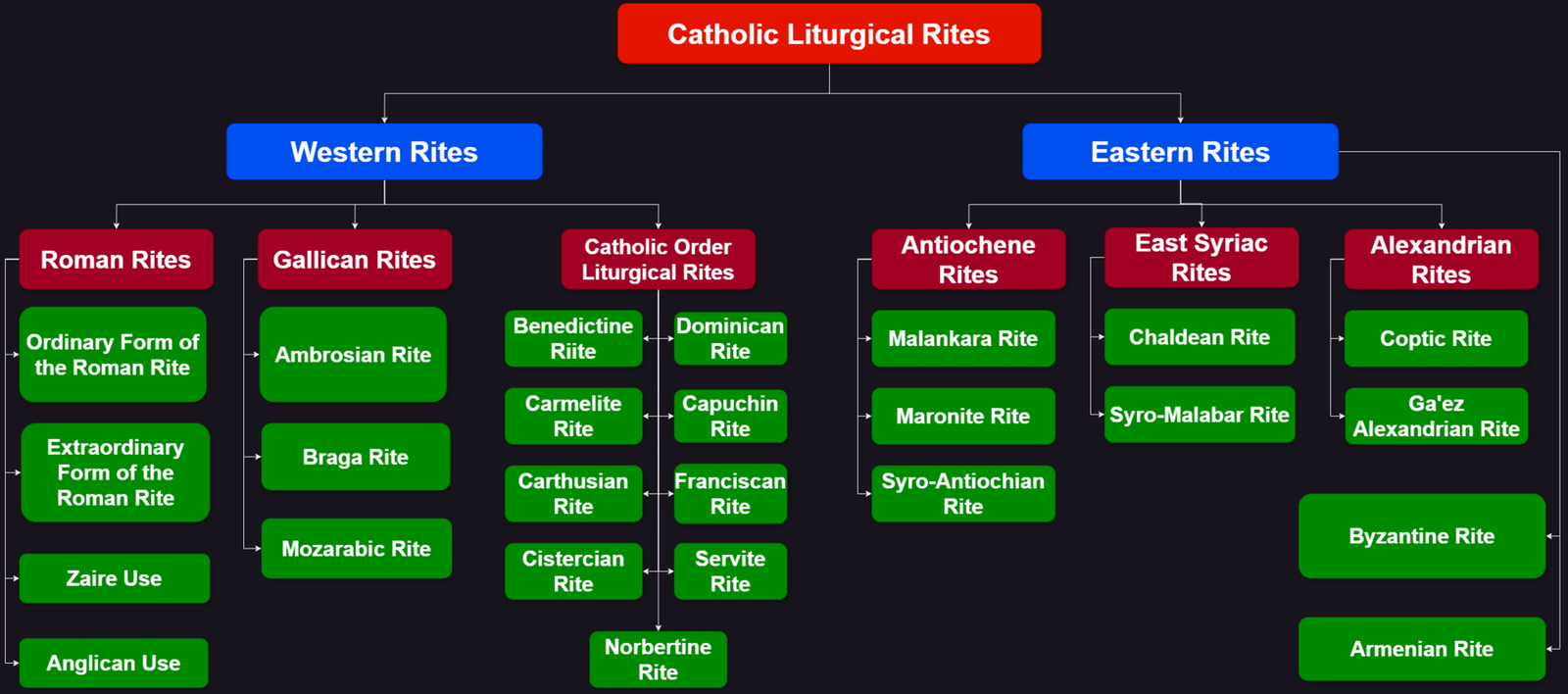
Communion and ritual tradition are separate parts of the explanation. Eastern Catholic churches accept papal authority while retaining Eastern forms of worship and languages. Their five historical ritual traditions are Alexandrian, Armenian, Byzantine, East Syriac, and West Syriac. The 23 churches therefore do not represent 23 separate ritual families.
Ronald Roberson’s CNEWA classification distinguishes Eastern Catholics from the Assyrian Church of the East, the Oriental Orthodox churches, and the Eastern Orthodox churches of Byzantine tradition. These are separate church families. If you encounter the word “Eastern,” that word alone does not establish a church’s relationship with Rome.
Catholic teaching also recognizes sacramental life in Eastern churches separated from Rome. Article 15 of the Second Vatican Council’s Unitatis Redintegratio states that apostolic succession preserves their true priesthood and Eucharistic sacraments. Article 16 accepts their right to follow their own laws and traditions.
How were rites, church law, and local traditions preserved or changed over time?
Permission to retain Eastern worship developed alongside a theology emphasizing papal authority over all local churches. CNEWA presents these developments together. Communion could therefore combine Eastern liturgy and canonical discipline with recognition of Rome’s direct authority.
Preservation was uneven in practice. The Synod of Diamper in 1599, directed by Goa’s Portuguese archbishop, introduced Latin practices among India’s Thomas Christians. These included Roman-style vestments, changes to worship, and clerical celibacy. The continuation of an Eastern community did not guarantee that every inherited practice remained intact.
Later Syro-Malabar reforms turned toward East Syriac sources. Pius XI initiated the reform in 1934. Pius XII approved it in 1957, and the revised Eucharistic liturgy entered use in 1962. This sequence shows that changes to Eastern worship could later be reconsidered through its own historical tradition.
The Second Vatican Council gave explicit support to preservation and restoration. Issued on 21 November 1964, Orientalium Ecclesiarum affirmed the equal dignity of Eastern and Western rites. Articles 5–6 described government according to Eastern disciplines as both a right and a duty. They also called for a return to ancestral traditions where historical circumstances had caused departures.
Authority within Eastern churches remained part of this framework. Article 9 recognized the power of patriarchs and their synods to establish dioceses and appoint bishops within their patriarchal territories. It also reserved the pope’s right to intervene.
The 1990 Code of Canons of the Eastern Churches supplied their first common codification while allowing each church to retain its own internal canons and laws. Canons 27–28 distinguish a church as a hierarchical community from a rite as a liturgical, theological, spiritual, and disciplinary inheritance. Institution and tradition are related, but they are different concepts.
Timeline
- 1054: Mutual excommunications mark the Latin–Byzantine division.
- 1182: The Maronites formally reaffirm communion with Rome.
- 1204: Crusaders sack Constantinople, deepening the division.
- 1274: The Second Council of Lyon attempts a union that does not endure.
- 1438–1439: Ferrara–Florence fails to establish lasting general reunion.
- 1553: Yuhannan Sulaka receives episcopal consecration in Rome.
- 1595–1596: The Brest process proclaims the Kiev metropolitan province’s union with Rome.
- 1599: Diamper introduces Latin practices among the Thomas Christians.
- 1646: At Uzhhorod, 63 Rusyn priests enter Catholic communion.
- 1724–1729: Rival patriarchal claims and papal recognition formalize the Melkite Catholic separation.
- 1736: The Mount Lebanon Synod organizes Maronite law and dioceses.
- 1830: Recognition of Yuhannan Hormizd stabilizes the Chaldean Catholic patriarchate.
- 1930: Mar Ivanios and four companions enter Catholic communion.
- 1946: Under Soviet pressure, the Lviv meeting dissolves Ukrainian Catholic communion with Rome.
- 1964: The Second Vatican Council affirms Eastern traditions and equal ritual dignity.
- 1990: A common Eastern Catholic canon-law code appears.
- 1993: Balamand rejects uniatism as a future unity model while recognizing existing Eastern Catholic churches.
Details you won’t find in guidebooks
Sulaka’s initiative did not lead through an uninterrupted institutional line. The branch he began later separated from Rome. Chaldean Catholic organization gained stability when Pius VIII approved Yuhannan Hormizd as patriarch, based in Mosul, on 5 July 1830.
Brest also unfolded unevenly across dioceses. Przemyśl accepted union in 1692, and Lviv followed in 1700. These historical centers of the Ukrainian Greek Catholic Church adopted the decision roughly a century after the original Brest process.
Maronite government underwent substantial organization after communion had been reaffirmed. The Mount Lebanon Synod of 1736 prepared an almost complete collection of canon law. It also established the church’s first regular diocesan structure.
The everyday-life connection is visible in clerical families. Many Eastern Catholic churches admit married men to the priesthood, although they do not admit them to the episcopate. If you associate Catholic priesthood with celibacy, this Eastern discipline shows the different arrangements possible within communion with Rome.
Why does this history remain contested?
CNEWA records an Orthodox criticism that local unions with Rome divided Orthodox communities. It also emphasizes that Catholic missionaries did not initiate every union. The leadership dispute surrounding Sulaka and the preservation requests made by Malankara bishops illustrate different local routes toward communion.
Political coercion could also reverse formal allegiance. Soviet authorities arrested Ukrainian Catholic bishops in April 1945. A meeting held in Lviv in March 1946 then dissolved communion with Rome and incorporated the church into the Russian Orthodox Church.
The Balamand document of 23 June 1993 addressed this contested inheritance. The Catholic–Orthodox joint commission rejected uniatism as a method and model for future unity. At the same time, it explicitly recognized existing Eastern Catholic churches’ right to exist and serve their communities.
FAQ
How many Eastern Catholic churches are there?
There are 23 sui iuris Eastern Catholic churches in full communion with the bishop of Rome. They represent five historical ritual traditions.
Why did Eastern Catholic churches retain Eastern rites?
Union with Rome allowed Eastern Christians to retain their liturgies and canonical disciplines. The Second Vatican Council affirmed the equal dignity of Eastern and Western rites and supported a return to ancestral traditions.
Are Eastern Catholic and Eastern Orthodox churches the same?
They belong to different church families distinguished by their relationship with Rome. Eastern Catholic churches accept papal authority while preserving Eastern traditions.
Can Eastern Catholic priests be married?
Many Eastern Catholic churches admit married men to the priesthood. They do not admit married men to the episcopate.
Sources
- Wikipedia — Eastern Catholic Churches en.wikipedia.org
- Vikipedi — Doğu Katolik Kiliseleri tr.wikipedia.org
- CNEWA, Ronald Roberson — Introduction cnewa.org
- CNEWA — The Catholic Eastern Churches cnewa.org
- CNEWA — The Maronite Catholic Church cnewa.org
- CNEWA — The Chaldean Catholic Church cnewa.org
- CNEWA — The Ukrainian Catholic Church cnewa.org
- CNEWA — The Ruthenian Catholic Churches cnewa.org
- CNEWA — The Melkite Catholic Church cnewa.org
- CNEWA — The Syro-Malankara Catholic Church cnewa.org
- CNEWA — The Syro-Malabar Catholic Church cnewa.org
- Second Vatican Council — Orientalium Ecclesiarum vatican.va
- Second Vatican Council — Unitatis Redintegratio vatican.va
- International Joint Commission for Theological Dialogue between the Catholic Church and the Orthodox Church — Balamand Document christianunity.va
Image: Catholic Liturgical Rites Chart.png — EXANXC, CC BY-SA 4.0