The Irish Civil War broke out because the 1921 Anglo-Irish Treaty divided former independence fighters over accepting dominion status within the British Empire instead of a republic. Disputes over allegiance to the king and the authority of the Dáil escalated into armed confrontation. The National Army’s bombardment of Dublin’s Four Courts on 28 June 1922 marked the generally accepted beginning of the war.
How did people who had fought together become enemies? You can follow the break through three connected disputes: what independence meant, who could approve a settlement, and who controlled armed force. The path from the July 1921 truce to the Four Courts explains why a treaty intended to settle one conflict helped produce another.
Why did the 1921 Anglo-Irish Treaty divide the independence movement?
The truce of 11 July 1921 halted fighting between Britain and the IRA in the War of Independence. It opened the way for negotiations. The resulting Anglo-Irish Treaty was signed in London on 6 December 1921.
Article 1 gave the Irish Free State the same constitutional status as Canada within the British Empire. For opponents, this fell short of the republic proclaimed in 1919. They regarded replacing that republic with a dominion as abandoning the independence they had fought for.
Article 4 sharpened the disagreement. Members of parliament had to swear allegiance to the Free State constitution and fidelity to King George V and his successors. The settlement therefore demanded more than acceptance of new institutions. It required an explicit commitment involving the Crown.
Think of the difference between accepting an agreement’s practical benefits and putting your own signature beneath its commitments. The oath made that distinction concrete for Irish representatives. You could see dominion status as a useful advance and still face a separate question about the allegiance required to participate.
Partition needs careful placement in this story. The legal framework separating six northeastern counties from the other twenty-six came from the Government of Ireland Act of 1920. It preceded the Treaty. Treating the December 1921 agreement as the original legal source of partition obscures that sequence.
What positions did Michael Collins and Éamon de Valera take?
Michael Collins defended the Treaty as a step towards full independence. Its opponents argued that the arrangement could not deliver that goal. Their disagreement concerned both the immediate settlement and whether its constitutional limits could eventually be overcome.
Éamon de Valera advocated a different formula at the cabinet meeting of 3 December 1921. He proposed external association with the British Commonwealth instead of membership. His formula recognised the king as head of the associated states. That position shows how the dispute involved competing constitutional arrangements, as well as acceptance or rejection of the Treaty.
On 7 January 1922, Dáil Éireann approved the Treaty by 64 votes to 57. Two days later, de Valera resigned as president. The proposal to re-elect him was defeated by 60 votes to 58. These close results reveal how deeply the political leadership had divided.
Collins became chairman of the Provisional Government established on 14 January. His responsibilities included the transfer of authority from British administration and preparation of a constitution. Treaty supporters were now building the institutions of the settlement that their former comrades rejected.
Yet the split did not immediately eliminate cooperation. In May 1922, Collins and de Valera prepared an electoral pact. It envisaged a coalition of pro-Treaty and anti-Treaty Sinn Féin candidates after the election. The attempt to contain the division came before open civil war.
How did a political split become armed conflict?
The decisive institutional break came on 26 March 1922. An anti-Treaty IRA convention in Dublin rejected the Dáil’s authority and elected its own military executive. Parliamentary approval of the Treaty had failed to secure obedience from this part of the independence movement.
On 14 April, anti-Treaty IRA members led by Rory O’Connor occupied the Four Courts complex in Dublin. The occupation gave the dispute a fixed, armed centre. The Provisional Government and the occupiers now represented competing claims to authority.
Pressure increased after Field Marshal Henry Wilson was killed in London on 22 June. The British government demanded that the Provisional Government act against the anti-Treaty IRA. This demand intensified a crisis already rooted in the Treaty split and the Four Courts occupation.
On 26 June, the Four Courts garrison kidnapped J. J. O’Connell, deputy chief of staff of the National Army. The kidnapping followed the arrest of Leo Henderson. The confrontation now directly involved a senior officer of the government’s army.
The National Army began bombarding the Four Courts on the morning of 28 June. Collins ordered the acceptance of two British-supplied 18-pounder field guns for the attack. Former independence fighters were now using artillery against former comrades in Dublin.
On 30 June 1922, an explosion destroyed the archives at the Four Courts. The cause of the explosion remains disputed: accounts of deliberate mining compete with the possibility that bombardment accidentally ignited stored ammunition. You should distinguish that disputed explanation from the established destruction of the archive.
Timeline
- 1920: The Government of Ireland Act established the legal framework separating six northeastern counties from the other twenty-six.
- 11 July 1921: The truce between Britain and the IRA took effect.
- 6 December 1921: The Anglo-Irish Treaty was signed in London.
- 7 January 1922: The Dáil approved the Treaty, 64 votes to 57.
- 14 January 1922: The Provisional Government was established under Collins.
- 26 March 1922: The anti-Treaty IRA convention rejected the Dáil’s authority.
- 14 April 1922: Anti-Treaty fighters occupied the Four Courts.
- May 1922: Collins and de Valera prepared their electoral pact.
- 28 June 1922: The Four Courts bombardment began.
- 22 August 1922: Collins was killed at Béal na mBláth.
- 6 December 1922: The Irish Free State was established.
- 30 April 1923: Frank Aiken ordered a ceasefire.
- 24 May 1923: Aiken’s order to dump arms effectively ended the war.
How did the war end and shape Irish politics?
Historian Helene O’Keeffe dates the conventional phase to roughly seven weeks. It ran from the Four Courts bombardment to mid-August 1922, when government forces had taken most major cities. By late August, the anti-Treaty IRA had abandoned fixed defensive positions and returned to guerrilla warfare.
Collins died on 22 August 1922. He was shot in the head during an ambush on his convoy at Béal na mBláth in County Cork. The war continued, and the Irish Free State was established across twenty-six counties on 6 December.
De Valera remained the anti-Treaty side’s political leader, but his control over military operations was limited. Liam Lynch directed the military campaign until April 1923. This distinction matters when assessing responsibility for the continuation and conduct of the fighting.
The Irish Defence Forces’ historical account records 77 prisoners executed under special powers during the war. UCC’s fatalities research identifies 1,426 violent deaths in the twenty-six counties between 28 June 1922 and 24 May 1923. These comprise 648 pro-Treaty personnel, 438 anti-Treaty personnel, 336 civilians and four members of British forces.
Lynch was killed on 10 April 1923. His successor, Frank Aiken, ordered a ceasefire on 30 April. On 24 May, Aiken instructed fighters to dump their arms and stop the struggle. The anti-Treaty campaign ended without a negotiated peace agreement or formal surrender.
The political division continued through parties. De Valera and his supporters left Sinn Féin over its policy of abstaining from the Dáil. They founded Fianna Fáil in 1926 and entered parliament in August 1927. In March 1932, power passed peacefully from Cumann na nGaedheal to Fianna Fáil.
In 1933, the pro-Treaty Cumann na nGaedheal merged with the National Centre Party and National Guard to form Fine Gael. The origins of Fianna Fáil and Fine Gael therefore preserved connections to opposing sides of the civil war. The peaceful transfer of 1932 also showed former opponents competing through parliamentary politics.
Details you won’t find in guidebooks
UCC identified 637 National Army deaths, of which 197 resulted from accidents. This narrower army figure differs from the broader pro-Treaty total. It also shows why battlefield fighting alone cannot explain the army’s losses.
Seven of the National Army members who died had previously served in both the IRA and British forces. Their service histories complicate any simple picture of two neatly separated camps. The men involved carried earlier experiences into the army fighting for the Treaty settlement.
The May 1922 electoral pact and the May 1923 order to dump arms frame another revealing detail. Collins and de Valera attempted political cooperation before the fighting. At the end, Aiken halted the anti-Treaty campaign without signing a peace settlement.
FAQ
What was the main cause of the Irish Civil War?
The 1921 Anglo-Irish Treaty split the independence movement over accepting dominion status within the British Empire instead of the republic declared in 1919. Disputes over the oath to the king and the Dáil’s authority deepened the division.
When did the Irish Civil War begin?
Its generally accepted starting point is 28 June 1922, when the National Army began bombarding the anti-Treaty garrison in Dublin’s Four Courts.
Did Éamon de Valera command the anti-Treaty army?
De Valera was the anti-Treaty side’s political leader. Liam Lynch directed military operations until April 1923, and de Valera’s operational control was limited.
Did the Irish Civil War end with a peace treaty?
No. Frank Aiken ordered a ceasefire on 30 April 1923 and instructed fighters to dump their arms on 24 May. The war ended without a negotiated peace agreement or formal anti-Treaty surrender.
Sources
- National Archives of Ireland — The Treaty 1921 nationalarchives.ie
- UCC CELT — Anglo-Irish Treaty text celt.ucc.ie
- Irish Defence Forces — Defence Forces History military.ie
- Documents on Irish Foreign Policy — Cabinet minutes, 3 December 1921 difp.ie
- Cork Public Museum — By a Treaty Divided corkcity.ie
- University College Cork — The Irish Civil War educational poster ucc.ie
- Courts Service of Ireland — The Four Courts and the Civil War courts.ie
- English Wikipedia — Irish Civil War en.wikipedia.org
- RTÉ / Helene O’Keeffe — What was the Conventional Phase of the Civil War? rte.ie
- National Museum of Ireland — Béal na mBláth, 22 August 1922 source.museum.ie
- University College Cork — Irish Civil War Fatalities Project: Research Findings ucc.ie
- University College Cork — National Army Fatalities, 1922–23 ucc.ie
- RTÉ — The evolution of Fianna Fáil and Fine Gael rte.ie
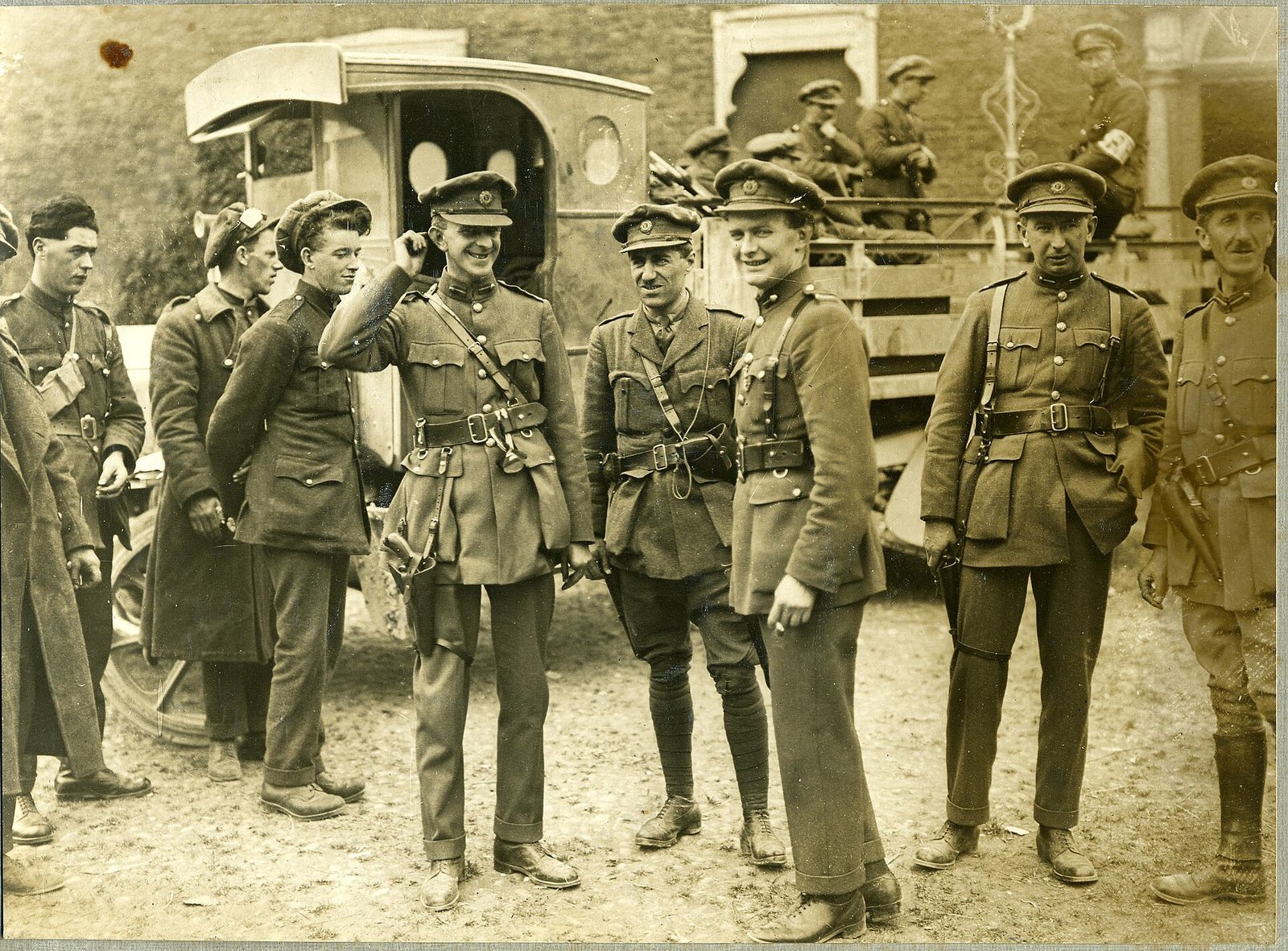
Image: Irish soldiers during the Civil War.jpg — unknown – personal collection, Public domain