How did Siberia become part of Russia?
Siberia became part of Russia through campaigns, fur tribute, and permanent settlements. Yermak’s capture of the Khanate of Sibir’s capital in 1582 was a major opening. Russian foundations at Tyumen in 1586 and Tobolsk in 1587 made that presence more durable. Expansion continued eastward, reaching the Pacific coast in 1639.
If you want a single conquest date, the sequence matters. Taking a capital, establishing administrative centers, and defeating a khan were separate events. Kuchum’s defeat in 1598 marked the collapse of the western Siberian khanate. Russian control across the wider region developed over a longer period.
What was the Khanate of Sibir?
The Khanate of Sibir emerged from the breakup of the Golden Horde. It included Turkic-speaking communities. Turkish Wikipedia dates its existence to 1464–1598. Its capitals included Chimgi-Tura and Qashliq, placing the history of Russian expansion within the history of an existing khanate.
Qashliq also appears under the names Isker and Sibir. It stood on the right bank of the Irtysh River, about 17 kilometers from present-day Tobolsk. When you encounter these different names, you are reading about the same khanate center. That distinction helps connect accounts of the campaign with archaeological work at Isker.
Relations with Moscow preceded Yermak’s expedition. In 1555, envoys sent by Yadigar Khan recognized the supremacy of Ivan IV. They also accepted an annual payment in furs. Moscow therefore had a tribute relationship with Sibir before Russian forces entered its capital.
How did Kuchum change relations with Moscow?
Kuchum, a member of the Shaybanid dynasty, seized power in 1563. He overthrew and killed the Taybugid rulers Yadigar and Bekbulat. His takeover changed the leadership of the khanate that had accepted Moscow’s supremacy eight years earlier.
Kuchum initially continued paying fur tribute to Moscow. In the chronology presented by Armstrong, his final payment came in 1571. The succession of tribute agreements, a violent takeover, and discontinued payments shows that relations changed before Yermak’s military advance.
Ivan IV’s charter of 1574 authorized the Stroganov family to build fortifications beyond the Urals. It named the Tobol, Irtysh, and Ob rivers. These permissions connected the family’s activities with routes that would also matter to Russian expansion into Siberia.
Why did Yermak march against Sibir?
The Stroganovs were wealthy merchants in the Urals. They hired Yermak Timofeyevich’s Cossack force to protect their estates from attacks by Tatars and other local communities. The expedition grew out of this setting of merchant property, armed protection, and conflict along the frontier.
Who decided to attack the khanate remains disputed. One interpretation assigns the order to the Stroganovs. Another holds that Yermak’s Cossacks chose to advance themselves. Their employment by the merchants is therefore a separate question from responsibility for the offensive.
The departure date is also disputed. The traditional account places the expedition’s beginning in 1581. Historian Ruslan Skrynnikov instead argued that Yermak was fighting in the Livonian War that year. He placed the departure for Siberia in 1582. Both dates appear in discussions of the campaign.
How did Yermak capture Qashliq?
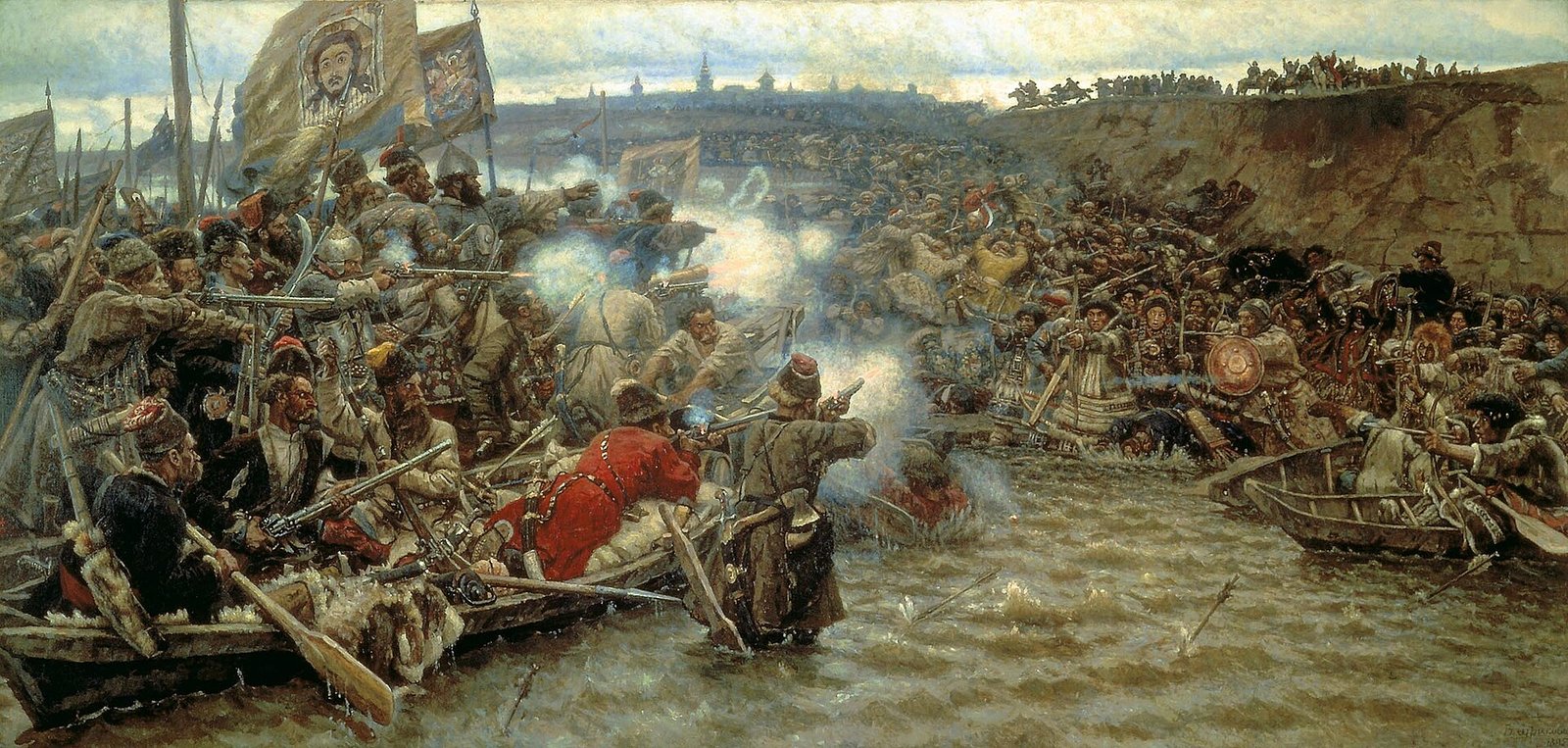
Yermak led a force of several hundred men. They traveled along Siberian rivers in light boats. The campaign depended on waterways, a pattern also seen in the later eastward movement of Russian hunters and merchants through river tributaries and crossings between drainage basins.
In October 1582, Yermak’s forces defeated Kuchum’s army in a three-day battle beside the Irtysh. After fighting around Chuvash Cape, Yermak entered Qashliq on 26 October. The capture placed the khanate’s capital in the hands of his Cossacks.
The weapons carried by those men have also attracted scrutiny. Archaeologist Aleksandr Adamov’s 2021 study identifies matchlock pishchal guns from Russia’s first half of the sixteenth century among the weapons used by Yermak’s soldiers. His interpretation draws on finds from Isker.
Adamov also challenged claims that the Cossacks carried flintlock weapons and pistols. The Isker collections he examined did not confirm those claims. You should therefore distinguish the matchlocks supported by his study from other weapons attributed to the expedition.
What happened after Yermak’s death?
Kuchum’s attack brought Yermak’s campaign to a fatal end, but the year differs between accounts. Turkish Wikipedia gives 1584. Maureen Perrie’s entry in the Encyclopedia of Russian History dates the fatal raid to 1585. The disagreement should remain visible when describing his final campaign.
After Yermak’s defeat, the surviving Cossacks withdrew from Qashliq under Meshcheryak. Their retreat shows how insecure the initial occupation remained. The seizure of the capital in 1582 had not created an uninterrupted Russian hold on that center.
Russian foundations soon provided a more permanent presence. Tyumen was established in 1586, followed by Tobolsk in 1587. These became military and administrative centers in western Siberia. Their establishment links the story of conquest to the practical work of maintaining Russian authority.
Kuchum suffered another decisive defeat in August 1598 at the Battle of Irmen, near the Ob. He escaped without being captured by the Russians. His defeat nevertheless marked a principal turning point in the destruction of the Khanate of Sibir.
Why did furs, rivers, and forts matter?
Fur connected military expansion with revenue. Russian ostrog forts stood at river junctions and places where boats were carried overland. They served to control local populations and collect yasak, a fur tribute. Their locations joined transport routes to the machinery of tribute collection.
Sable pelts were valuable in European markets. They became a symbol of Siberia’s wealth and drew Russian merchants and hunters eastward for centuries. For an everyday comparison, think about checking a coat’s price: the material’s value matters. In Siberia, valuable pelts helped drive both commerce and tribute demands.
The direction of the rivers required crossings between river systems. Many major Siberian rivers flowed toward the Arctic Ocean. Hunters and merchants advanced eastward by following tributaries and using passages between drainage basins. River travel therefore involved connections between waterways as well as movement along them.
In 1639, Ivan Moskvitin reached the coast of the Sea of Okhotsk. His arrival marks a major stage in Russian movement through Siberia to the Pacific. It belongs to the longer expansion that followed the struggle with Sibir, rather than to Yermak’s own campaign.
Timeline
- 1464: The beginning of the Khanate of Sibir’s existence as dated by Turkish Wikipedia, which gives the period 1464–1598.
- 1555: Yadigar recognized Moscow’s supremacy and accepted annual fur tribute.
- 1563: Kuchum overthrew Yadigar and Bekbulat and seized the khanate.
- 1571: Kuchum made his final tribute payment according to Armstrong’s chronology.
- 1574: The Stroganovs received permission to build fortifications beyond the Urals.
- 1581–1582: The two principal proposed dates for the beginning of Yermak’s expedition.
- October 1582: Yermak defeated Kuchum’s army and entered Qashliq on 26 October.
- 16 November 1582: Ivan IV reprimanded the Stroganovs over their deployment of Yermak.
- 1584–1585: The competing dates for Yermak’s death; Perrie gives 1585.
- 1586: The Russians founded Tyumen.
- 1587: The Russians founded Tobolsk.
- August 1598: Kuchum lost the Battle of Irmen but escaped capture.
- 1639: Moskvitin reached the Sea of Okhotsk coast.
Details you won’t find in guidebooks
Ivan IV reprimanded the Stroganovs in a letter dated 16 November 1582. He accused them of sending Yermak and his men to the wrong place. This response complicates any account that presents the expedition as a straightforward execution of the ruler’s instructions.
Stone bullet molds found at Isker reveal a practical detail of the soldiers’ equipment. They cast their lead ammunition in molds. Alongside the matchlock evidence, these objects bring the campaign down to the level of weapons and the production of bullets.
Kuchum escaped after his defeat in 1598, but captured members of his family were taken to Moscow. They were held there as hostages. His personal escape therefore had a different outcome from the experience of those relatives who fell into Russian hands.
FAQ
When did Siberia become part of Russia?
It happened through a long process. Yermak captured Qashliq in 1582, permanent Russian centers followed in 1586 and 1587, and Kuchum suffered a major defeat in 1598. Russian expansion reached the Pacific coast in 1639.
Was Yermak’s expedition ordered by the Stroganovs?
The Stroganovs hired Yermak’s Cossacks to defend their estates. Whether they also ordered the attack on Sibir is disputed; another interpretation assigns that decision to the Cossacks themselves.
Did Yermak die in 1584 or 1585?
The sources differ. Turkish Wikipedia gives 1584, while Maureen Perrie dates Kuchum’s fatal attack on Yermak to 1585.
Why was the fur trade important to Russian expansion?
Sable pelts were valuable in European markets. Fur attracted merchants and hunters, while Russian forts supported the collection of a fur tribute called yasak.
Sources
- Vikipedi — Sibir Hanlığı tr.wikipedia.org
- Wikipedia — Qashliq en.wikipedia.org
- Armstrong — Yermak’s Campaign in Siberia api.pageplace.de
- Maureen Perrie — Encyclopedia of Russian History: Yermak Timofeyevich encyclopedia.com
- Library of Congress — The Russian Discovery of Siberia loc.gov
- Wikipedia — Russian conquest of Siberia en.wikipedia.org
- A. A. Adamov — Firearms and weapon devices of the Russian army in 1582–1585 researchgate.net
Image: Surikov Pokoreniye Sibiri Yermakom.jpg — Vasiliy Surikov, Public domain