A didgeridoo is a tube-shaped wind instrument developed by Aboriginal peoples in northern Australia. Its traditional homeland is Arnhem Land and the Top End, and players create its deep sound by vibrating their lips, sustaining it through circular breathing.
That continuous sound raises a practical question: how can someone breathe without stopping the music? The answer involves air stored in the cheeks. But understanding the instrument also means following its local names, termite-hollowed timber and place in ceremonies. You can begin with the tube, then listen for the human actions that transform its sound.
Where is the didgeridoo from?
The didgeridoo’s traditional homeland lies in Arnhem Land and the Top End of Australia’s Northern Territory. These regional roots matter when discussing an instrument associated with Aboriginal peoples. Local names and performance practices connect it to particular communities within northern Australia.
An assessment by anthropologist A. P. Elkin in 1938 recorded the instrument in eastern Kimberley and the northern third of the Northern Territory. That account describes its known distribution at the time. It does not establish where or when the first instrument was made.
Arnhem Land rock art provides another kind of evidence. A painting at Ginga Wardelirrhmeng shows a didgeridoo player with two singers taking part in an Ubarr ceremony. The scene places the instrument alongside voices in a ceremonial setting.
How old is the didgeridoo?
The instrument’s exact age remains disputed. Arnhem Land depictions are assigned to a rock-art phase that began about 1,500 years ago. Dating that phase does not provide a precise invention date. A depiction records an instrument already known to the people who represented it.
The Musical Instruments Museum in Brussels cites cave depictions about 1,500 years old. It also suggests that use of the instrument probably reaches further back. This assessment distinguishes the surviving visual evidence from the potentially longer history of playing.
Ethnomusicologist Alice M. Moyle proposed a different historical interpretation in 1981. Drawing on the distribution of native bamboo, she suggested that early instruments originated in the northwestern Northern Territory. She argued that they spread into Arnhem Land within the preceding 1,000 years or less. This remains a theory about origins and movement.
Didgeridoo meaning: what is its real name?
The word “didgeridoo” does not come from an Aboriginal language. A common explanation treats it as an imitation of the instrument’s sound. The familiar English name therefore has a different origin from the names used by the communities that make and play it.
Among Yolngu peoples in northeastern Arnhem Land, yiḏaki, also written yidaki, refers particularly to the instrument type made and played within those communities. You should read that name with its regional meaning in mind. It identifies a tradition more precisely than the general English term.
Around Maningrida, the names mako or mago occur in Kunwinjku, Kune and Kuninjku. Burarra and Gun-nartpa speakers use ngorla. These names show why the question of a single “real name” needs a local answer: several languages have their own terms for the instrument.
Didgeridoo pronunciation
In English, didgeridoo is pronounced /ˌdɪdʒəriˈduː/. The final syllable carries the main stress. If you are saying the word aloud, give that last “doo” the strongest emphasis.
The spelling has also varied in print. In 1908, the Hamilton Spectator used “did-gery-do.” That written form belongs to the history of the English name, whose commonly accepted explanation connects it to an imitation of the sound.
What kind of instrument is a didgeridoo?
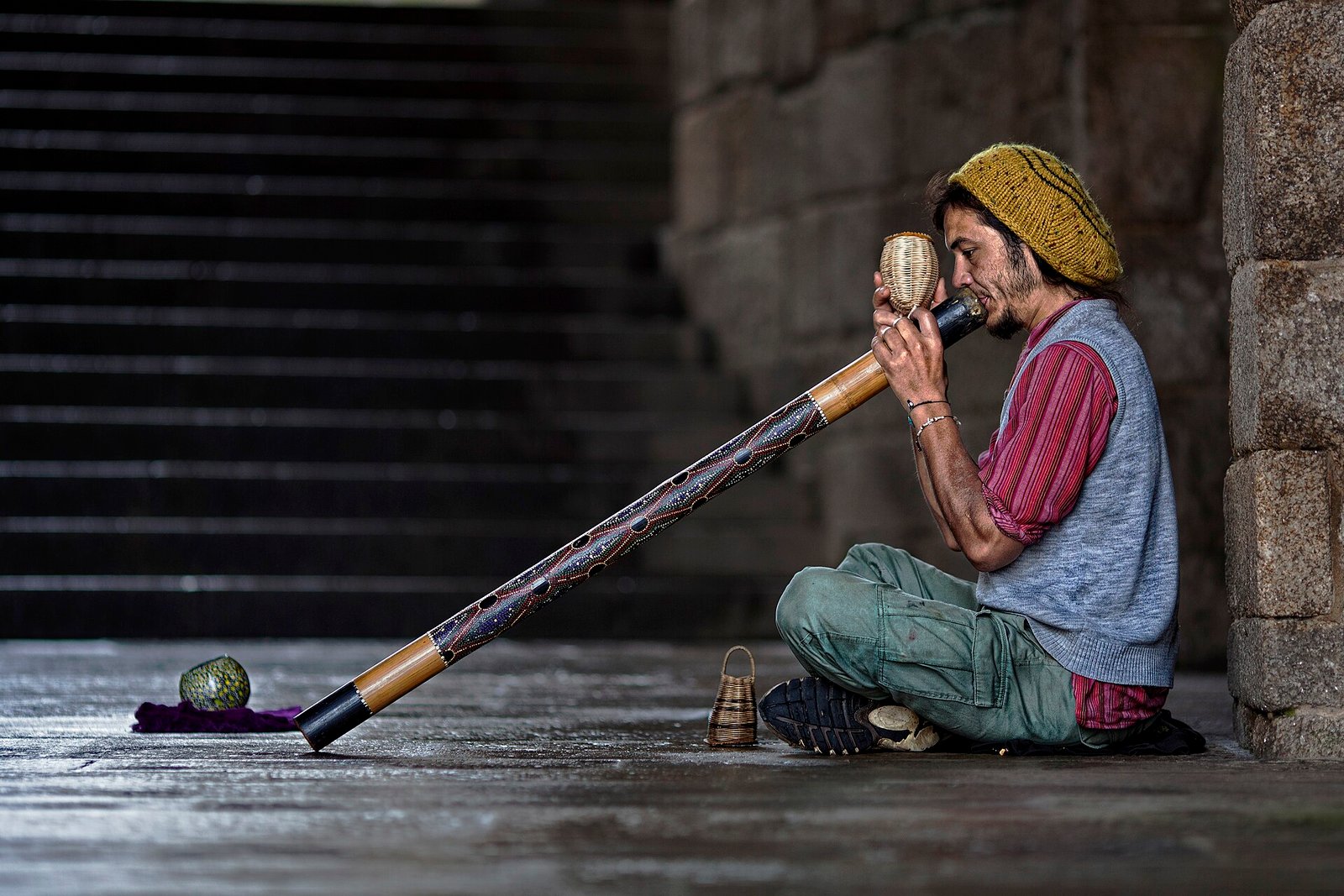
Modern didgeridoos are generally cylindrical or conical tubes. They commonly measure between 1 and 3 metres, with many around 1.2 metres long. Their length and shape help explain why examples can look different while belonging to the same broad instrument family.
Around Maningrida, makers commonly use young trunks of Eucalyptus tetradonta or Eucalyptus miniata. Termites hollow suitable trees from within. The maker then works with that existing cavity to produce the instrument’s open passage.
After cutting the selected trunk, the maker clears away termite debris. The outer bark is removed, and both ends are trimmed. These steps turn a hollowed section of timber into a tube that can be played.
Beeswax is sometimes applied to the blowing end. It narrows the opening and makes contact with the lips more comfortable. This small addition changes the point where the player’s mouth meets the wooden instrument.
Didgeridoo sound: how is it produced?
The player seals the narrow end with the mouth and vibrates the lips to create the basic sound. The action resembles the lip vibration used for brass instruments such as the tuba. The sound begins with the player’s lips, even when the tube itself is made from eucalyptus.
A longer didgeridoo generally produces a lower pitch. Length alone does not determine the result, however. The way the tube widens toward its end also affects pitch. Two instruments therefore need to be considered through both their measurements and their shape.
The player can change the tone by altering the shape of the mouth cavity. The vocal cords can also be used while playing to imitate animal calls. What you hear can therefore combine the low instrumental sound with changes produced inside the player’s mouth and throat.
How is a didgeridoo played without stopping for breath?
Circular breathing allows the player to sustain the sound while replenishing the lungs. Air held in the cheeks is pushed into the instrument. At the same time, the player takes a short breath through the nose. The stored air bridges that moment of inhalation.
You can connect this technique to an everyday action: taking a breath. In didgeridoo playing, the cheeks supply the instrument during the brief nasal inhalation. This coordinated use of cheek air and lung air explains how the sound can continue across the breathing cycle.
Breathing also helps shape the rhythm. By giving rhythmic emphasis to the breathing cycle, a player turns the sustained low sound into a pulsing pattern. Circular breathing therefore supports both continuity and the movement you hear within the drone.
Didgeridoo music and its ceremonial setting
In Maningrida, didgeridoos chiefly accompany songs at public exchange and diplomacy ceremonies. They also accompany songs at funerals and certain death rituals. Their role connects instrumental sound with singing and with specific occasions in community life.
In western and central Arnhem Land traditions, the didgeridoo is generally not a solo instrument. It is also absent from the region’s most secret and sacred ceremonies. Its ceremonial importance should therefore be understood through the particular settings in which it is played.
Aboriginal rock groups such as Arnhem Land’s Yothu Yindi have helped increase the instrument’s international recognition. That wider audience forms another part of its musical story, alongside the regional traditions of song accompaniment.
Timeline
- About 1,500 years ago: An Arnhem Land rock-art phase begins. Didgeridoo depictions are assigned to this phase, which does not establish an exact invention date.
- 1835: T. B. Wilson’s Narrative of a Voyage Round the World includes a drawing of an Aboriginal man from Raffles Bay on the Cobourg Peninsula playing the instrument.
- 1908: The Hamilton Spectator prints the spelling “did-gery-do.”
- 1938: A. P. Elkin describes its known distribution as eastern Kimberley and the northern third of the Northern Territory.
- 1981: Alice M. Moyle publishes an article proposing an account of the instrument’s origins and spread into Arnhem Land.
Details you won’t find in guidebooks
Maningrida makers listen to trees before selecting suitable timber. They remove a small patch of bark and tap the trunk. The resulting sound helps them identify a tree hollowed by termites. Listening is therefore part of making the instrument as well as playing it.
The Musical Instruments Museum in Brussels holds five examples measuring between 83 and 132 centimetres. Those collection measurements provide a concrete view of variation between individual instruments. They also sit alongside the broader dimensions commonly given for modern didgeridoos.
Circular breathing is not confined to the didgeridoo. It is also used with Indonesian flutes and in oboe and flute performance. The technique belongs to a wider range of wind-instrument practices, even though it is central to sustaining the didgeridoo’s sound.
FAQ
What is a didgeridoo?
A didgeridoo is a tube-shaped wind instrument developed by Aboriginal peoples in northern Australia. The player produces its basic sound by vibrating the lips.
Where is the didgeridoo from?
Its traditional homeland is Arnhem Land and the Top End in Australia’s Northern Territory. Its exact date of invention remains uncertain.
What is the didgeridoo’s real name?
Different communities use different names. These include yiḏaki or yidaki among Yolngu peoples of northeastern Arnhem Land, mako or mago in Kunwinjku, Kune and Kuninjku, and ngorla in Burarra and Gun-nartpa.
How do you pronounce didgeridoo?
The English pronunciation is /ˌdɪdʒəriˈduː/, with the stress on the final syllable.
How does a didgeridoo player keep the sound going?
Through circular breathing, the player pushes stored air from the cheeks into the instrument while briefly inhaling through the nose. This refills the lungs without interrupting the sound.
Sources
- Musical Instruments Museum — Didjeridoo mim.be
- Maningrida Arts & Culture — About musical instruments maningrida.com
- Turkish Wikipedia — Didgeridoo tr.wikipedia.org
- English Wikipedia — Didgeridoo en.wikipedia.org
- Alice M. Moyle — 1981 article on the didgeridoo tandfonline.com
- Neville Fletcher, UNSW — The Didjeridu newt.phys.unsw.edu.au
Image: Didgeridoo street player-2.jpg — Didgeridoo_street_player.jpg: Noel Feans
derivative work: To, CC BY 2.0