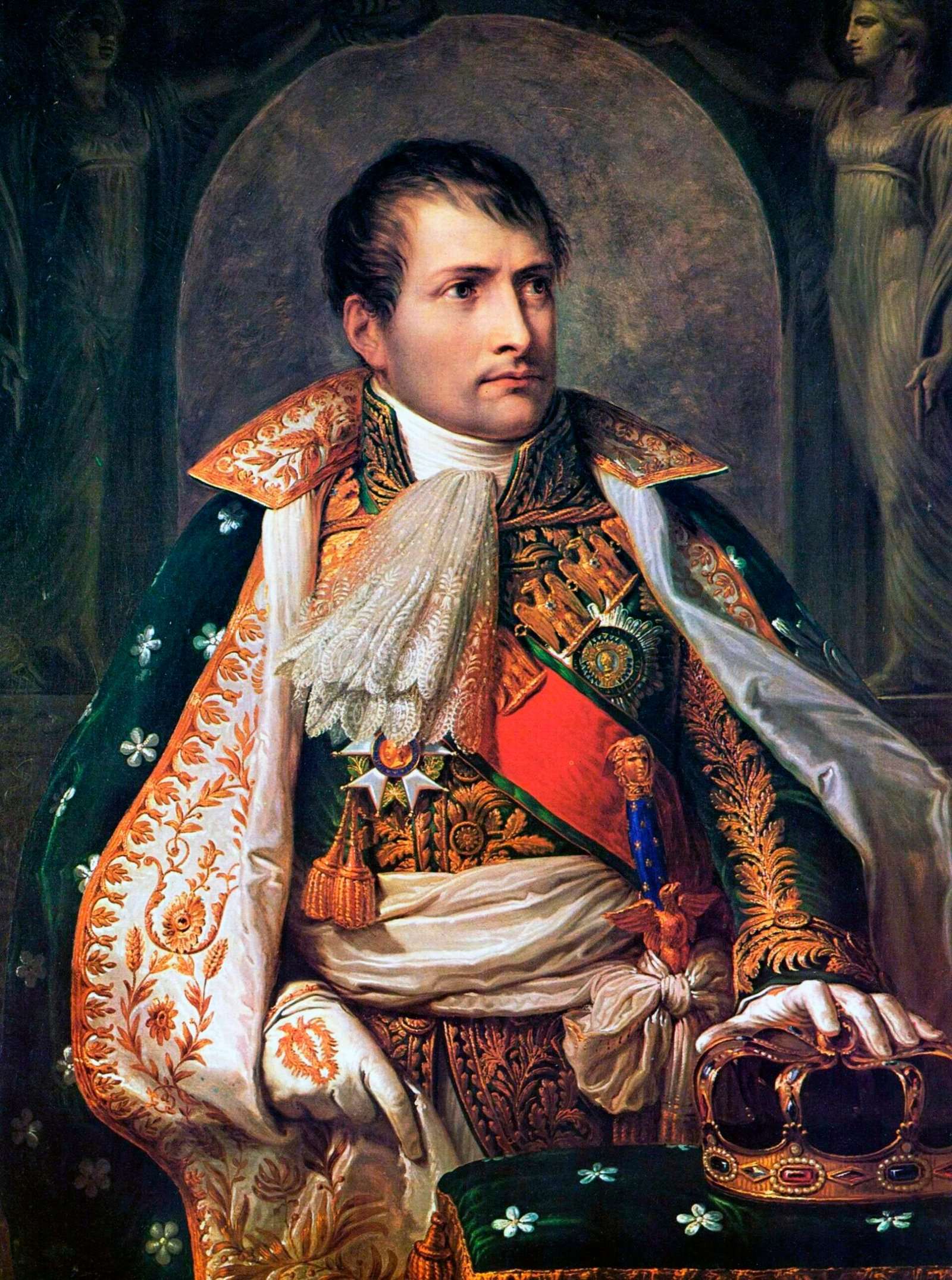
You know the name. You may have seen the hat, the hand in the waistcoat, the painting on the rearing horse. Behind the images stands a man who was born on an island that had been French for one year, ruled most of Europe, and died on another island 1,870 km from the nearest coast. This article follows him from Ajaccio to Waterloo, with a stop at a city wall in Acre that matters to anyone reading this in Turkey.
Napoleon: where is he from?
Napoleon was born on 15 August 1769 in Ajaccio, Corsica. The Republic of Genoa had handed the island to France in 1768, so he arrived one year after Corsica became French. His birth name was Napoleone di Buonaparte. His father was Carlo Buonaparte and his mother Maria Letizia Ramolino. He was the second of eight children.
In 1779 he was sent to France with his older brother Joseph and entered the military school at Brienne. In September 1784 he moved to the École Militaire in Paris. He graduated in September 1785, the first Corsican to do so. The mathematician Pierre-Simon Laplace sat on his examination board.
Napoleon Bonaparte: from artillery officer to First Consul
The Revolution gave the young officer his opening. At the siege of Toulon in 1793 he commanded the artillery. On 18 December 1793 his guns took the key hill, and he became a brigadier general at 24. On 5 October 1795 he put down a royalist rising in Paris with cannon fire.
On 9 March 1796 he married Joséphine de Beauharnais. The same month he took command of the Army of Italy. In that campaign he fought 67 engagements, including 18 pitched battles, and took 150,000 prisoners and 540 guns.
The Egyptian expedition of 1798 was part military, part scientific. 167 scholars travelled with the army. Their work appeared in 1809 as the Description de l’Égypte. In July 1799 soldiers under Captain Pierre-François Bouchard found the Rosetta Stone at Fort Julien near Rashid (Rosetta). It passed to the British when Alexandria surrendered in 1801 and has sat in the British Museum since 1802.
On 9 November 1799 the coup of 18 Brumaire made him First Consul. The 1800 plebiscite recorded 3,011,007 votes for and 1,562 against.
The wall that stopped him: Acre, 1799
If you travel in Turkey, this is the chapter to remember. Between 20 March and 21 May 1799 Napoleon besieged Acre. The Ottoman garrison of about 5,000 men under Cezzar Ahmed Pasha, backed by Sidney Smith’s British squadron, held out against a French army of 12,000 to 13,000. The French lost 2,300 dead in the fighting, and plague killed another 2,000 soldiers.
The siege is counted as the turning point of the Egyptian campaign. In 1805 Napoleon said that had he taken Acre, he would have made himself ’emperor of the East’ and returned to Paris by way of Istanbul. An Ottoman governor’s walls closed that road.
Emperor: the Code, the crown, Austerlitz
On 30 April 1803 Napoleon sold Louisiana to the United States for 15 million dollars (80 million francs). The roughly 2.14 million km² nearly doubled the size of the USA.
The French Civil Code, the Code Napoléon, came into force on 21 March 1804. A four-man commission of Tronchet, Portalis, Maleville and Bigot de Préameneu wrote it, and Napoleon chaired most of the sessions. The code is still in force in France today. Here is the everyday link: if you ever sign a rental contract or inherit property in France, the rules trace back to that 1804 text.
In May 1804 a vote of 3,572,329 to 2,579 made him emperor. He was crowned at Notre-Dame on 2 December 1804. October 1805 brought defeat for the Franco-Spanish fleet at Trafalgar. December 1805 brought the victory at Austerlitz. After Jena in October 1806 and Friedland in June 1807, the Treaty of Tilsit followed in July 1807.
His marriage to Joséphine was annulled in January 1810. On 1 April 1810 he married the Austrian archduchess Marie Louise. Their son, the King of Rome, was born on 20 March 1811.
Russia, Leipzig, Elba
On 24 June 1812 the first wave of the Grande Armée crossed the Neman, 440,000 to 450,000 men. On 14 September it entered an empty, burning Moscow. After the Berezina crossing of 26 to 29 November, only about 75,000 soldiers made it back west of the Neman.
At Leipzig on 19 October 1813 the French lost 38,000 dead and wounded and 15,000 prisoners. In April 1814 Napoleon abdicated. The Treaty of Fontainebleau of 11 April 1814 made him sovereign of Elba, an island of 12,000 people, with an allowance of 2 million francs a year. He built roads and developed the iron mines. On 26 February 1815 he left with about 1,000 men and 7 ships.
Waterloo, 18 June 1815
He landed at Golfe-Juan on 1 March 1815 and entered Paris on 20 March. The Hundred Days had begun. On 12 June he marched into Belgium with the Army of the North, about 124,000 strong.
The battle was fought on Sunday 18 June 1815 on the ridge of Mont-Saint-Jean, south of Brussels. About 72,000 to 73,000 French faced Wellington’s 68,000 and, from the afternoon, about 50,000 Prussians. Heavy rain the night before had turned the ground to mud, so Napoleon delayed his attack. Wellington put the start at 10:00, other sources at 11:30. At 16:30 the Prussians opened the road through Plancenoit. The Imperial Guard attacked at 19:30 and was thrown back. The cry ‘La Garde recule’ spread panic, and the army came apart.
Wellington’s army lost about 17,000 killed and wounded, the Prussians 6,600 to 7,000, the French 25,000 plus 8,000 prisoners. At least 7,000 horses were killed or injured. Four days later, on 22 June 1815, Napoleon abdicated for the second time.
Saint Helena and death
In October 1815 he reached Saint Helena with a suite of 27 people. The island lies 1,870 km off the African coast. 2,100 soldiers and a squadron of 10 ships guarded him. From 10 December 1815 until his death he lived at Longwood House.
He died there on 5 May 1821, aged 51. The autopsy on 6 May recorded internal bleeding caused by stomach cancer. In 2021 an international team of gastrointestinal pathologists reached the same conclusion.
The arsenic theory rests on a 1961 hair analysis. In 2008 hairs examined by neutron activation at the University of Pavia showed similar arsenic levels from Napoleon’s childhood to his death. People of that era carried about 100 times today’s arsenic in their hair, which points to an environmental source. The poisoning claim was rejected.
France bought Longwood House and the Valley of the Tomb in 1858 for 7,100 pounds. The house is now a museum owned by the French Ministry of Foreign Affairs. The body itself came back in 1840. On 15 December 1840 about a million people attended the burial at Les Invalides. On 2 April 1861 the nested coffins were placed in the crypt under the dome, in a sarcophagus long believed to be porphyry but actually red quartzite.
Napoleon height: was he short?
The death record gives his height as 5 pied 2 pouce 4 ligne. The old French inch was longer than the English inch, so the figure converts to about 1.68 to 1.70 m, not 1.58 m. That was average for his time. A counter-argument holds that the measurement on Saint Helena may have used an English ruler, which would support 1.58 m. Either way, ‘short Napoleon’ is a debate about units more than about the man.
Napoleon II and Napoleon III
Napoleon II, the King of Rome, counted as emperor only on paper from 22 June to 7 July 1815. He grew up in Vienna as ‘Franz’, Duke of Reichstadt, and died of tuberculosis at Schönbrunn on 22 July 1832, aged 21. In 1940 Hitler had his remains moved to Les Invalides. His heart and intestines stayed in Vienna by Habsburg custom.
Napoleon III was the emperor’s nephew, son of his brother Louis and Hortense de Beauharnais. In December 1848 he became France’s first elected president with 74 percent of the vote. He staged a coup on 2 December 1851 and proclaimed the empire on 2 December 1852. Captured at Sedan in 1870, he died at Chislehurst in England on 9 January 1873.
Napoleon movie: what is invented
French guns never fired at the pyramids.
Details you won’t find in guidebooks
- He wore his bicorne hat ‘en bataille’, points over the shoulders, unlike everyone else. The court ordered four hats a quarter. Between 1804 and 1815, 120 to 160 were bought. About 20 survive.
- On 19 November 2023 one of those hats sold at Osenat in Fontainebleau for 1.932 million euros with commission, beating the 2014 record of 1.884 million.
- The Lion’s Mound at Waterloo is 43 m high. King Willem I of the Netherlands ordered it in 1820, and it was built in 1823-1826 from 300,000 m³ of earth taken from the battlefield. 226 steps lead to a 28-ton lion. Legend says it was cast from cannon bronze. It is cast iron.
Timeline
- 15 August 1769 born in Ajaccio, Corsica
- December 1793 siege of Toulon, promoted to brigadier general
- 9 March 1796 marries Joséphine, commands the Army of Italy
- 20 March – 21 May 1799 siege of Acre, repulsed by Cezzar Ahmed Pasha
- July 1799 Rosetta Stone found during the Egyptian campaign
- 9 November 1799 coup of 18 Brumaire, First Consul
- 30 April 1803 sells Louisiana to the USA
- 21 March 1804 Code Napoléon in force
- 2 December 1804 crowned emperor at Notre-Dame
- December 1805 victory at Austerlitz
- 20 March 1811 son Napoleon II born
- 24 June 1812 invasion of Russia begins; Moscow 14 September; Berezina in November
- 19 October 1813 defeat at Leipzig
- 11 April 1814 abdication, exile to Elba
- 26 February 1815 escapes Elba; Paris on 20 March (Hundred Days)
- 18 June 1815 Waterloo; second abdication on 22 June
- 10 December 1815 settles at Longwood House, Saint Helena
- 5 May 1821 dies at Longwood House
- 15 December 1840 buried at Les Invalides, Paris
- 2 April 1861 placed in the quartzite sarcophagus in the crypt
- 2008 Pavia hair analysis rejects the arsenic theory
FAQ
Where was Napoleon from?
He was born on 15 August 1769 in Ajaccio, Corsica, one year after the Republic of Genoa handed the island to France in 1768. His birth name was Napoleone di Buonaparte.
How tall was Napoleon really?
His death record gives 5 pied 2 pouce 4 ligne in old French units. Because the French inch was longer than the English inch, that converts to about 1.68 to 1.70 m, average for his time. A counter-view says an English ruler may have been used on Saint Helena, which would support 1.58 m.
How did Napoleon die?
He died at Longwood House on Saint Helena on 5 May 1821, aged 51. The autopsy of 6 May recorded internal bleeding caused by stomach cancer, and a 2021 international pathologist team reached the same conclusion. A 2008 hair analysis at the University of Pavia rejected the arsenic poisoning theory.
Did Napoleon ever fight the Ottomans?
Yes. From 20 March to 21 May 1799 he besieged Acre, held by about 5,000 Ottoman troops under Cezzar Ahmed Pasha with support from Sidney Smith’s British squadron. The French lost 2,300 dead in the fighting and 2,000 more to plague, and withdrew.
Sources
- Wikipedia (EN) – Napoleon en.wikipedia.org
- Vikipedi – Napolyon tr.wikipedia.org
- Wikipedia (EN) – Rosetta Stone en.wikipedia.org
- Wikipedia (EN) – Siege of Acre (1799) en.wikipedia.org
- Wikipedia (EN) – Louisiana Purchase en.wikipedia.org
- Wikipedia (EN) – Napoleonic Code en.wikipedia.org
- Wikipedia (EN) – French invasion of Russia en.wikipedia.org
- Wikipedia (EN) – Principality of Elba en.wikipedia.org
- Wikipedia (EN) – Battle of Waterloo en.wikipedia.org
- Wikipedia (EN) – Lion’s Mound en.wikipedia.org
- Wikipedia (EN) – Longwood House en.wikipedia.org
- Wikipedia (EN) – Death of Napoleon en.wikipedia.org
- Physics World – Napoleon not murdered, say physicists physicsworld.com
- Britannica – Napoleon as Pop Culture Icon britannica.com
- Fondation Napoléon – Pierre Branda, Napoleon’s Hat napoleon.org
- The Peninsula (AFP) – Napoleon’s hat sells for record 1.9 mn euros thepeninsulaqatar.com
- Fondation Napoléon – Bullet point 27, most visited place of Napoleonic memory napoleon.org
- Wikipedia (EN) – Napoleon II en.wikipedia.org
- Wikipedia (EN) – Napoleon III en.wikipedia.org
- Wikipedia (EN) – Napoleon (2023 film) en.wikipedia.org
- Wikipedia (EN) – Mille-feuille en.wikipedia.org
- Fruit Varieties Journal (American Pomological Society), S. Brown 1987 journal.americanpomological.org
Image: Napoleon I of France by Andrea Appiani.jpg — Andrea Appiani, Public domain