The Kingdom of Benin was centred on Benin City in present-day Nigeria, not in the modern Republic of Benin. Its capital was called Edo. Today, that city belongs to Nigeria’s Edo State. If you are trying to locate the kingdom, Benin City is your starting point.
The modern country followed a separate history. It became independent from France as Dahomey on 1 August 1960. In 1975, the Republic of Dahomey changed its name to the People’s Republic of Benin. That later name should not move the historical Edo kingdom across your map.
Kingdom of Benin map: where was it?
The kingdom’s political centre was Edo, now Benin City. Its territory lay in what is now Nigeria. The Metropolitan Museum of Art places the reach of its authority around 1500 between the Niger Delta to the east and the Lagos coastal lagoon to the west.
That description gives you more than a capital marker. Benin was a regional power whose authority extended beyond its court. The Niger Delta and Lagos coastal lagoon provide reference points for its reach at that particular moment, around 1500.
Benin City also belonged to a wider trading world. Cloth, pepper, ivory and salt circulated through networks connecting West Africa, Central Africa and the Atlantic. The capital was one of the centres within those networks.
Where is the Kingdom of Benin now?
The kingdom’s historical centre remains Benin City in Nigeria’s Edo State. British annexation in 1897 ended its sovereignty. The monarchy continued afterward without sovereign political status.
The oba’s palace and ceremonial leadership survive in Benin City. The city remains a spiritual centre for Edo people and a place where craft guilds work. Its continuing monarchy therefore belongs to a different political setting from the independent kingdom that existed before 1897.
Kingdom of Benin history: rulers and changing power
The Pitt Rivers Museum dates the beginning of the kingdom, also known as Edo, to approximately AD 900. Its rulers later bore the title oba, meaning king. Eweka is identified as the first oba.
Accounts of the dynasty’s origins differ. One oral tradition connects its foundation to Oranmiyan, who came from Ife. Alternative Edo accounts connect the dynasty to the line of Ogiso Owodo. Historians regard some of these alternatives as narratives formed in modern times, so these traditions require careful attribution.
Oba Ewuare came to the throne around 1440. He is associated with developing the capital and establishing three associations of palace chiefs. His reign provides a concrete connection between the growth of royal power and the organisation of the court.
Power also changed through conflict. Paula Ben-Amos Girshick and John Thornton argue that the civil war of 1689–1721 transformed the kingdom. In their interpretation, government moved from a more centralised structure toward one in which power was shared more widely.
Timeline
- Around AD 900: Beginning of the kingdom, according to the Pitt Rivers Museum’s dating.
- Around 1440: Oba Ewuare took the throne; he is associated with developing the capital and establishing three associations of palace chiefs.
- Around 1500: Benin’s authority reached between the Niger Delta and the Lagos coastal lagoon.
- 1689–1721: Civil war changed the distribution of political power.
- 1897: British forces captured Benin City, looted the palace and ended the kingdom’s independence.
- 1 August 1960: The separate country of Dahomey became independent from France.
- 1975: Dahomey adopted the name People’s Republic of Benin.
- 1 November 1995: Nigeria submitted Benin Iya / Sungbo’s Eredo to the UNESCO World Heritage Tentative List.
Kingdom of Benin walls: earthworks and ditches
The structures commonly discussed as Benin’s walls included earthen banks and ditches. Nigeria’s UNESCO submission describes a network belonging to communities in the Benin rainforest region. It gives a combined length of about 16,000 kilometres across approximately 6,500 square kilometres.
Those figures describe a regional network. They should not be read as the length of one wall surrounding the royal palace or the capital alone. The submission includes earthworks associated with communities and settlement enclosures across the wider area.
The UNESCO description dates the network’s core to approximately the eighth century. It dates the wider surrounding settlement enclosures as late as the fifteenth century. These dates concern different parts of the earthwork system, rather than a single construction event.
Benin Iya / Sungbo’s Eredo entered Nigeria’s UNESCO Tentative List submission on 1 November 1995. That designation is specifically a Tentative List entry.
Kingdom of Benin religion: the oba and the ancestors
The oba combined political leadership with religious authority. He served as a high priest and led important religious ceremonies. Understanding his position therefore requires attention to both government and ritual.
Edo ancestor worship included palace altars for deceased obas and queen mothers bearing the title iyoba. Brass or bronze heads commemorated these figures. Such sculptures belonged to practices of remembrance within the palace, linking court art to religious life.
Kingdom of Benin art: materials and royal memory
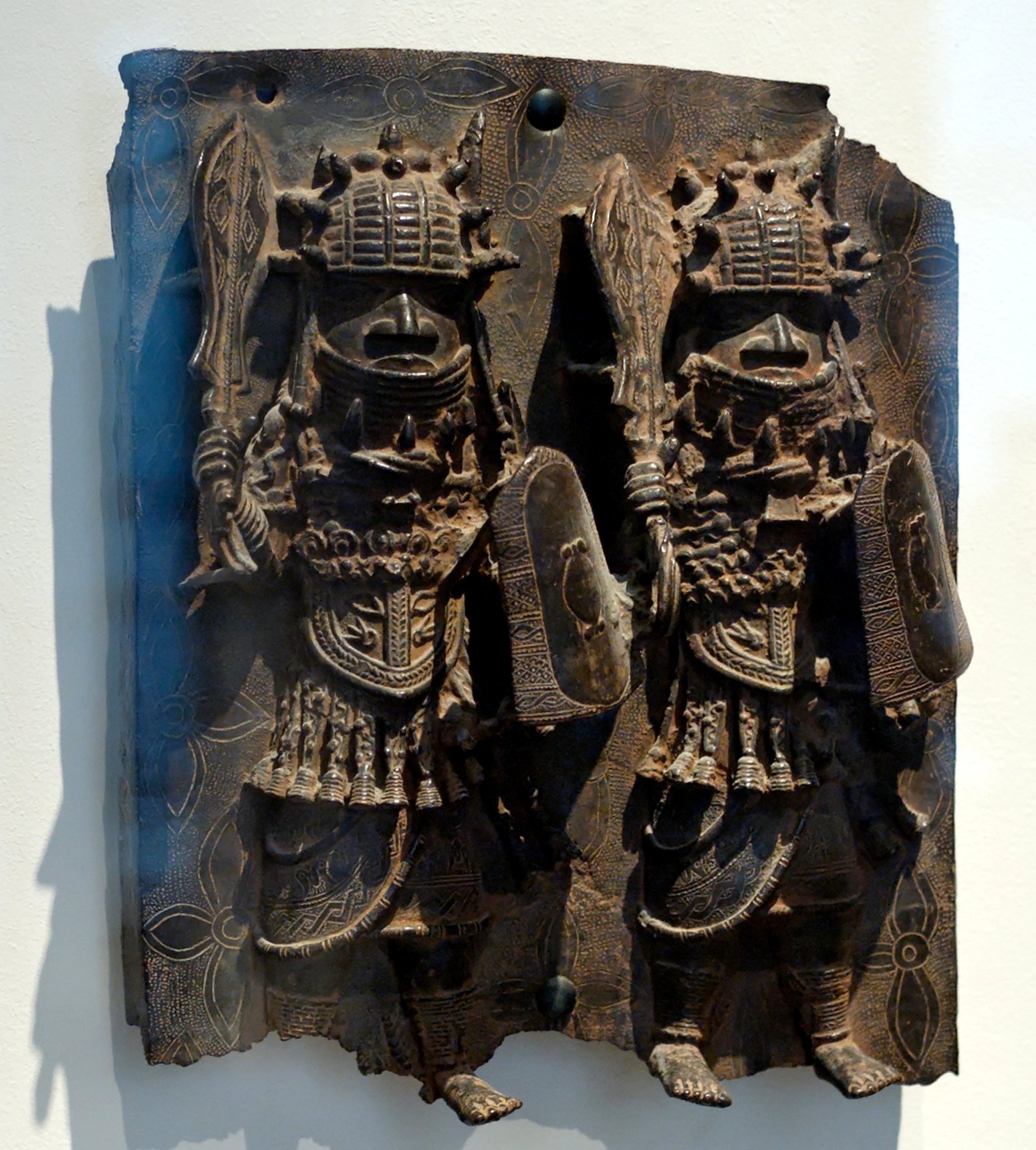
Benin artists worked in brass, wood and ivory. They made relief plaques showing historical events, as well as sculptures of human heads. These objects connected artistic production with the people and events remembered at court.
The commemorative heads also show why material and purpose belong together. A brass or bronze head on an ancestral altar was part of the remembrance of a deceased oba or iyoba. Its role extended beyond its appearance as a crafted object.
The palace’s artworks suffered a violent dispersal in 1897. After British forces captured Benin City, soldiers looted objects from the palace. Oba Ovonramwen was exiled to Calabar.
Kingdom of Benin slavery and trade
Benin’s trading history included enslaved people as well as goods such as pepper, cloth, ivory and salt. The Metropolitan Museum of Art states that, for centuries, Benin’s rulers limited their participation in the Atlantic slave trade to selling war captives to the Portuguese.
Slavery within the kingdom also needs a distinction. Philip A. Igbafe’s 1975 study describes slavery and the pledging of people against debt as closely related but separate institutions in precolonial Benin. Treating them as interchangeable would erase that distinction.
Igbafe also argues that British authorities used emancipation to help facilitate their occupation when they entered Benin in 1897. This places the freeing of enslaved people within the circumstances of conquest and colonial occupation.
Kingdom of Benin flag: what did it mean?
A red flag showing a beheading scene is often presented as the kingdom’s official flag. Its attribution is uncertain. Royal Museums Greenwich offers an alternative identification: “probably Itsekiri.”
The uncertainty affects its meaning as well as its identity. You cannot securely assign official Benin state symbolism to the scene when the object’s use by the kingdom is itself unresolved. The image alone does not establish either an official flag or an agreed interpretation.
Details you won’t find in guidebooks
The Pitt Rivers Museum describes sixteenth-century Benin City as a planned city with street lighting, drainage, earthen walls and ditches called iya. Think of the street lighting and drains you encounter in everyday life: these same practical concerns formed part of the capital’s urban organisation.
Portuguese maritime traders also entered Edo religious imagery. Artists associated them with Olokun, the deity of waters and prosperity. They depicted these traders alongside animals that live between water and land.
An ivory saltcellar in the Metropolitan Museum of Art dates to approximately 1525–1600. Its Portuguese figures show that Benin artists also produced objects for European customers. Court-linked artistic skill thus reached customers beyond the kingdom.
Sound had specific ceremonial functions. Brass bells called ancestral spirits. Side-blown ivory horns called oko announced the oba’s arrival and communicated news of births and deaths.
The disputed flag has its own physical details. Royal Museums Greenwich preserves it under the number AAA0557. It measures approximately 1.73 by 3.51 metres, and a paper label attached to its cord bears the name Kennedy.
Kingdom of Benin facts for KS2 readers
For a school summary, begin with the location: Benin was an Edo kingdom in present-day Nigeria. Its capital was Edo, now Benin City. Its kings were called obas, and its artists made objects from brass, wood and ivory.
Keep the two histories separate in your schoolwork. British forces ended the kingdom’s independence in 1897. Modern Benin became independent as Dahomey in 1960 and changed its name in 1975. These dates belong to separate political histories.
FAQ
Where was the Kingdom of Benin?
It was centred on Edo, now Benin City in Nigeria’s Edo State. Around 1500, its authority extended east to the Niger Delta and west to the Lagos coastal lagoon.
Is the Kingdom of Benin the same as modern Benin?
No. Modern Benin became independent from France as Dahomey on 1 August 1960. It adopted the name People’s Republic of Benin in 1975.
What did the Kingdom of Benin flag mean?
The red flag often attributed to the kingdom has an uncertain identity and meaning. Royal Museums Greenwich offers the alternative attribution “probably Itsekiri,” so its imagery cannot securely be interpreted as official Benin symbolism.
Where is the Kingdom of Benin now?
Its historical capital is Benin City in present-day Nigeria. British annexation ended its independence in 1897, but the monarchy continued without sovereignty, and its palace and ceremonial leadership survive.
Sources
- Wikipedia — Kingdom of Benin en.wikipedia.org
- Office of the Historian, U.S. Department of State — Benin (Dahomey) history.state.gov
- Presidency of the Republic of Benin — Histoire du Bénin presidence.bj
- University of Oxford, Pitt Rivers Museum — The Kingdom of Benin prm.ox.ac.uk
- National Geographic Society — The Kingdom of Benin education.nationalgeographic.org
- Art Institute of Chicago — Oba Ewuare and the Portuguese archive.artic.edu
- The Metropolitan Museum of Art — The Legacy of Benin Court Art metmuseum.org
- UNESCO World Heritage Centre — Benin Iya / Sungbo’s Eredo whc.unesco.org
- Indiana University — Civil War in the Kingdom of Benin, 1689–1721 scholarworks.iu.edu
- Cambridge University Press — Slavery and Emancipation in Benin, 1897–1945 cambridge.org
- Royal Museums Greenwich — West African flag rmg.co.uk
- Wikipedia — Unidentified flag from the Kingdom of Benin en.wikipedia.org
Image: Benin kingdom Louvre A97-4-1.jpg — Unknown artistUnknown artist, Public domain