Puerto Rico is a US territory because Spain ceded it to the United States after the Spanish–American War in 1898. US citizenship and the local Constitution adopted in 1952 did not make it a state or an independent country. Changing that status requires federal legislation.
The puzzle becomes clearer when you separate citizenship, local government, and sovereignty. Puerto Ricans gained US citizenship in 1917 and first elected their own governor in 1948. Yet Congress retained broad authority over the territory. Those milestones explain how local political control expanded while the island’s underlying status continued.
Puerto Rico: where is it located, and what is its capital?
Puerto Rico is a Caribbean archipelago between the Dominican Republic and the US Virgin Islands. It includes the main island and smaller islands such as Vieques, Culebra, and Mona. Its capital, San Juan, stands on the main island’s northern coast.
If you are looking at a Puerto Rico map, remember that the political territory includes those smaller islands. The official name, Commonwealth of Puerto Rico, applies to a territory under US sovereignty that has not joined the union as a state.
The US Census Bureau counted 3,285,874 residents on April 1, 2020. Its estimate for July 1, 2025, was 3,184,835. These population figures describe the territory whose political future remains the subject of status referendums.
How did Spanish rule lead to the American takeover?
Christopher Columbus arrived in 1493. Juan Ponce de León began Spanish colonization in 1508. Nearly four centuries of Spanish rule followed, providing the historical foundation for the Spanish language’s dominance in daily life.
Independence was already a political objective under Spain. The Grito de Lares uprising of 1868, supported by Ramón Emeterio Betances, sought independence. It was quickly suppressed. Puerto Rico therefore entered the final decades of Spanish rule without achieving the independence the uprising demanded.
Spain allowed Puerto Ricans to establish an autonomous government early in 1898. The Spanish–American War began that same year and cut its life short. On July 25, American troops landed at Guánica on the island’s southern coast.
The decisive transfer followed through a treaty. Spain agreed to cede Puerto Rico under Article II of the Treaty of Paris, signed on December 10, 1898. The treaty entered into force on April 11, 1899. Puerto Rico passed from Spanish to American sovereignty through that settlement.
Why did US citizenship not make Puerto Rico a state?
American military government gave way to civilian government on May 1, 1900, when the Foraker Act took effect. The new administration was headed by a governor appointed by the US president. Civilian government therefore began with the governor still selected outside Puerto Rico.
The Jones–Shafroth Act granted Puerto Ricans US citizenship in 1917. It did not change Puerto Rico’s status as a territory that had not been admitted as a state. Citizenship and admission to statehood were separate legal developments, and the act delivered only the former.
That distinction still affects political participation. US citizens living in Puerto Rico cannot vote in the presidential general election unless they have official residence in a state or Washington, DC. If you are trying to understand the status debate, this residence rule shows why citizenship alone does not answer every question about voting rights.
Puerto Rico also has a representative in Washington called the Resident Commissioner. That representative cannot participate in final votes on the floor of the US House of Representatives. The territory thus has representation with a specific limit on voting power.
What did the Commonwealth arrangement change in 1952?
Puerto Ricans first elected their own governor in 1948. Luis Muñoz Marín won that election. It marked a change from the earlier system established under the Foraker Act, in which the US president appointed the governor.
The Puerto Rico Constitution took effect on July 25, 1952. It established the local constitutional framework of Commonwealth government. The official Commonwealth name belongs to this arrangement, but the Constitution did not turn Puerto Rico into a state or an independent country.
The meaning of the 1952 settlement remains disputed. One interpretation treats it as a special partnership based on mutual consent. The opposing interpretation emphasizes that Congress’s constitutional authority over territories continued. Article IV of the US Constitution gives Congress broad powers over Puerto Rico, and a status change requires federal legislative action.
Why have votes for statehood not changed Puerto Rico’s status?
The June 11, 2017, referendum produced a large percentage for statehood: 97.2 percent. Only 23 percent of registered voters participated. Both figures matter. The result records the preference expressed in the vote, while turnout limits what that percentage alone tells you about the registered electorate.
In 2020, the option calling for Puerto Rico’s immediate admission as a state received 52.5 percent support. Another federal step followed in December 2022, when the House of Representatives passed a status bill by 233 votes to 191. That bill did not become law.
The certified results of the November 5, 2024, referendum gave statehood 58.61 percent of valid option votes. Free association received 29.57 percent, and independence received 11.82 percent. The denominator matters here: these percentages describe valid votes for the listed options.
Interpretations of the 2024 result remain contested. Supporters read the statehood majority as a mandate. Boycott criticism points to calls by PIP and MVC for blank votes and to 165,521 blank ballots. Those ballots are central to the dispute over how broadly the result represents political preferences.
The legal obstacle is the same across these votes. Referendums alone have not changed the territory’s status. Federal legislation remains necessary, and the House’s passage of a bill in 2022 did not complete that process. A majority for statehood and admission as a state are therefore separate events.
Timeline
- 1493: Christopher Columbus arrived.
- 1508: Juan Ponce de León began Spanish colonization.
- 1868: The Grito de Lares independence uprising was suppressed.
- July 25, 1898: US troops landed at Guánica.
- December 10, 1898: Spain signed the Treaty of Paris and agreed to cede Puerto Rico.
- April 11, 1899: The treaty entered into force.
- May 1, 1900: Civilian government began under the Foraker Act.
- 1917: The Jones–Shafroth Act granted Puerto Ricans US citizenship.
- 1948: Luis Muñoz Marín won Puerto Rico’s first election for governor.
- July 25, 1952: The Constitution established the local constitutional framework of Commonwealth government.
- 2017: Statehood received 97.2 percent in a referendum with low turnout.
- 2020: Immediate statehood received 52.5 percent support.
- December 2022: The House passed a status bill that did not become law.
- November 5, 2024: Statehood received 58.61 percent of valid option votes.
Puerto Rico language: why is Spanish still dominant?
Spanish and English are the government’s official languages, but Spanish dominates everyday life. Its historical roots lie in the long period of Spanish rule following Columbus’s arrival in 1493 and the start of colonization in 1508. The transfer of sovereignty in 1899 did not erase that linguistic history.
Details you won’t find in guidebooks
American administration changed the island’s name in official English usage to “Porto Rico.” That spelling lasted until 1932. The change offers a small, concrete example of how the transition to American rule reached official language as well as government institutions.
Puerto Rico’s flag was officially adopted in 1952. It has three red and two white horizontal stripes, with a white star inside a blue triangle. Yet its earlier adoption took place outside Puerto Rico: 59 Puerto Rican revolutionaries gathered at Chimney Hall in New York on December 22, 1895, and adopted the design.
The flag’s colors reverse those of the Cuban flag’s red triangle and blue stripes. Its 1895 adoption therefore predates both the American landing of 1898 and the Commonwealth Constitution of 1952. The flag’s history spans those different political periods.
Separate sporting representation provides another striking detail. On August 15, 2004, Puerto Rico’s men’s basketball team defeated the United States 92–73 at the Athens Olympics. It was the first Olympic defeat for a US team composed of NBA players. Puerto Rico’s territorial status coexisted with that separate team on the court.
FAQ
Why is Puerto Rico a US territory?
Spain ceded Puerto Rico to the United States through the Treaty of Paris, signed in 1898 and effective in 1899. It remains under US sovereignty without having been admitted as a state.
Why has Puerto Rico not become a state after its referendums?
Referendums do not change its status by themselves. Federal legislation is required, and the status bill passed by the House of Representatives in December 2022 did not become law.
Are Puerto Ricans US citizens, and can they vote for president?
The Jones–Shafroth Act granted Puerto Ricans US citizenship in 1917. US citizens residing in Puerto Rico cannot vote in the presidential general election unless they have official residence in a state or Washington, DC.
Is Puerto Rico an independent country?
No. Its official name is the Commonwealth of Puerto Rico, but it remains under US sovereignty. Its 1952 Constitution established local constitutional government without making it independent.
Sources
- Wikipedia — Puerto Rico en.wikipedia.org
- Vikipedi — Porto Riko tr.wikipedia.org
- U.S. Census Bureau — QuickFacts: Puerto Rico census.gov
- Encyclopedia of Puerto Rico — Brief History of Puerto Rico en.enciclopediapr.org
- Smithsonian National Museum of American History — Acquiring Puerto Rico from Spain americanhistory.si.edu
- National Park Service — American Latino Theme Study: Empires, Wars, Revolutions nps.gov
- Puerto Rico Department of State — Department of State and Official Signs statedepartment.pr.gov
- Congressional Research Service — Political Status of Puerto Rico, R44721 everycrsreport.com
- U.S. National Archives — Electoral College Frequently Asked Questions archives.gov
- United Nations — A/AC.109/2026/L.13 digitallibrary.un.org
- Gobierno de Puerto Rico — Banderas y Escudo pr.gov
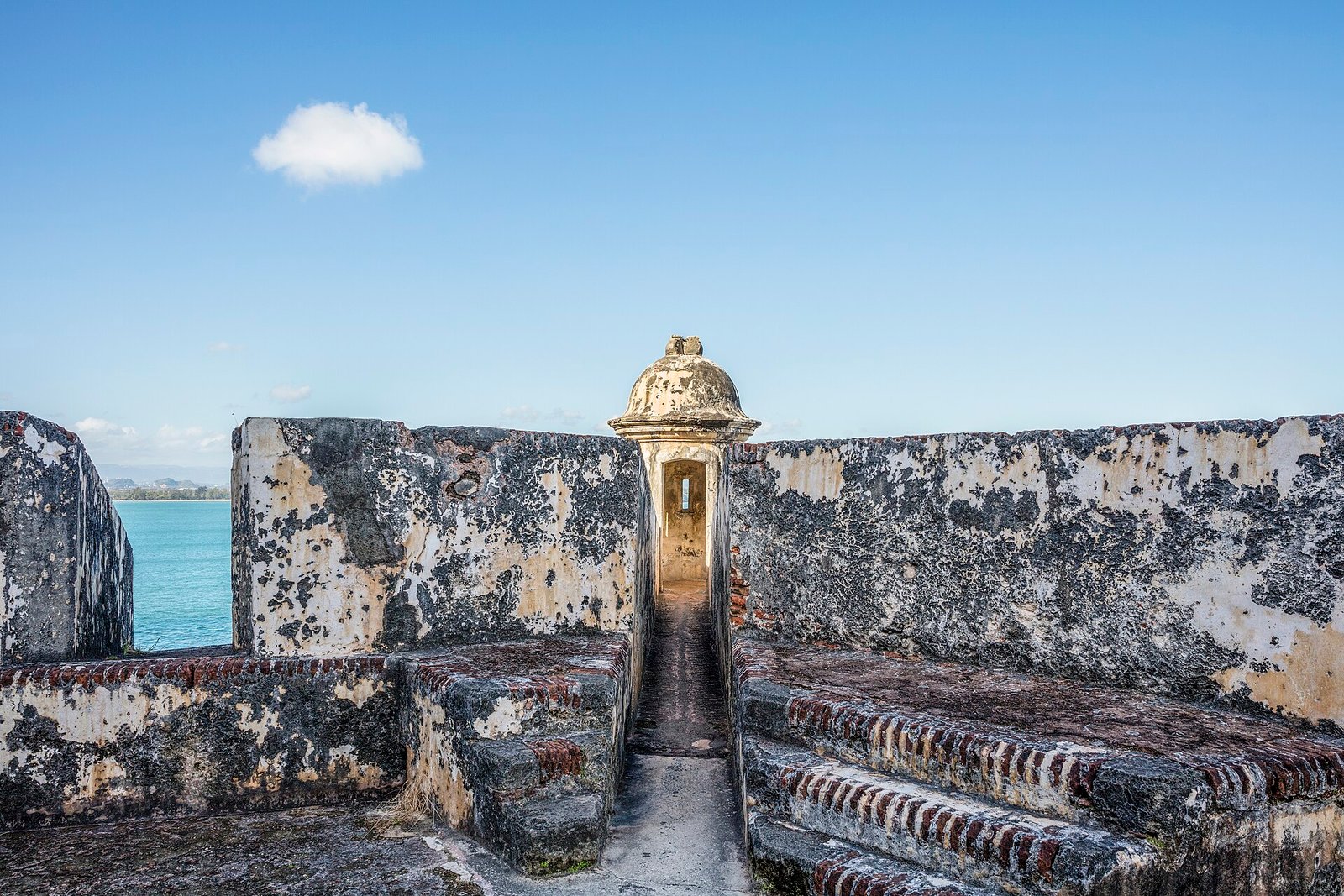
Image: USA-2016-Puerto Rico-San Juan-Castillo San Felipe del Morro 10.jpg — Godot13, CC BY-SA 4.0