What was the Battle of Trafalgar?
The Battle of Trafalgar was a British naval victory over a combined French-Spanish fleet on 21 October 1805. Fought in the Atlantic Ocean off southwestern Spain, it strengthened Britain’s command of the sea. It also cost Britain its commander, Horatio Nelson, who died aboard HMS Victory during the fighting.
Britain had 27 ships of the line. Its opponents had 33. Nelson’s answer to that numerical disadvantage was a plan to cut through the enemy formation in two columns. If you want to understand Trafalgar, start with those two facts: the British fleet was smaller, and its attack aimed to break the opposing line.
Battle of Trafalgar date: why 1805 matters
Trafalgar took place during the War of the Third Coalition. Its immediate background included a long pursuit at sea. During the summer of 1805, Nelson followed Pierre-Charles Villeneuve’s fleet to the West Indies and then returned to European waters.
Napoleon ordered Villeneuve, whose fleet was at Cádiz, to sail into the Mediterranean. The fleet was to support his operations on the European continent. Trafalgar therefore belonged to a wider war, even though the decisive encounter happened offshore.
Napoleon had already abandoned his plan to invade Britain before Trafalgar. He did not revive it after the battle. That sequence matters: the victory reinforced British naval supremacy, but it did not interrupt an invasion plan that was still being carried out.
Battle of Trafalgar location: where did it take place?
The battle took place off Cape Trafalgar, in the Atlantic Ocean beside southwestern Spain. The cape lies in Cádiz province, northwest of the Strait of Gibraltar. The battlefield was offshore; the cape supplied the battle’s name.
For a Battle of Trafalgar map reference, the approximate position is 36.25° north, 6.20° west. If you locate those coordinates, you can place the encounter in relation to Cape Trafalgar and the Strait of Gibraltar. They provide an approximate battlefield position, rather than a precise location for every ship.
Cádiz also belongs in the geographical picture because Villeneuve received Napoleon’s Mediterranean sailing order there. Keep the fleet’s departure setting and the offshore battlefield together when following the campaign: Cádiz and Cape Trafalgar both feature in the events leading to the encounter.
Battle of Trafalgar ships: who commanded the fleets?
Nelson and Cuthbert Collingwood were the principal British commanders. Villeneuve and Federico Gravina commanded the opposing force. Their combined fleet contained 18 French and 15 Spanish ships of the line, giving it six more than Britain’s 27.
HMS Victory led Nelson’s column. HMS Royal Sovereign led Collingwood’s. Both carried 100 guns. These two ships headed separate parts of the British attack, so following their movements helps you understand how Nelson’s plan divided the fleet’s work.
Villeneuve’s flagship was Bucentaure. Nelson directed his northern column towards the enemy flagship, while Collingwood’s column was to attack the rear of the opposing line. The two British commanders thus had distinct targets within the same formation.
How did Nelson’s two-column attack work?
Nelson planned to divide his fleet into two columns, cut the enemy line and force a close-range battle. His own column would head towards the enemy flagship. Collingwood would strike farther back. The aim was to break into the French-Spanish formation and bring the ships into close combat.
The contrast between fleet size and attack formation is central to the battle. Britain brought fewer ships of the line, yet Nelson chose an attack that cut across the opposing line. The plan focused on where the British ships would enter the formation and how closely they would fight.
Nelson explained this approach to his captains at dinners off Cádiz. He called it ‘The Nelson Touch’. There is an everyday-life connection here: discussing a shared task around a dinner table. At Cádiz, those meals gave Nelson an occasion to explain the battle plan his captains would carry into action.
Battle of Trafalgar flag: what did Nelson signal?
Before the fighting, Nelson sent a message from HMS Victory using signal flags: ‘England expects that every man will do his duty’. Its wording addressed the fleet’s morale and responsibility before the attack.
A further signal instructed the ships to engage the enemy more closely. Read together, the messages show two parts of Nelson’s direction: a call to duty and an instruction about fighting distance. The second message matched his plan to force a close-range encounter.
Captain Home Riggs Popham had developed the flag coding system used for Nelson’s famous message only two years before Trafalgar. The celebrated words therefore travelled through a recently developed system, rather than through a method unchanged across generations.
How did Nelson die at Trafalgar?
A marksman in the mizzenmast of the French ship Redoutable shot Nelson. He was taken below aboard HMS Victory, to the area where the wounded were gathered. He died there at 16:30 on 21 October 1805.
British casualties totalled 458 dead and 1,208 wounded. Those figures place Nelson’s death within a much larger human cost. Britain’s victory came with substantial casualties even though it lost no ships.
Nelson’s body was preserved in alcohol for the journey to Britain. On 9 January 1806, he received a state funeral at St Paul’s Cathedral in London.
Who won, and what happened after the fighting?
Britain won the battle. Royal Museums Greenwich’s account records 17 opposing ships surrendering and one exploding. No British ship was lost. Those ship losses and surrenders show the scale of the French-Spanish defeat despite its larger starting fleet.
The captured ships faced another danger after combat: a storm that continued until 27 October. By its end, only four captured enemy ships remained in British hands. The number of ships that surrendered during battle therefore differs sharply from the number Britain retained after the storm.
France’s navy did not again seriously challenge the Royal Navy in a major fleet battle after Trafalgar. Napoleon’s shipbuilding programme nevertheless produced a fleet of 80 ships of the line by 1814. Even that programme failed to break Britain’s naval superiority during the war.
The Napoleonic Wars continued for about another decade after Trafalgar. Naval supremacy and the duration of the wider war are separate parts of its outcome: Britain secured a decisive advantage at sea, while fighting continued beyond this victory.
Timeline
- Summer 1805: Nelson pursued Villeneuve’s fleet to the West Indies and back to European waters.
- 21 October 1805: Britain defeated the French-Spanish fleet off Cape Trafalgar.
- 21 October 1805, 16:30: Nelson died aboard HMS Victory.
- After the battle, until 27 October 1805: A storm struck; by its end, only four captured enemy ships remained in British hands.
- 9 January 1806: Nelson received a state funeral at St Paul’s Cathedral.
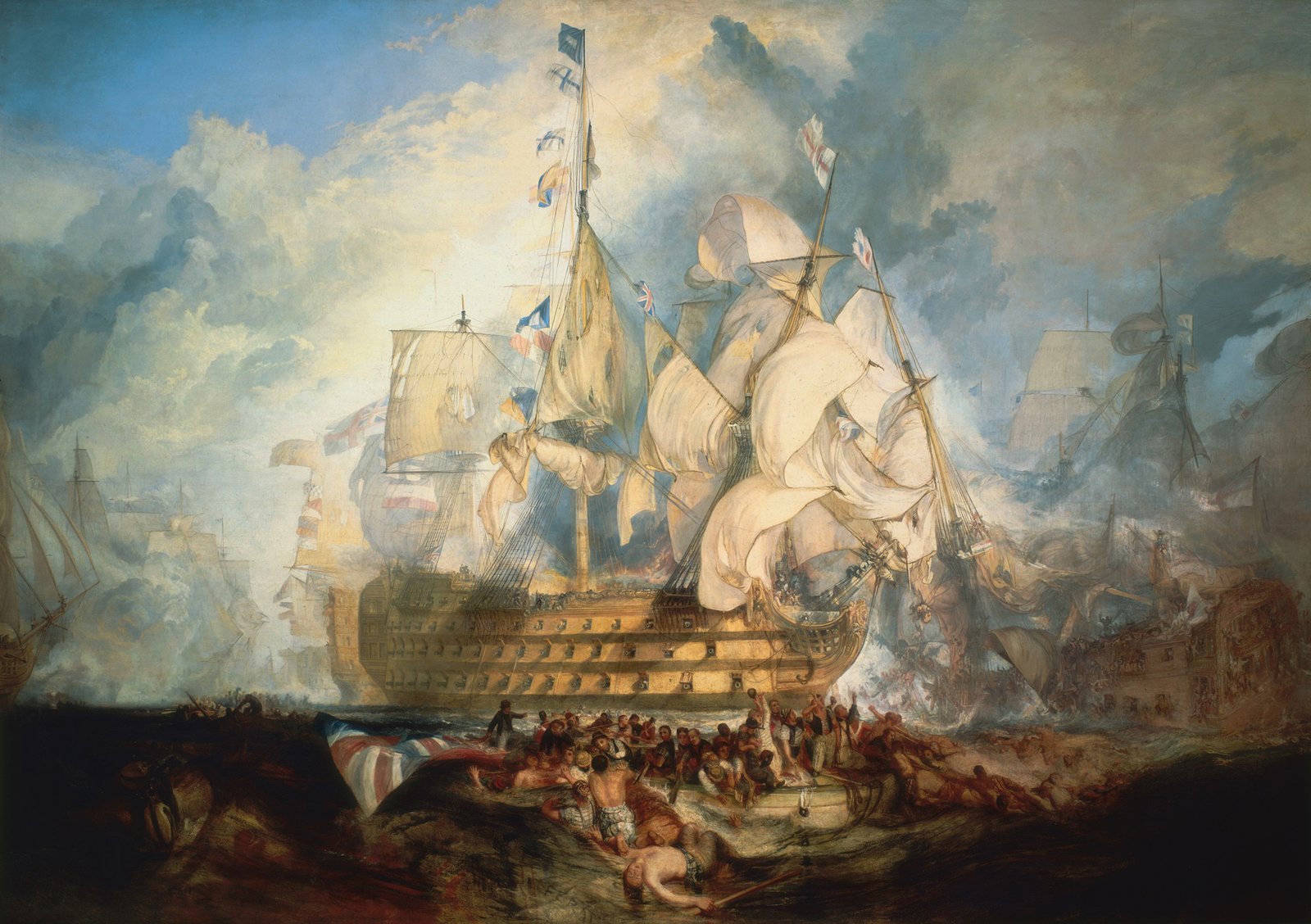
- May 1824: Turner’s Trafalgar painting was installed at St James’s Palace.
- 1847: Royal approval was granted for medals for lower-ranking sailors; surviving Trafalgar veterans could receive the Naval General Service Medal with the ‘TRAFALGAR’ clasp.
Battle of Trafalgar painting: what does Turner show?
J. M. W. Turner painted The Battle of Trafalgar on a canvas about three metres wide. King George IV commissioned it. The painting was installed at St James’s Palace in May 1824, well after the battle it represented.
Its treatment of events prompted disagreement. William James criticised Turner for combining different stages of the fighting. Museum curator Katherine Gazzard explains the work’s purpose through its presentation of human drama. The debate concerns both historical sequence and what the painting seeks to convey.
When you look at Turner’s Trafalgar painting, remember that it combines moments from the battle. James’s criticism and Gazzard’s explanation offer two ways to approach it: examine the sequence of events, and consider the human experience Turner brought into the composition.
Details you won’t find in guidebooks
Nelson’s dinners off Cádiz connected social occasions with operational planning. His captains heard ‘The Nelson Touch’ explained before the fleet fought. The two-column attack was therefore a plan discussed ahead of the encounter, rather than an arrangement first communicated during combat.
Recognition for lower-ranking sailors came much later. Royal approval for their medal arrived only in 1847. Surviving Trafalgar veterans could receive the Naval General Service Medal with a clasp bearing ‘TRAFALGAR’.
The storm also changes how the victory’s material results should be read. Seventeen ships surrendered during the action, but only four captured ships remained in British hands after the storm. Both figures belong to Trafalgar’s outcome; they describe different stages of it.
FAQ
What was the Battle of Trafalgar date?
The Battle of Trafalgar took place on 21 October 1805, during the War of the Third Coalition.
Where did the Battle of Trafalgar take place?
It took place in the Atlantic Ocean off Cape Trafalgar in southwestern Spain. The cape lies in Cádiz province, northwest of the Strait of Gibraltar.
How many ships fought at Trafalgar?
Britain fielded 27 ships of the line against 33 French-Spanish ships of the line. The combined fleet included 18 French and 15 Spanish ships.
Did Nelson survive the Battle of Trafalgar?
No. A marksman aboard the French ship Redoutable shot Nelson. He died aboard HMS Victory at 16:30 on 21 October 1805.
Did Trafalgar end the Napoleonic Wars?
No. The Napoleonic Wars continued for about another decade. Trafalgar strengthened British naval supremacy, but Napoleon had already abandoned his invasion plan before the battle.
Sources
- Vikipedi — Trafalgar Muharebesi tr.wikipedia.org
- Wikipedia — Battle of Trafalgar en.wikipedia.org
- Wikipedia — Cape Trafalgar en.wikipedia.org
- Old Royal Naval College — The Battle of Trafalgar ornc.org
- Royal Museums Greenwich — Battle of Trafalgar background rmg.co.uk
- U.S. Naval Institute — Command and Control in the Age of Sail usni.org
- Royal Museums Greenwich — Research guide N1: Horatio Nelson rmg.co.uk
- Royal Museums Greenwich — Turner’s The Battle of Trafalgar: a maligned masterpiece? rmg.co.uk
Image: Turner, The Battle of Trafalgar (1822).jpg — J. M. W. Turner, Public domain