Is 1917 based on a true story?
1917 draws on Alfred Mendes’s wartime memories, but Schofield, Blake and their mission to save 1,600 soldiers are fictional; the German withdrawal to the Hindenburg Line supplies the real historical setting.
That withdrawal was a planned military operation called Alberich. German forces abandoned positions between Arras and Soissons and moved into stronger defences. They also destroyed settlements and infrastructure across the territory they left. If you follow the retreat through Bapaume and Bullecourt, you encounter both its military purpose and its consequences for civilians.
The central calculation was straightforward. A shorter front required fewer formations to hold it. The withdrawal released 13 German divisions into reserve. Concrete defences and deep belts of barbed wire strengthened the new positions. Giving up ground therefore brought a military advantage, even as Allied troops advanced into the evacuated area.
Why did Germany prepare the Hindenburg Line?
German high command adopted a defensive strategy for 1917 after the heavy cost of the Allied offensives in 1916. Preliminary planning for the new defensive arrangement began in September 1916. Construction of the main Siegfried positions followed in October. The retreat thus had months of preparation behind it.
The Germans called the positions the Siegfriedstellung. The Allies called them the Hindenburg Line, after Paul von Hindenburg. These names describe the same defensive setting from different sides. At its centre, the Siegfriedstellung consisted of mutually supporting fortifications between Cambrai and Saint-Quentin.
Concrete shelters and deep barbed-wire belts gave German troops a stronger defensive position. The construction figures show the scale of the work. More than 100,000 tonnes of cement and 12,500 tonnes of barbed wire went into the Siegfried Line. The move backwards led into a system built for defence.
How far did German troops withdraw?
Between Arras and Soissons, German troops withdrew 15–50 kilometres from the positions they had held at the end of the 1916 Somme battles. The distance varied across that sector. You should therefore picture a withdrawal across a broad area, with different distances between the abandoned positions and the new defences.
Deutsches Historisches Museum dates the beginning of the strategic withdrawal of four German armies to late February 1917. The National Army Museum places the broader retreat to the Hindenburg Line between 23 February and 5 April 1917. These dates give you a framework for events that unfolded over several weeks.
The withdrawal shortened the German front and freed 13 divisions for reserve duties. Its effects also reached Allied planning. French commander-in-chief Robert Nivelle’s spring offensive plans suffered a temporary disruption. The Germans had changed the location and defensive strength of the positions facing the Allies.
What happened to the abandoned towns and roads?
German troops destroyed buildings, wells, waterways, roads and railways as they withdrew. This made the evacuated territory harder for the Allies to use. Taking possession of ground did not mean taking possession of working infrastructure. Roads and water supplies could be damaged alongside the settlements they served.
An everyday comparison helps explain the practical effect. If you return home to find the water supply unusable and the access road destroyed, reaching the building has solved only part of your problem. During Alberich, damage to wells and roads imposed that kind of obstacle across the abandoned territory.
Dennis Showalter’s account puts the systematically devastated area at approximately 1,500 square kilometres of French territory. More than 200 settlements were completely razed. These figures describe destruction across a substantial area, beyond damage to a single town or a particular stretch of road.
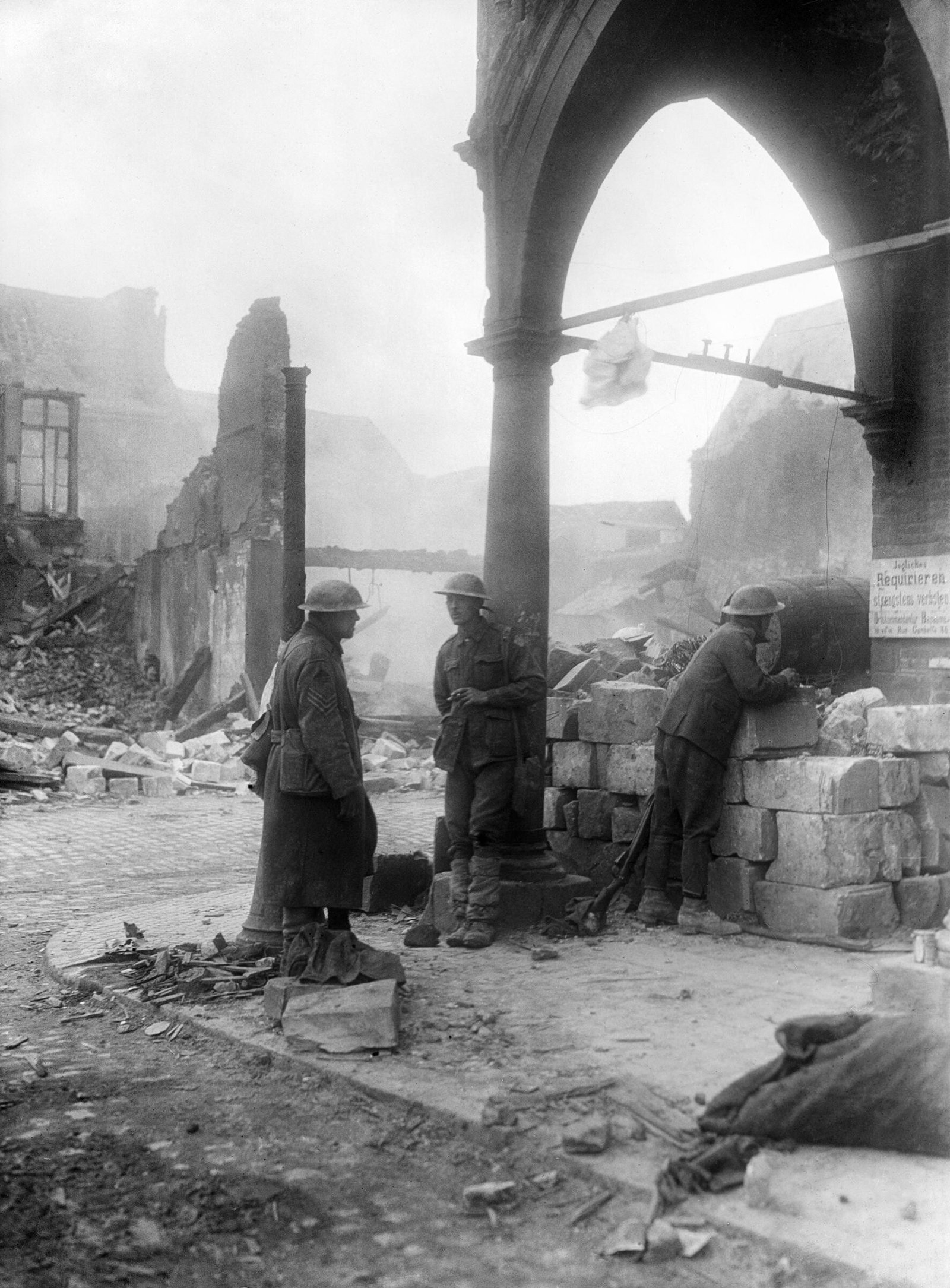
Bapaume offers a dated example. Australian infantry entered the town on 17 March 1917, after the Germans had largely destroyed it. Their arrival marked a change in military possession. The ruined buildings, however, remained part of what the advancing troops encountered.
What happened to civilians during Operation Alberich?
Forced evacuation accompanied the German withdrawal. Deutsches Historisches Museum gives approximately 125,000 forcibly evacuated people considered fit for work. Showalter gives a different figure: 140,000 people in that category. He also records the evacuation of another 15,000 sick people, elderly people and children.
The distinction between those categories matters. Showalter’s additional 15,000 are separate from his figure for people considered fit for work. The museum’s approximately 125,000 and Showalter’s 140,000 are alternative estimates for that working category. They should not be added together as separate groups.
The removal of people occurred alongside the removal of possessions. During Alberich, 18,000 freight wagons were used to carry away movable property. That included personal belongings and household goods. The withdrawal therefore affected homes through both physical destruction and the taking away of their contents.
Details you won’t find in guidebooks
The construction materials reveal how thoroughly the new position had been prepared. More than 100,000 tonnes of cement and 12,500 tonnes of barbed wire were used for the Siegfried Line. Those quantities give substance to descriptions of concrete shelters and deep wire belts.
The abandoned territory also contained booby traps. A book left on a table, a piece of coal or a badge that someone might take as a souvenir could trigger one. Ordinary objects could therefore carry a danger that was not apparent from their everyday purpose.
Bapaume supplies a particularly clear sequence. On 19 March 1917, the band of the 5th Australian Infantry Brigade marched into the ruined town square while playing. This happened two days after Australian infantry had entered the town. Music accompanied the occupation of a place already heavily damaged.
On 25 March, a delayed-action bomb left by the withdrawing Germans destroyed Bapaume Town Hall. The town had been entered on 17 March, yet a German explosive still caused destruction on 25 March. The sequence shows why the date troops occupied a town cannot by itself mark the end of danger there.
Timeline
- September 1916: Preliminary planning began for the new German defensive arrangement.
- October 1916: Construction began on the Siegfriedstellung defensive system.
- Late February 1917: The strategic withdrawal under the code name Alberich began.
- 17 March 1917: Australian infantry entered the largely destroyed town of Bapaume.
- 19 March 1917: The 5th Australian Infantry Brigade’s band marched through Bapaume’s ruined square.
- 25 March 1917: A delayed-action bomb destroyed Bapaume Town Hall.
- 5 April 1917: The National Army Museum’s broader withdrawal period ended.
- 9 April 1917: Australian operations against the outpost villages ended, and the British attacked at Arras.
- 11 April 1917: The First Battle of Bullecourt took place.
- 3 May 1917: The Second Battle of Bullecourt began.
What followed the retreat at Arras and Bullecourt?
Australian operations to capture the outpost villages in front of the Hindenburg Line continued until 9 April 1917. That date falls after the end of the broader withdrawal period given by the National Army Museum. Fighting around the approaches continued as the Allies confronted the new German positions.
The British attacked at Arras on 9 April. Their purpose was to support the French offensive planned farther south. Although the withdrawal had temporarily disrupted Nivelle’s plans, Allied offensive operations went ahead. The next fighting included an Australian assault near Bullecourt.
On 11 April, the 4th and 12th Brigades of the 4th Australian Division attacked the Hindenburg Line near Bullecourt. They were forced to withdraw that same day. Australian losses totalled approximately 3,330 casualties, including 1,170 men taken prisoner. The prisoner figure forms part of the total casualties.
A second attack to capture the Hindenburg Line at Bullecourt began on 3 May 1917. The sequence from the prepared withdrawal to these assaults explains the stakes of Alberich. German troops had surrendered territory while gaining a shorter front, reserve divisions and stronger positions that the Allies then attacked.
FAQ
Why did the Germans retreat to the Hindenburg Line?
German high command adopted a defensive strategy after the heavy cost of the Allied offensives in 1916. The withdrawal shortened the front, provided stronger positions and released 13 divisions into reserve.
When did Operation Alberich take place?
Deutsches Historisches Museum places the beginning of the strategic withdrawal in late February 1917. The National Army Museum dates the broader retreat to the Hindenburg Line from 23 February to 5 April 1917.
What happened to civilians during the retreat?
Civilians were forcibly evacuated. Deutsches Historisches Museum gives approximately 125,000 people considered fit for work. Dennis Showalter gives 140,000 in that category and a further 15,000 sick people, elderly people and children evacuated.
What happened at the First Battle of Bullecourt?
The 4th and 12th Brigades of the 4th Australian Division attacked on 11 April 1917 and withdrew the same day. Australian casualties totalled approximately 3,330, including 1,170 prisoners.
Sources
- Smithsonian Magazine, “The True History Behind the Movie 1917” smithsonianmag.com
- National Army Museum, “1917: A Year of Stalemate” nam.ac.uk
- Deutsches Historisches Museum, “Siegfriedstellung” dhm.de
- Dennis Showalter, “Operation Alberich,” 1914-1918-online encyclopedia.1914-1918-online.net
- Australian War Memorial, Hindenburg Line awm.gov.au
- Australian Department of Veterans’ Affairs, “Battles of Bullecourt” dva.gov.au
- National Army Museum, “Germans Retreat to Hindenburg Line” ww1.nam.ac.uk
- Australian Defence Force Academy, academic thesis, Chapter 4 aif.adfa.edu.au
- Anzac Portal, Department of Veterans’ Affairs, “1917: Bapaume and Bullecourt” anzacportal.dva.gov.au
Image: Aus 2nd Division troops in Bapaume Mar 1917.jpg — Australian official photographer, Public domain