Where is Kronborg Castle in Denmark?
Kronborg Castle stands in Helsingør, at the northeastern tip of Sjælland in Denmark. It overlooks the Øresund Strait between Denmark and Sweden. At this point, the water narrows to about four kilometres. That position explains why a castle here could serve both royal power and maritime control.
If you know Kronborg as Hamlet’s Castle, its location adds another layer to the name. This was a place where Denmark controlled passage toward the Baltic Sea. Between 1429 and 1857, ships passing through the strait were subject to tolls collected under Danish authority.
The castle’s geography connects directly to its history. Across the water stood Kärnan Castle in Helsingborg. Kronborg’s predecessor, Krogen, worked with that fortress to control the entrance route to the Baltic. The two shores formed part of the same strategic problem: who could pass through, and under whose authority?
Kronborg Slot: from Krogen to a royal residence
Eric of Pomerania built Krogen on this site in the 1420s. Its location came before the Renaissance palace now associated with Kronborg. The earlier fortress established the connection between this patch of coast, shipping and Danish control of the strait.
Frederick II transformed the medieval stronghold between 1574 and 1585. His project combined a defensive structure with a royal residence. Kronborg therefore had two practical purposes. It guarded an important passage while providing a setting for royal life.
The principal architects were Hans Hendrik van Paesschen and Anthonis van Obbergen. Gert van Groningen directed the sculptural work. Their roles belong to the castle’s documented construction history, alongside Frederick II’s decisions about its materials and appearance.
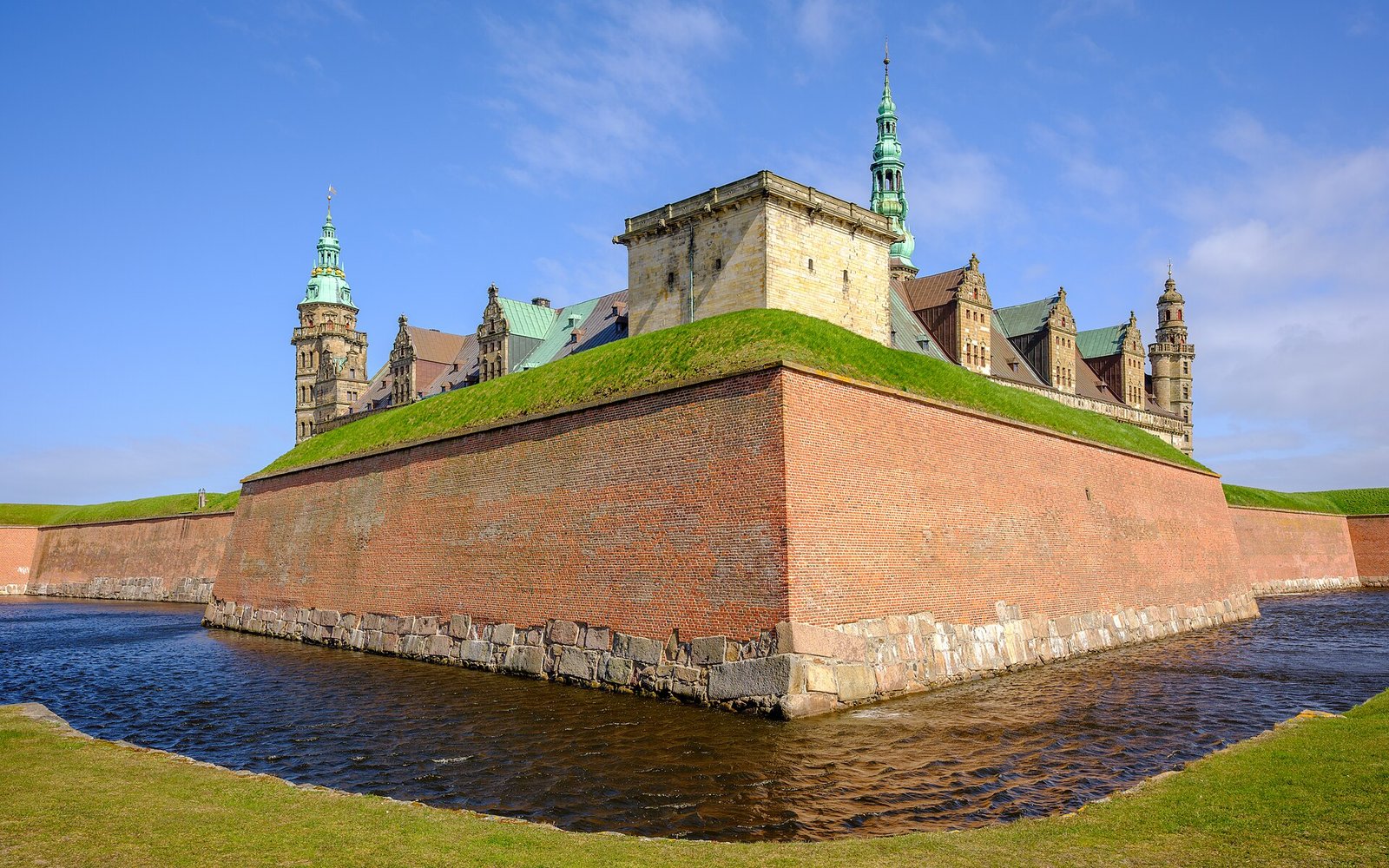
During construction, Frederick II ordered the red brick walls covered with white sandstone from Skåne and Gotland. Copper covered the roofs, and gilding decorated the tower tips. These choices gave the royal residence a carefully planned exterior over its brick structure.
Why is Kronborg known as Hamlet’s Castle?
Kronborg is identified with Elsinore, the castle in William Shakespeare’s tragedy Hamlet, written around 1600. Elsinore is the English form of Helsingør. The link begins with the town’s name and extends to the castle associated with the play’s setting.
Hamlet is a fictional Danish prince. Among the character’s sources is the legend of Amleth, recorded by Saxo Grammaticus in the 12th century. That literary ancestry is separate from the documented history of Frederick II’s Renaissance building.
When you encounter the phrase “Hamlet’s Castle,” read it as a literary association. Kronborg’s royal rebuilding took place between 1574 and 1585. Hamlet was written around 1600. The castle and the play belong to connected cultural histories, but the prince remains a fictional character.
There is no evidence that Shakespeare personally visited Denmark. A claim that he saw Kronborg before writing Hamlet cannot therefore be treated as established history. Lund University discusses another possibility: he may have learned about Danish court life through acquaintances who travelled there.
Will Kempe provides one example behind that theory. He performed in Elsinore in 1586. His presence offers a possible route by which knowledge could travel, although it does not establish how Shakespeare obtained his information about the castle or court.
Kronborg Castle photos: architectural details to notice
Kronborg’s main building has four wings around a large courtyard. If you are studying castle photos, that arrangement helps you understand the building as a connected complex. Its defensive and residential functions belonged within this shared architectural plan.
The ballroom was completed in 1582 and measures 62 by 12 metres. Those dimensions give you a concrete sense of the scale of Frederick II’s royal residence. The room belongs to the same rebuilding period that turned Krogen into a Renaissance castle.
White sandstone, copper roofing and gilded tower tips were part of Frederick II’s design decisions. These details help explain the attention given to the exterior. UNESCO added Kronborg to the World Heritage List in 2000 as an outstanding example of Renaissance castle architecture.
Fire, occupation and life as a barracks
A fire in 1629 destroyed much of Kronborg’s interior. Christian IV directed the rebuilding. The castle’s history therefore includes a major reconstruction after Frederick II’s transformation, while the chapel retained important elements that survived the fire.
In 1658, the forces of Charles X Gustav of Sweden occupied and looted Kronborg. The castle returned to Denmark in 1660. This episode shows the continuing military importance of a building that also contained a royal residence and a large ballroom.
Kronborg ceased to serve as a royal residence in 1785 and became an army barracks. The change affected the chapel as well. It became a gymnastics and fencing hall, before its original furnishings were restored and worship resumed in 1843.
Timeline
- 1420s: Eric of Pomerania builds Krogen, Kronborg’s predecessor.
- 1429: The period of Øresund toll collection begins.
- 1574–1585: Frederick II transforms the medieval fortress into a Renaissance castle.
- Around 1600: Shakespeare writes Hamlet, set at Elsinore.
- 1629: Fire damages the castle; Christian IV directs reconstruction.
- 1658–1660: Kronborg remains under Swedish occupation.
- 1785: The former royal residence becomes an army barracks.
- 1816: Garrison soldiers perform Hamlet at the castle for the first time.
- 1857: The Øresund toll period ends.
- 1985: A concrete copy replaces the plaster Holger Danske statue underground.
- 2000: Kronborg joins the UNESCO World Heritage List.
Details you won’t find in guidebooks
About 1.8 million ships passed through the Øresund during the toll period of 1429–1857, according to UNESCO. These vessels were subject to tolls at Kronborg. For an everyday comparison, think of paying to use a controlled crossing: the charge here concerned ships using a strategic stretch of water.
The chapel survived the 1629 fire with its original altar, gallery and pews. Its survival creates a specific connection to the castle before the disaster. Its later use for gymnastics and fencing also shows how thoroughly the barracks conversion changed royal spaces.
Hamlet was first performed at Kronborg in 1816 by soldiers from the garrison. The occasion marked the 200th anniversary of Shakespeare’s death. The castle’s military occupants thus helped turn its literary association into a performance tradition.
From 1937, Hamlet performances became an established part of Kronborg’s cultural life. The connection with Shakespeare therefore extends beyond the name Elsinore. It also includes the repeated staging of the play within the castle associated with its setting.
Who is Holger Danske beneath Kronborg?
A statue of Holger Danske stands in Kronborg’s underground defensive galleries. It represents the warrior who, according to legend, will wake when Denmark faces great danger. This is another legendary identity attached to the castle, separate from Hamlet’s fictional Danish prince.
H. P. Pedersen-Dan’s Holger Danske statue dates from 1907. The plaster copy at Kronborg could not withstand the damp underground conditions. In 1985, it was replaced with a concrete copy. The figure’s material history is therefore tied directly to its underground location.
FAQ
Where is Kronborg Castle?
Kronborg Castle is in Helsingør, at the northeastern tip of the Danish island of Sjælland. It overlooks the narrowest part of the Øresund Strait between Denmark and Sweden.
Why is Kronborg known as Hamlet’s Castle?
Kronborg is identified with Elsinore, the castle setting in William Shakespeare’s Hamlet, written around 1600. Elsinore is the English form of Helsingør.
Sources
- Turkish Wikipedia — Kronborg tr.wikipedia.org
- UNESCO — Kronborg Castle whc.unesco.org
- Kronborg Museum — What is Kronborg Castle? kronborg.dk
- English Wikipedia — Kronborg en.wikipedia.org
- Kronborg Museum — Who is Hamlet? kronborg.dk
- Lund University — Kronborg Castle, Elsinore konferens.ht.lu.se
- Kronborg Museum — Holger the Dane kronborg.dk
- Kronborg Museum — Praktisk kronborg.dk
Image: Kronborg April 2026 06.jpg — ArildV, CC BY-SA 4.0