On the night of 11–12 November 1940, aircraft from HMS Illustrious attacked Italian warships anchored at Taranto. Twenty-one Fairey Swordfish biplanes launched for the operation. By the end of the raid, three Italian battleships had been disabled. Britain had lost two aircraft.
The British called the attack Operation Judgement. Its importance lay in the relationship between the attackers and their targets: aircraft launched from a carrier at sea had inflicted heavy losses on a major fleet inside its harbour. If you want to understand why Taranto matters, begin with that result. The aircraft did not need to meet the battleships in a surface engagement.
Battle of Taranto 1940: what happened in World War II?
The raid targeted the Italian naval base at Taranto during World War II. Admiral Andrew Cunningham commanded Britain’s Mediterranean naval forces. Admiral Inigo Campioni commanded the Italian forces. Fleet Air Arm aircraft carried out the attack from HMS Illustrious.
The Italian fleet at Taranto threatened Britain’s convoy route linking Gibraltar, Malta and Alexandria. The ships in harbour therefore mattered beyond the anchorage itself. Operation Judgement aimed at the battleships supporting that threat, using aircraft carrying torpedoes, bombs and illumination flares.
Six Italian battleships were at the centre of the target fleet: Littorio, Vittorio Veneto, Giulio Cesare, Caio Duilio, Andrea Doria and Conte di Cavour. Three would be disabled by torpedo hits. That distinction matters when you assess the result: the attack seriously reduced the available battleship force, but did not eliminate it.
Battle of Taranto map: where was the attack in Italy?
Taranto lies in Puglia, in southern Italy. The raid struck Italian warships anchored in its harbour. For a map-based understanding, connect Taranto with the Gibraltar–Malta–Alexandria convoy route. The fleet’s ability to threaten that route explains why Britain wanted to strike it.
Malta also appears in the preparations. Reconnaissance flights operated from there before the attack. On the night of 11 November, an RAF Short Sunderland flying boat confirmed again that the Italian fleet was at Taranto. That confirmation placed the intended targets in the harbour before the Swordfish arrived.
The aircraft approached from different directions. According to the British Ministry of Defence account, the first wave came from the southwest at 22:58. The second approached from the northwest around midnight. If you sketch the attack, those two directions help you follow the sequence without treating the raid as a single arrival.
How did the Swordfish attack the Italian fleet?
HMS Illustrious launched the Swordfish in two waves. The first contained 12 aircraft; the second contained nine. Eleven aircraft carried torpedoes. The others carried bombs and flares, so the attacking force had several roles within the same operation.
The launch total does not mean that every aircraft reached Taranto. One Swordfish in the second wave turned back after its additional fuel tank broke loose during flight. Its departure from the attack is a small but useful distinction between aircraft launched and aircraft reaching the target.
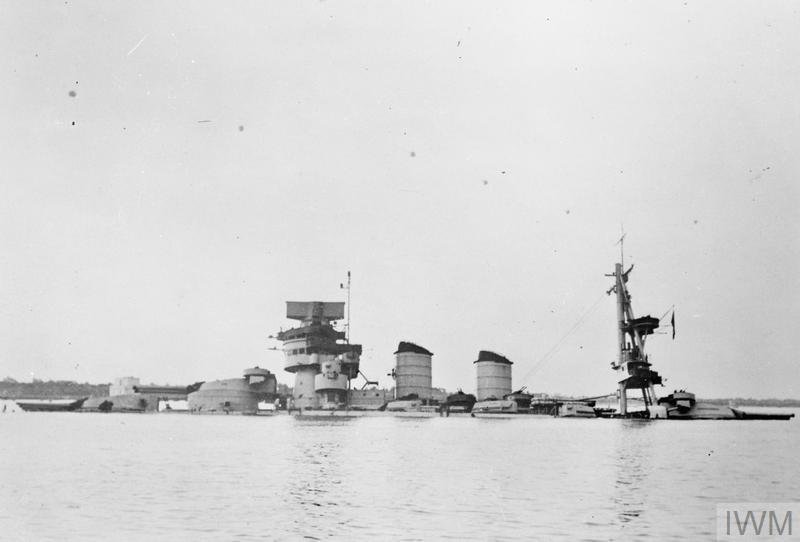
Torpedo hits disabled Conte di Cavour, Littorio and Caio Duilio. Littorio received three torpedo hits and was grounded to prevent it from sinking. These were direct blows against the battleships that Operation Judgement had set out to attack.
Britain lost two Swordfish. Of their four aircrew, two were killed and two became prisoners. Those losses belong alongside the damage to the Italian fleet when judging the operation. The attack succeeded, but its outcome included deaths and captivity for the attacking crews.
Who won the Battle of Taranto?
Britain won the raid. Three of Italy’s six battleships were put out of service, while Britain lost two aircraft. The British Ministry of Defence describes this as a success that halved the Italian battleship fleet and gave Britain an advantage in the Mediterranean.
The Italian navy moved its undamaged warships from Taranto to Naples after the attack. The consequences therefore extended beyond repairs to the ships that had been hit. The surviving force also changed its base following the raid.
The disabled battleships had different futures. Littorio returned to service after about four months of repairs. Caio Duilio returned after about seven months. Conte di Cavour was refloated and taken to Trieste, but never returned to active service. Counting three disabled ships captures the immediate result; following their repairs reveals how long that result lasted.
Why was the Battle of Taranto important?
Taranto is remembered as the first attack in which aircraft launched from a carrier at sea inflicted heavy losses on a major enemy fleet in harbour. Its importance rests on that demonstrated capability. A carrier’s aircraft could strike anchored battleships and take several out of service in one night.
The National WWII Museum reports that American and Japanese naval planners studied the raid. They examined what it showed about fleets in harbour and their vulnerability to aerial torpedoes. Taranto’s audience therefore extended beyond the British and Italian forces directly involved.
Its broader strategic achievement remains open to interpretation. In a 2006 academic assessment, Angelo N. Caravaggio treated the operation as a missed opportunity to eliminate Italian battleship power altogether. That argument asks whether Britain could have achieved more than the damage it inflicted.
The Ministry of Defence places greater weight on the three battleships disabled and the resulting British advantage. You can distinguish these judgments by keeping their questions separate: how successful was the attack that occurred, and how much more might the operation have accomplished? Both assessments concern the same raid and its consequences.
Timeline
- 21 October 1940: The original attack date could not be used because of a fire aboard HMS Illustrious.
- 11 November 1940: RAF reconnaissance confirmed that the Italian fleet was at Taranto.
- 11–12 November 1940: Swordfish from HMS Illustrious attacked in two waves, approaching from the southwest and then the northwest.
- 12 November 1940: Three Italian battleships were disabled. After the raid, the Italian navy moved its undamaged warships to Naples.
- After approximately four and seven months of repairs: Littorio and Caio Duilio respectively returned to service.
- 1943: Conte di Cavour’s repairs were still incomplete when Italy surrendered.
Details you won’t find in guidebooks
The raid was originally planned for 21 October 1940, Trafalgar Day. A fire in the hangar of HMS Illustrious forced its postponement. The November attack thus followed a disrupted schedule, rather than the original timetable.
HMS Eagle also affected the preparations. A fault in its aviation fuel system prevented it from participating. Five of its Swordfish were transferred to HMS Illustrious, bringing aircraft from another carrier into the force used for the operation.
The torpedo-carrying Swordfish received additional fuel tanks in the observers’ positions. Their observers moved into the rear seats used by the wireless operator and gunner. Think of rearranging your everyday luggage to make room for something essential: here, extra fuel required a change in where a crew member sat.
Weather had already weakened part of Taranto’s defences. Strong winds had carried away 60 of the 87 barrage balloons protecting the harbour. Weather also affected British plans after the raid. A further attack was considered for the following night, but bad conditions prevented it.
Battle of Taranto 1943: how does that year fit?
The attack took place in November 1940. The connection with 1943 concerns Conte di Cavour and the long aftermath of its damage. The battleship had been refloated and moved to Trieste, yet its repairs were still unfinished when Italy surrendered in 1943.
That repair history separates Conte di Cavour from Littorio and Caio Duilio. Both of those ships returned to service following repairs. Conte di Cavour did not return to active service, making its loss of availability the most lasting of the three battleship outcomes described here.
Battle of Taranto museum, painting and film
The National WWII Museum’s account, “Forgotten Fights: Strike on Taranto,” examines the attack and its significance. It also discusses the interest shown by American and Japanese naval planners. For a museum-based reading of the event, that account connects the damage in the harbour with the questions raised beyond Italy.
Charles David Cobb depicted the attack in Taranto Harbour, an oil painting on canvas. Its subject is the strike by Swordfish from HMS Illustrious on 11 November 1940. The painting provides a visual representation of the same carrier aircraft and harbour attack described in the operational accounts.
The Imperial War Museums archive holds the 1954 film Taranto Anniversary Dinner in HMS Illustrious, reference ADM 1505, recording the fourteenth-anniversary dinner aboard the carrier with participating aircrew among those present.
FAQ
Who won the Battle of Taranto?
Britain won the raid. Its aircraft disabled three of Italy’s six battleships, while Britain lost two Swordfish aircraft.
Why was the Battle of Taranto important?
It demonstrated that aircraft launched from a carrier at sea could inflict heavy losses on a major fleet in harbour. American and Japanese naval planners subsequently studied the attack.
Was the Battle of Taranto in 1940 or 1943?
The raid took place on 11–12 November 1940. The year 1943 relates to its aftermath: Conte di Cavour remained unrepaired when Italy surrendered.
Which aircraft attacked Taranto?
Twenty-one Fairey Swordfish biplanes launched from HMS Illustrious in two waves. Eleven carried torpedoes, while the others carried bombs and flares.
Sources
- UK Ministry of Defence — Navy commemorates 70th anniversary of Battle of Taranto gov.uk
- Wikipedia — Battle of Taranto en.wikipedia.org
- Vikipedi — Taranto Muharebesi tr.wikipedia.org
- The National WWII Museum — Forgotten Fights: Strike on Taranto nationalww2museum.org
- The Maritime Foundation — Operation Judgement: The Battle of Taranto maritimefoundation.uk
- Naval War College Review — Angelo N. Caravaggio, The Attack at Taranto digital-commons.usnwc.edu
- Bridgeman Images — Charles David Cobb, Taranto Harbour bridgemanimages.com
- Imperial War Museums — Taranto Anniversary Dinner in HMS Illustrious film.iwmcollections.org.uk
Image: The Italian battleship CONTE DI CAVOUR after the attack. Only her funnels and super-structure remain above the water.jpg — Photographer not identified., Public domain