The Battle of Sinop was a Russian naval victory fought in Sinop harbour on 30 November 1853. Admiral Pavel Nakhimov’s fleet largely destroyed the Ottoman squadron commanded by Osman Pasha, accelerating Britain and France’s entry into the Crimean War.
Why had Ottoman ships gathered in a harbour where they suffered such destruction? Their mission involved protecting supplies for the Caucasus front, but bad weather brought them into Sinop. Follow that supply route, the attack, and the surviving memorial, and you can connect the naval battle with the wider war.
Battle of Sinop 1853: why was the Ottoman fleet there?
The battle took place during Sultan Abdülmecid’s reign, which lasted from 1839 to 1861. It belonged to the opening phase of the Crimean War of 1853–1856. The fighting at Sinop therefore came early in a conflict that would later include Britain and France.
Osman Pasha’s squadron had a practical assignment. It was to protect maritime supplies reaching Ottoman forces on the Caucasus front through Trabzon and Batum. Sent towards the Caucasian coast in early November 1853, the squadron sheltered at Sinop because of bad weather.
Think of the deliveries you depend on in everyday life: transport connects supplies with the people who need them. At Sinop, that connection concerned forces on the Caucasus front. The Ottoman squadron’s protective mission and Nakhimov’s orders to destroy Ottoman supply vessels made maritime transport central to the confrontation.
Battle of Sinop map: understanding the locations
To understand a map of the battle, start with Sinop harbour, where the Ottoman squadron lay. Then connect the wider operation with Trabzon, Batum, and the Caucasus front. These places explain the supply mission that brought Osman Pasha’s ships towards the Caucasian coast before weather interrupted their movement.
At the harbour level, the essential movement was the Russian approach in two columns. Nakhimov’s ships closed on the Ottoman vessels and attacked at short range. If you are following the battle geographically, distinguish that harbour engagement from the longer maritime supply route the Ottoman squadron had been assigned to protect.
Istanbul belongs to the aftermath of this geographical story. The Ottoman steamer Taif escaped from Sinop and carried news of the defeat there two days later. Its journey links the destruction in the harbour with the arrival of the news on 2 December 1853.
How did the Russian-Turkish sea battle of Sinop unfold?
Nakhimov commanded the Russian attack. Patrona Osman Pasha commanded the Ottoman squadron. The force listing in the English-language Battle of Sinop account gives Russia six ships of the line, two frigates, and three steamships. It lists seven frigates, three corvettes, two steamships, and coastal artillery on the Ottoman side.
The Russian fleet approached in two columns and opened its close-range attack against the ships in the harbour. Explosive shells started fires aboard the wooden Ottoman vessels. Those fires contributed to the scale of the destruction, making the ammunition an important part of how the battle unfolded.
The result was a decisive Russian victory. Osman Pasha was wounded and taken prisoner. Russia lost no ships, while the Ottoman squadron suffered extensive destruction. Taif’s escape provided a surviving vessel that could carry the news to Istanbul.
The Encyclopedia of Russian History describes Sinop as the last major naval battle between sailing fleets. Yet the force lists also include steamships on both sides. Both details belong in the account: the battle’s association with sailing fleets should not obscure the steam vessels present.
How much of the Ottoman fleet was destroyed?
The force devastated at Sinop was the squadron in the harbour. It was not the whole Ottoman navy. This distinction matters when you encounter descriptions of the destruction of the Ottoman fleet: the phrase refers here to the ships gathered under Osman Pasha at Sinop.
The human losses require similar care. Besim Özcan’s study places Ottoman sailor deaths at nearly 2,000. The Encyclopedia of Russian History reports Ottoman losses of 3,000 and separately lists 200 prisoners. These accounts present different totals and should remain attributed to their respective sources.
The destruction also reached beyond the ships. Özcan’s research records substantial damage to Sinop’s Muslim quarter from the Russian bombardment. The battle therefore forms part of the city’s history as well as the history of the Ottoman navy.
Why was the Battle of Sinop a turning point in the Crimean War?
The British press described the destruction at Sinop as a massacre. That coverage amplified the event’s impact on European public opinion. The fighting in the harbour became an issue extending beyond the immediate Russian and Ottoman naval confrontation.
Sinop accelerated Britain and France’s entry into the war alongside the Ottoman Empire. By 28 March 1854, both countries had declared war on Russia. Its importance as a turning point rests on this widening of participation, alongside the scale of the Ottoman naval defeat.
The Crimean War ended with the Treaty of Paris, signed on 30 March 1856. The treaty neutralized the Black Sea and restricted Ottoman and Russian war fleets and naval arsenals there. The settlement thus placed limits on naval forces in the sea where the Sinop operation had unfolded.
Timeline
- Early November 1853: Osman Pasha’s squadron was sent towards the Caucasian coast to protect maritime supplies for Ottoman forces.
- November 1853: Bad weather forced the squadron to shelter in Sinop harbour.
- 30 November 1853: Nakhimov’s Russian fleet inflicted a decisive defeat on the Ottoman squadron at Sinop.
- 2 December 1853: The steamer Taif brought news of the defeat to Istanbul.
- March 1854: Britain and France declared war on Russia and entered the conflict.
- 1854: A decision was made to build the Martyrs’ Fountain in memory of the sailors killed at Sinop.
- 30 March 1856: The Treaty of Paris ended the Crimean War.
- 21 August 1858: Construction of the Martyrs’ Fountain was completed, according to Cenk Demir’s archival research.
Battle of Sinop painting: Ivan Aivazovsky
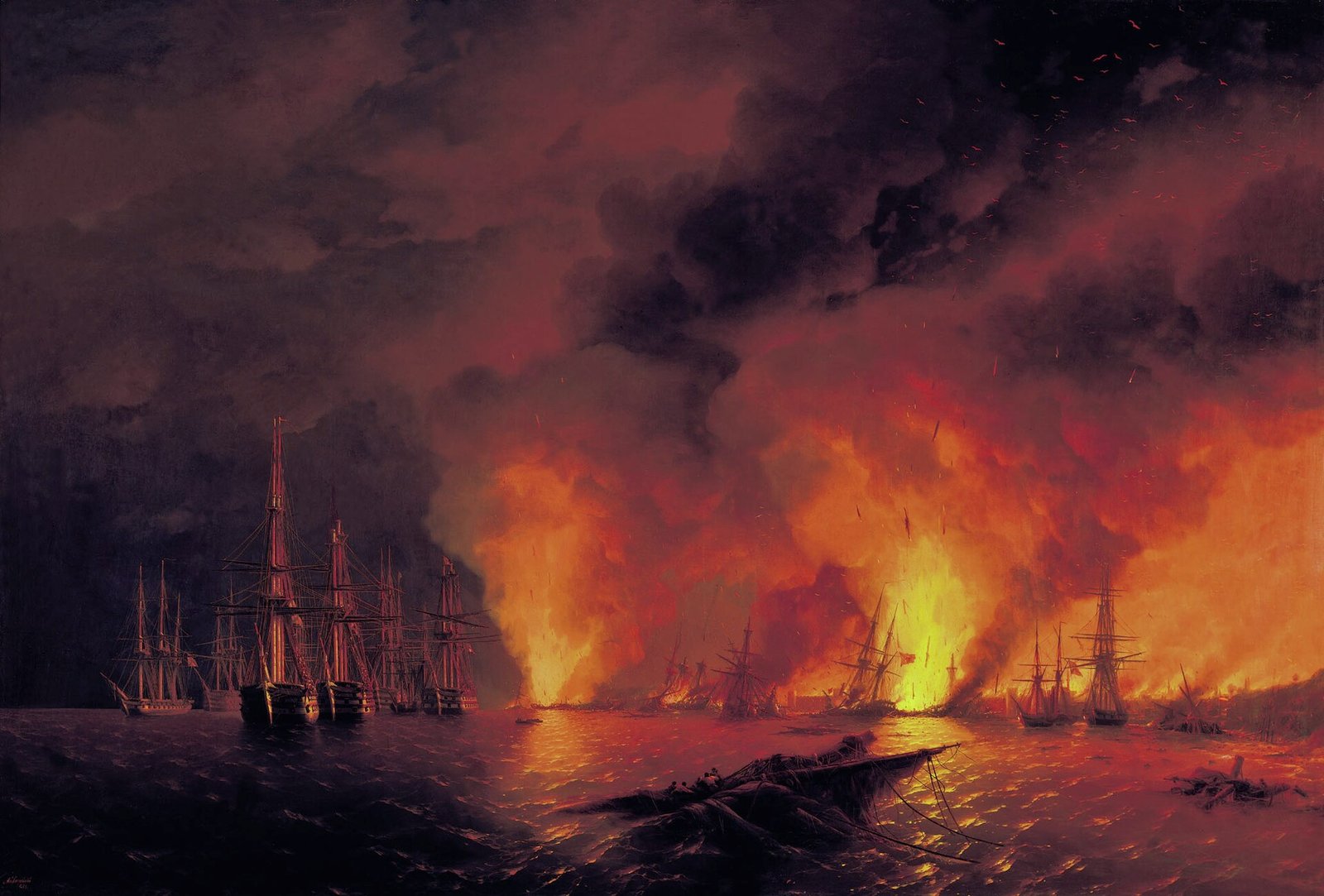
Ivan Aivazovsky painted the Battle of Sinop in 1853. The Central Naval Museum in St. Petersburg holds a painting of the subject bearing that date. For readers searching for an Aivazovsky Battle of Sinop painting, this museum collection provides a specific work and an institutional reference.
The painting’s date places it in the same year as the battle. The Martyrs’ Fountain followed a different timetable: its construction was approved in 1854 and completed in 1858. Together, the painting and fountain connect the event with two forms of remembrance, a museum artwork and a monument in Sinop.
Details you won’t find in guidebooks
One of the ships lost at Sinop had previously belonged to Russia. The Ottoman frigate Fazlullah was formerly named Rafail and had been captured from the Russians in 1829. Its destruction in 1853 gives an individual ship’s history within the larger account of the squadron’s defeat.
The Ottoman force also included Dimyad, a frigate belonging to the Egyptian navy. Its presence adds a detail that broad totals of frigates and corvettes can conceal. Among the vessels gathered at Sinop was a ship with that separate naval affiliation.
The Martyrs’ Fountain carries another individual connection. Archival research identifies the calligrapher Mevlevi Mehmed Zeki as the person who prepared its inscription. The memorial therefore preserves a named contribution alongside its commemoration of the dead sailors.
The fountain’s funding has competing explanations. Turkish Wikipedia repeats the account that money recovered from the dead sailors paid for it. Yazıcı Metin’s archival research finds that donations raised only a small amount and that Sultan Abdülmecid supplied the necessary construction funds.
For your understanding of the memorial, that archival finding matters. It connects the fountain’s construction with the sultan who ruled when the battle occurred. Demir’s completion date, 21 August 1858, also places the finished monument after the Treaty of Paris had ended the war.
FAQ
When was the Battle of Sinop?
The Battle of Sinop took place on 30 November 1853 in Sinop harbour, during the opening phase of the Crimean War.
Did Russia destroy the entire Ottoman navy at Sinop?
No. The destruction affected the Ottoman squadron in Sinop harbour, rather than the entire Ottoman navy. The steamer Taif escaped and brought news of the defeat to Istanbul.
Why was the Battle of Sinop a turning point?
The destruction accelerated Britain and France’s entry into the Crimean War alongside the Ottoman Empire. Both had declared war on Russia by 28 March 1854.
Where is Ivan Aivazovsky’s Battle of Sinop painting?
The Central Naval Museum in St. Petersburg holds an 1853 painting of the Battle of Sinop by Ivan Aivazovsky.
Sources
- Vikipedi — Sinop Baskını tr.wikipedia.org
- Wikipedia — Battle of Sinop en.wikipedia.org
- Encyclopedia of Russian History — Sinope, Battle of encyclopedia.com
- Besim Özcan — Bir Baskının Anatomisi: Sinop Faci‘ası dergipark.org.tr
- Nurcan Yazıcı Metin — Arşiv Belgelerine Göre Sinop’taki Şüheda / Şehitler Çeşmesi dergipark.org.tr
- Cenk Demir — Anıtsal Bir Hayrat: Sinop Şehitler Çeşmesi dergipark.org.tr
- Central Naval Museum — Синопский бой. 1853 г navalmuseum.ru
- Wikipedia — Crimean War en.wikipedia.org
- Wikipedia — Treaty of Paris (1856)) en.wikipedia.org
Image: Battle of Sinop.jpg — Ivan Aivazovsky, Public domain