The Mongol conquests were severely destructive, causing massacres, enslavement, forced displacement and urban decline. Their impact varied by city and region, while claims of millions killed remain disputed because chronicles and population records cannot establish precise death tolls.
Merv, Otrar and Yaroslavl show why the answer requires more than a single number. If you compare their written accounts, buildings and burials, different kinds of destruction emerge: direct killing, hurried departure, interrupted maintenance and longer environmental stress. Baghdad adds another problem: deaths from violence became entangled with hunger and contaminated water.
Under what circumstances did Mongol armies carry out massacres and forced displacement?
The campaign against the Khwarazmshah’s territories followed the killing of merchants sent on Genghis Khan’s behalf by Otrar’s governor in 1218. Peter Jackson describes an important distinction within that campaign. Cities that surrendered without resistance generally received better treatment than cities that resisted, especially where prominent Mongols died during a siege.
Resistance therefore mattered, but the treatment of conquered populations also depended on their usefulness. According to Columbia University’s account, Genghis Khan ordered that artisans be spared during the attack on Samarkand. Protection for skilled workers could coexist with severe violence against other inhabitants.
Enslavement and forced recruitment also removed people from urban communities. In Katie Campbell’s interpretation of Merv and Otrar, killing, flight, enslavement and compulsory military service could interrupt the maintenance on which earthen buildings depended. A conquest could damage a city through the loss of its inhabitants as well as through attacks on its structures.
The demand for skilled labour extended beyond the captured city. Ögedei’s construction of Karakorum and Kublai’s construction of Shangdu and Daidu required extensive employment of foreign artisans and architects. These projects show how Mongol urban building depended on skills drawn from elsewhere, even as other cities suffered population loss.
Timeline
- 1218: Otrar’s governor had merchants sent on Genghis Khan’s behalf killed, providing the justification for the Khwarazmshah campaign.
- 1221: Merv was conquered and suffered severe population loss and urban contraction.
- Winter 1238: Batu Khan’s army attacked Yaroslavl; researchers associate its mass burials with this attack.
- 1241: The Battle of Mohi took place; Carl Sverdrup questions estimates placing more than 50,000 soldiers on each side.
- 1258: Hülegü captured Baghdad; massacre was followed by hunger and water contamination from corpses.
- 1350–1550: Economic revival in the Otrar oasis coincided with more favourable water and climate conditions.
- 1408–1447: During Shah Rukh’s reign, the smaller Abdullah Khan Kala was established south of Merv.
How can archaeology and written accounts be compared at cities such as Merv and Otrar?
Excavations at Merv identified houses and pottery workshops that had been abandoned hurriedly. This supports a picture of serious disruption. It does not, by itself, establish how many inhabitants were killed, escaped or were taken away. The material evidence answers a narrower question than a chronicle’s total death toll.
Campbell notes that excavations at Merv and Otrar have not found mass graves convincingly connected with the massacres described in chronicles. She does not treat that absence as a rejection of severe conquest effects. You should distinguish between evidence for urban disruption and evidence that can substantiate a particular account of mass killing.
Yaroslavl provides a different comparison. Researchers associate nine collective burials outside cemeteries, containing people alongside domestic animals, with Batu Khan’s winter attack in 1238. Here, burial evidence offers a concrete counterpart to written accounts of violent conquest. The archaeological situation differs from that reported at Merv and Otrar.
At Merv, settlement continued during the thirteenth and fourteenth centuries. Occupation contracted around roads leading to the gates and south of Sultan Kala. This pattern supports substantial urban decline while showing that conquest did not end all habitation. A smaller occupied area and a completely deserted city are different historical outcomes.
Why are medieval population estimates and death tolls disputed?
Juvayni claimed that more than 1.3 million people died at Merv. Jackson cautions against accepting such figures at face value. The existence of a precise-looking number in a chronicle does not make it a verified count, even when the broader account describes a destructive conquest.
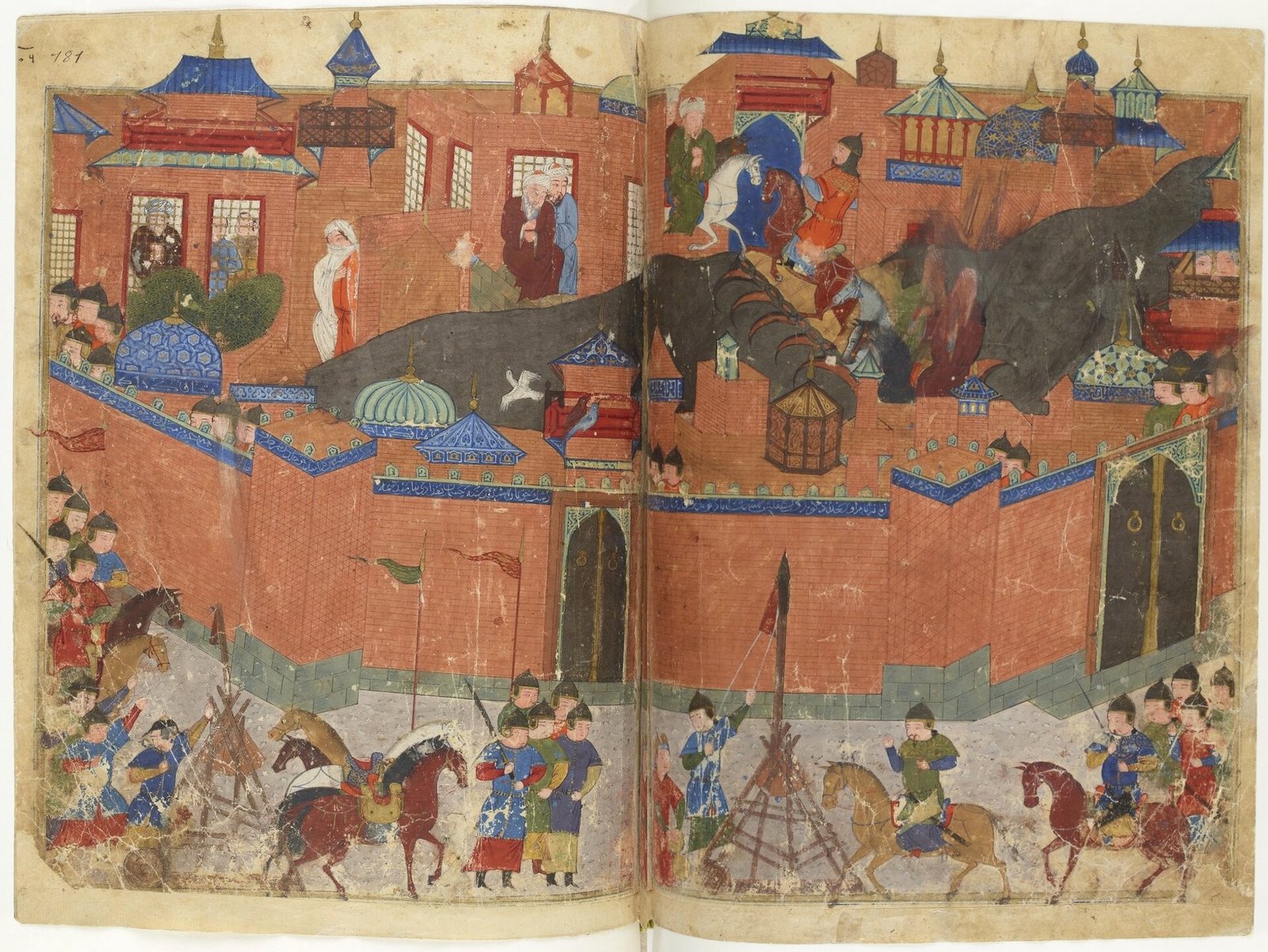
Accounts of Baghdad illustrate the scale of disagreement. Mustawfi claimed 800,000 deaths in 1258. Hülegü claimed two million in a letter to the king of France. Jackson suggests that Hülegü’s figure may have been inflated to demonstrate power. The author’s purpose therefore matters when assessing the number.
The often-repeated estimate of 40–60 million deaths across the Mongol conquests is also disputed. Wikipedia’s discussion records criticism of the numerical foundations of the 1978 population atlas associated with that estimate. It should be presented as an estimate under criticism, rather than as a settled total.
The comparison between roughly 120 million people in China before conquest and roughly 60 million around 1300 presents another difficulty. Incomplete registration prevents the difference from being read directly as 60 million deaths. Frederick Mote emphasised administrative recording failures. Timothy Brook offered an explanation involving people entering dependent statuses and disappearing from counts.
Even army sizes require scrutiny. Carl Sverdrup questions estimates placing more than 50,000 soldiers on each side at Mohi in 1241 by comparing them with European mobilisation capacity. His 2010 interpretation proposes Mongol armies smaller than common estimates, but often larger than their battlefield opponents. This challenges the familiar picture of consistently outnumbered Mongols.
Can the effects of warfare, famine, migration and economic disruption be separated?
Baghdad shows how the categories overlap. The account examined by Brack, Biran and Amitai records hunger after the massacre and water contaminated by corpses. A description of the conquest’s consequences can therefore include direct violence and conditions that continued to threaten survivors afterward.
The diagnosis of particular diseases requires further caution. Fancy and Green proposed a Mongol-associated plague outbreak in Baghdad in 1258. Brack, Biran and Amitai’s 2024 study argues that the three near-contemporary accounts used for that interpretation do not support the diagnosis. Evidence for suffering does not automatically establish a specific disease.
At Merv and Otrar, Campbell proposes that interrupted maintenance may have damaged earthen buildings more than direct demolition did. Think of the everyday work of keeping a home repaired: her argument places that practical need at the centre of urban survival. Killing, flight, enslavement and forced recruitment could remove the people who sustained the buildings.
Otrar also faced environmental pressure before the Mongol attack began in 1219. Toonen and colleagues’ 2020 study places the assault after more than 200 years of declining rainfall. It links much canal abandonment to drought and riverbed incision, challenging the claim that Mongol forces collectively destroyed the irrigation network.
Why did destruction and recovery vary between regions?
Southern Iran probably suffered less from the initial conquests because it was largely protected from the passage of major Mongol armies. Indirect rule through the Salghurids in Fars and the Qutlugh-Khanids in Kirman also mattered. Its experience differed from that of cities exposed to major sieges and army movements.
Recovery elsewhere faced continuing burdens. In Iran, the qubchur tax was added to existing taxes, alongside extraordinary demands and obligations to provision postal stations. These pressures impeded recovery. The consequences of conquest therefore extended into the demands imposed after military operations.
Otrar’s later revival coincided with changing environmental conditions. Between 1350 and 1550, economic recovery in the oasis overlapped with a wetter climate, higher river flows and alluvial deposition. That relationship makes water conditions essential to explaining recovery, just as declining rainfall matters when interpreting earlier abandonment.
Merv’s later urban form also changed. UNESCO’s nomination dossier records the foundation of Abdullah Khan Kala south of the earlier city during Shah Rukh’s reign, between 1408 and 1447. Its area was approximately one square kilometre. Renewed urban settlement thus took a smaller form in a different location.
Biran and Kim’s concluding assessment places destruction in China, Iran, Russia and Central Asia alongside economic exchange and institutional transformation. You can recognise those wider changes while retaining the evidence of massacre and displacement. At Merv, Otrar and Yaroslavl, the specific evidence determines which consequences can be demonstrated.
Details you won’t find in guidebooks
Ibn al-Athir claimed that Sultan Sanjar’s mausoleum at Merv had been burned. Yet Campbell reports that no fire damage was visible before restoration in the 1990s. The discrepancy shows why an individual monument deserves examination alongside the written account of its fate.
The geographer Yaqut al-Hamawi left Merv in 1219, before its conquest in 1221. His departure matters when assessing his relationship to the event. Campbell also reports radiocarbon evidence suggesting that abandonment at Otrar began more than 50 years before the Mongol armies arrived.
Dating itself can produce apparent contradictions. Some charcoal from Otrar’s canal fills yielded radiocarbon ages more than 200 years older than luminescence dates at the same depth. The charcoal dates the growth of the wood. Those results therefore require interpretation before being assigned to canal abandonment.
At Yaroslavl, a Bayesian model using 65 samples from the nine mass burials produced a range of 1197–1280 and an average of 1239. That result agrees with the chronicle date of 1238 without identifying the exact year on its own. Archaeology and writing reinforce each other here through comparison.
FAQ
How destructive were the Mongol conquests?
They caused massacres, enslavement, forced displacement and urban decline. Their severity varied with resistance, army movements, local administration and environmental conditions.
Did the Mongol conquests kill 40–60 million people?
The 40–60 million figure is disputed. Chronicle claims and incomplete population records cannot establish a secure total of people killed.
Was Merv completely abandoned after 1221?
Settlement continued during the thirteenth and fourteenth centuries, although occupied areas contracted around roads leading to gates and south of Sultan Kala.
Did the Mongols destroy Otrar’s entire irrigation system?
A 2020 study challenges that explanation. It links much canal abandonment to drought and riverbed incision, against a background of declining rainfall.
Sources
- Encyclopaedia Iranica — Mongols iranicaonline.org
- Columbia University — Mongol Support of Artisans afe.easia.columbia.edu
- Katie Campbell — The Impact of the Mongol Conquests on Earthen Cities in Central Asia api.repository.cam.ac.uk
- PNAS — A Hydromorphic Reevaluation of the Forgotten River Civilizations of Central Asia pmc.ncbi.nlm.nih.gov
- Wikipedia — Destruction under the Mongol Empire en.wikipedia.org
- Carl Sverdrup — Numbers in Mongol Warfare, publisher’s abstract cambridge.org
- Radiocarbon — The Extermination of the Ancient Russian City of Yaroslavl doi.org
- Medical History — Plague and the Mongol Conquest of Baghdad (1258)? doi.org
- UNESCO — Ancient Merv Nomination Dossier whc.unesco.org
- Michal Biran and Hodong Kim — Epilogue, The Cambridge History of the Mongol Empire, publisher’s abstract doi.org
Image: Bagdad1258.jpg — Sayf al-vâhidî et al., Public domain