The Emperor of Japan’s power shifted from royal authority to a position alongside military governments, then to constitutional sovereignty under the Meiji system. Shoguns exercised military power while the throne continued to confer legitimacy. Since the 1947 Constitution took effect, the Tennō has been a symbol of the state and the people’s unity, without governing powers.
How could the throne authorize a shogun in 1192 yet possess no governing powers under the 1947 Constitution? If you follow the title’s early evidence, the shoguns’ restrictions, and the constitutions of 1889 and 1947, the changes become clearer. The imperial institution survived, but the authority attached to it changed substantially.
How can legendary origins be distinguished from documented history?
The traditional foundation story places Jimmu’s founding of Japan in 660 BCE. It also describes him as a descendant of Amaterasu. This is a legendary account. The dynasty’s historical origins are instead sought in the Kofun period.
The Inariyama sword offers a different kind of evidence: an inscription on a surviving object. Its Wakatakeru is generally identified with Emperor Yūryaku. The inscription’s cyclical year is most commonly interpreted as 471 CE, although researchers have also discussed 531 CE.
You should therefore distinguish the traditional date of 660 BCE from the inscription’s debated dating. The first belongs to a foundation narrative. The second involves interpreting physical evidence. Neither should be presented as an equally certain starting point for documented imperial history.
How did the title Tennō and the imperial institution develop?
The title Tennō is documented from the seventh century. It was also applied retrospectively to earlier Japanese rulers. Encountering an early ruler described as a Tennō therefore does not establish that the ruler used that title during his lifetime.
In a 1981 study, Kikushi Hon-iden interpreted the Inariyama inscription as evidence that Japanese rulers used Daiō, meaning “great king,” during the fifth and sixth centuries. This separates the history of the ruling institution from the history of its later title.
The title’s origins remain debated. One theory proposes direct borrowing from the usage of the Tang ruler Gaozong. Hon-iden challenged that explanation. He suggested that Tennō might first have been used in Japan for rulers of the past.
An administrative foundation appears in the Imperial Household Agency’s institutional history. The agency traces its origins to the state organization provisions of the Taihō Code, issued in 701 under Emperor Monmu. A title and an administrative structure thus provide different evidence for the institution’s development.
What authority did emperors retain under the shoguns?
Imperial influence did not always depend on occupying the throne. Retired rulers including Shirakawa, Toba, and Go-Shirakawa strongly influenced court politics. The period from 1086 to 1185 is known as insei, or rule by retired emperors.
Military government brought another distribution of power. Minamoto no Yoritomo defeated his Taira rivals in 1185 and established military government at Kamakura. In 1192, Emperor Go-Toba appointed him seii tai shōgun. Military authority received legitimacy through the imperial office.
That appointment helps you separate two kinds of authority. Yoritomo had established military government in 1185. His imperial appointment followed in 1192. The throne remained politically significant even when the military government exercised power.
Emperors also tried to recover direct political authority. In 1333, Emperor Go-Daigo and his supporters overthrew the Kamakura shogunate. Their Kenmu Restoration sought to return political power to the throne.
The attempt produced no lasting settlement. Ashikaga Takauji drove Go-Daigo from Kyoto in 1336 and installed a rival emperor. Go-Daigo’s Southern Court at Yoshino competed with the Northern Court at Kyoto until 1392. Rival imperial courts became part of the struggle for power.
The Tokugawa shogunate later imposed explicit limits on court life. Its 17-article regulation of 1615 identified learning and the arts as the ruler’s principal pursuits. This gave the emperor a prescribed role under military government.
How did the Meiji Constitution of 1889 define imperial authority?
The Meiji Restoration changed the throne’s political position on 3 January 1868. Reforming forces used a palace coup to remove Tokugawa military government. The emperor returned to the center of political power.
The Meiji Constitution, promulgated on 11 February 1889, expressed that position in law. Article 3 declared the emperor sacred and inviolable. Article 4 defined him as the head of state who combined the rights of sovereignty in himself.
Those provisions existed alongside parliamentary requirements. Articles 5 and 37 required the Imperial Diet’s consent for legislation. Article 6 provided for imperial sanction of laws. Sovereign rights belonged to the emperor, but legislation still required the Diet’s participation.
Article 7 gave the emperor powers over parliamentary proceedings. He could summon the Imperial Diet, prorogue its sessions, and dissolve the House of Representatives. The constitution therefore placed important institutional powers in imperial hands.
Military and diplomatic authority were equally explicit. Article 11 gave the emperor supreme command of the army and navy. Article 13 granted the powers to declare war, make peace, and conclude treaties.
Ministers also had a defined constitutional role. Under Article 55, they were responsible for the advice they gave the emperor. Laws, ordinances, and imperial commands concerning state affairs required a ministerial countersignature. Reading this alongside Articles 3 and 4 gives a fuller picture of imperial authority.
How did the 1947 Constitution change sovereignty and the imperial role?
The transition passed through surrender in 1945. Hirohito’s rescript accepting the Potsdam Declaration was dated 14 August. A recording in his voice was broadcast by radio at noon on 15 August.
The surrender instrument signed in Tokyo Bay on 2 September 1945 placed the governing authority of the emperor and the Japanese government under the Supreme Commander for the Allied Powers. This preceded the constitutional redistribution of sovereignty.
The new constitution was promulgated on 3 November 1946 and took effect on 3 May 1947. Article 1 located sovereignty in the people. It defined the emperor as the symbol of the state and the people’s unity, deriving his position from their will.
Article 4 excluded powers of government. The emperor could perform only the acts in matters of state specified by the constitution. Article 3 required cabinet advice and approval for all such acts. The cabinet bore responsibility for them.
Appointments illustrate how this arrangement works. Under Article 6, the emperor appoints the prime minister designated by the Diet. He appoints the chief justice of the Supreme Court designated by the cabinet. If you read that the emperor “appoints” these officials, the constitutional designation process matters: the selection belongs to another institution.
Hereditary succession continued under Article 2. Yet the Imperial Household Law governing succession became a law enacted by the Diet. The constitution preserved inheritance of the throne while placing its legal framework within parliamentary legislation.
Details you won’t find in guidebooks
The Inariyama evidence comes from an iron sword recovered during the 1968 excavation of the Inariyama burial mound in Saitama. Its inscription contains 115 characters. That small object supplies evidence central to discussions of early rulers and their titles.
The Purple Robe Incident shows military intervention in religious honors. In 1629, the Tokugawa government revoked privileges to wear purple robes that the court had granted to certain Buddhist clerics since 1615. The emperor’s conferral of religious ranks was therefore subject to intervention.
The 1889 settlement also separated household administration from ordinary cabinet structures. The Imperial Household Law issued alongside the constitution kept internal dynastic affairs outside parliamentary proceedings. The Imperial Household Ministry operated independently of the cabinet.
Article 8 of the 1947 Constitution reaches into something familiar from everyday life: giving and receiving gifts. Grants of property to the imperial household, its acceptance of property, and gifts from it required Diet authorization. Even household transactions acquired a parliamentary condition.
Administrative changes reinforced the constitutional shift. On 3 May 1947, the Imperial Household Ministry became an office under the prime minister. Its staff, numbering more than 6,200 immediately after the war, fell below 1,500.
Timeline
- 660 BCE: Traditional foundation date associated with Jimmu; a legendary chronology.
- 471 CE: Predominant dating of the Inariyama inscription; 531 CE is an alternative.
- Seventh century: Tennō appears in documentary evidence.
- 701: The Taihō Code was issued under Monmu.
- 1086–1185: Retired emperors influenced court politics during insei.
- 1185: Yoritomo established military government at Kamakura.
- 1192: Go-Toba appointed Yoritomo shogun.
- 1333: Go-Daigo’s Kenmu Restoration began.
- 1336–1392: Northern and Southern imperial courts competed.
- 1615: Tokugawa authorities issued their 17-article court regulation.
- 3 January 1868: The Meiji Restoration returned the emperor to political centrality.
- 11 February 1889: The Meiji Constitution was promulgated.
- 15 August 1945: Hirohito’s recorded rescript was broadcast.
- 2 September 1945: Surrender subordinated imperial and governmental authority to the Allied Supreme Commander.
- 3 November 1946: The new constitution was promulgated.
- 3 May 1947: Popular sovereignty and the symbolic imperial role took constitutional effect.
FAQ
When did Japanese rulers begin using the title Tennō?
The title Tennō is documented from the seventh century. It was also applied retrospectively to earlier rulers.
Did emperors retain authority under the shoguns?
The imperial office continued to confer legitimacy, as Yoritomo’s appointment as shogun in 1192 shows. Military governments nevertheless exercised substantial power and restricted court activities.
What powers did the Meiji Constitution give the emperor?
The 1889 Constitution vested sovereign rights in the emperor and granted military and diplomatic powers. It also required parliamentary consent for legislation and ministerial countersignatures for state business.
Can Japan’s emperor govern under the 1947 Constitution?
No. Article 4 excludes governing powers, while Article 3 requires cabinet advice and approval for all imperial acts in matters of state.
Sources
- Türkçe Vikipedi — Japonya imparatoru tr.wikipedia.org
- English Wikipedia — Emperor of Japan en.wikipedia.org
- Shigaku Zasshi — On the Title of the Monarch in Ancient Japan and China jstage.jst.go.jp
- Saitama Prefectural Museum of the Sakitama Ancient Burial Mounds — Inariyama Kofun sakitama-muse.spec.ed.jp
- Saitama Museums Research Annual 17 — The Shingai Year on the Inariyama Iron Sword sakitama-muse.spec.ed.jp
- Imperial Household Agency — History of the Imperial Household Agency kunaicho.go.jp
- Cambridge History of Japan — Insei cambridge.org
- The Metropolitan Museum of Art — Japan, 1000–1400 A.D metmuseum.org
- Japan Society — The Polity of the Tokugawa Era japansociety.org
- Ohio State University, Origins — Japan’s Meiji Restoration origins.osu.edu
- National Diet Library — The Constitution of the Empire of Japan ndl.go.jp
- National Diet Library — Imperial Rescript of the Termination of the War ndl.go.jp
- National Diet Library — Instrument of Surrender ndl.go.jp
- National Diet Library — Chronological Table ndl.go.jp
- National Diet Library — The Constitution of Japan ndl.go.jp
- Imperial Household Agency — The Emperor kunaicho.go.jp
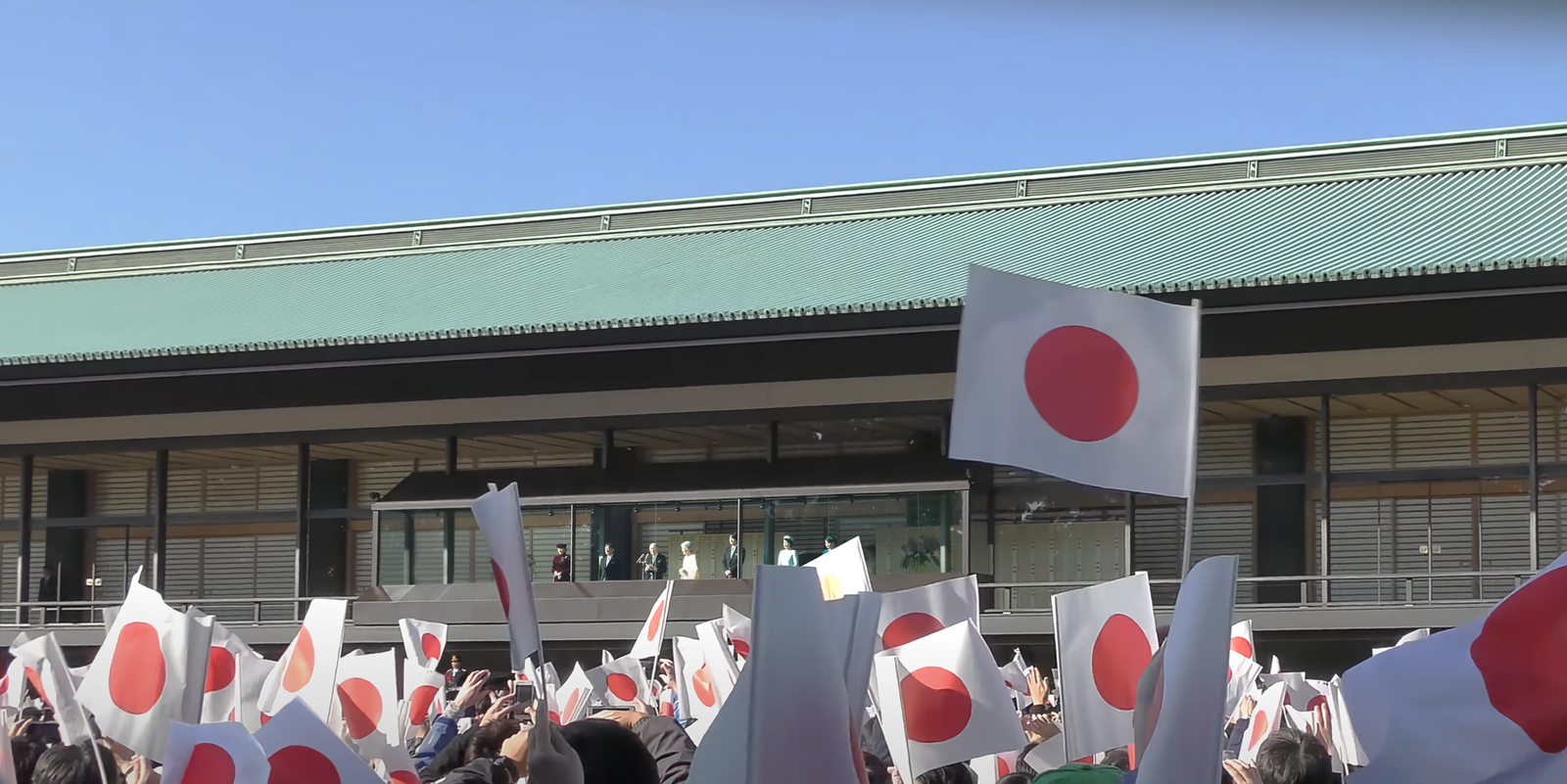
Image: Emperor of Japan Birthday Akihito 2017.png — Artanisen, CC BY-SA 4.0