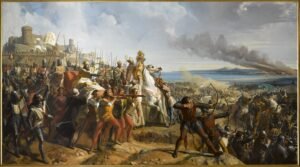
The Battle of New Orleans was fought on 8 January 1815 because news of the peace treaty signed on 24 December had not reached the United States. The Treaty of Ghent also required ratification by both sides and an exchange of ratification documents before becoming binding. That process ended on 17 February 1815, after the battle.
The puzzle becomes clearer when you separate three events: signing the treaty, receiving the news, and bringing the agreement into force. At Chalmette in Louisiana, Andrew Jackson’s American forces faced Edward Pakenham’s British army while that process remained unfinished. The port’s commercial value, Jackson’s defenses, and his later political career explain why this battle mattered beyond its unusual timing.
Why did Britain seek to capture New Orleans?
New Orleans was a gateway between the Mississippi River valley and overseas trade. Its port therefore held strategic importance for the American economy. A British operation against the city targeted a place where river transport and foreign commerce met.
Napoleon’s defeat in the spring of 1814 allowed Britain to concentrate more attention on American coasts, trade, and transportation. The operation against New Orleans belonged to that wider military effort. The Mississippi trading gateway gave the British a concrete objective.
British instructions also explain why peace rumors did not stop the campaign. On 24 October 1814, Henry Bathurst, Britain’s secretary for war and the colonies, secretly instructed Pakenham to continue operations even if he heard such rumors. A possible agreement was therefore no reason for him to abandon his orders.
Claims about permanent British possession require care. Historian Jon Latimer rejected the argument that Britain would have permanently retained the Louisiana Purchase territory after a victory. That argument also conflicts with Bathurst’s correspondence. The port’s strategic importance does not establish a plan for permanent territorial control.
How did the treaty’s signing, arrival of the news and ratification differ?
American and British representatives signed the Treaty of Ghent on 24 December 1814. They signed it in Ghent, in present-day Belgium. This established the agreed text, but the treaty itself specified further steps before it became binding.
Article 11 required both parties to ratify the agreement without changes. It also required them to exchange their ratification documents. If you treat the signing date as the entire peace process, you miss the conditions written into the agreement.
Britain ratified the treaty on 31 December 1814. American ratification and the exchange of documents had still not occurred. When the British attacked at Chalmette on 8 January, the agreement had been signed for 15 days, but its required approval process remained incomplete.
The information delay was separate from that legal process. News of the signed peace had not yet reached the United States when the battle occurred. The ship Favorite, carrying the treaty, reached New York on 11 February 1815. That was more than a month after the fighting at Chalmette.
For an everyday comparison, think of the difference between signing an agreement and receiving notice that all required approvals are complete. Ghent had its own explicit requirements: ratification by both governments and an exchange of documents. The signature alone did not satisfy them.
President James Madison submitted the treaty to the United States Senate. On 16 February 1815, the Senate unanimously approved it for ratification. Madison ratified it the following day, and the documents were exchanged in Washington that same day. The treaty entered into force on 17 February.
How did Andrew Jackson’s forces stop the British assault?
Jackson began preparing his main defensive position after attacking the British camp on the night of 23 December 1814. He then withdrew to the Rodriguez Canal. There, his forces started building the position known as Line Jackson.
The location reduced the frontage his army needed to defend. Between the Mississippi and a cypress swamp, the line extended about 950 yards, or 869 meters. Jackson could organize his defenses across that relatively narrow space.
American troops built their positions on the canal’s western bank. They used earth, wooden stakes, and cotton bales. The canal and these constructed defenses formed the position the British would have to assault.
Jackson’s army brought together several groups. It included regular soldiers, Tennessee and Kentucky militia, Louisiana troops, free Black men, Choctaw warriors, and Jean Lafitte’s men. The defense depended on a broader force than the Kentucky riflemen who later became especially prominent in its popular memory.
After the British probing attack of 28 December 1814, the American line contained eight artillery batteries. Their weapons included 32-pounder and 24-pounder guns. These batteries gave Jackson substantial artillery support along his defensive position.
On 8 January, Samuel Gibbs led a British column toward the American left center. Artillery fire, supported by Tennessee and Kentucky militia, stopped its advance. According to the Historic New Orleans Collection, the large American guns caused more British casualties than the Kentucky riflemen later celebrated in accounts of the victory.
The British command suffered heavily. Pakenham was killed, Gibbs was mortally wounded, and John Keane was wounded. The main British assault against Jackson’s line at Chalmette was repulsed in about half an hour.
Timeline
- 24 October 1814: Bathurst instructed Pakenham to continue operations despite peace rumors.
- 23 December 1814: Jackson attacked the British camp at night, then withdrew to the Rodriguez Canal.
- 24 December 1814: American and British representatives signed the Treaty of Ghent.
- 31 December 1814: Britain ratified the treaty.
- 8 January 1815: The main British assault at Chalmette ended in defeat.
- 11 February 1815: Favorite arrived in New York carrying the treaty.
- 16 February 1815: The United States Senate unanimously approved the treaty for ratification.
- 17 February 1815: Madison ratified the treaty. The documents were exchanged in Washington, bringing it into force.
- November 1828: Jackson was elected president.
- 4 March 1829: Jackson took office as president.
Details you won’t find in guidebooks
The Rodriguez Canal had an agricultural purpose before Jackson turned it into a military ditch. It separated the Rodriguez and Chalmette plantations. A feature of plantation farming thus became the central feature of the American defensive position.
The fields also reflected the agricultural calendar. The Chalmette plantation’s sugarcane had been harvested in December 1814. The British consequently advanced mainly across open fields covered with stubble. If you picture standing sugarcane surrounding the main advance, the harvested landscape gives you a different view.
The victory’s musical afterlife helped shape Jackson’s public image. Samuel Woodworth’s song Hunters of Kentucky celebrated the battle. During the 1820s and 1830s, it became associated with Jackson’s political campaigns.
The anniversary carried national importance for decades during the nineteenth century. Americans celebrated 8 January as a national holiday in a manner comparable to 4 July. The battle therefore remained part of public life long after the treaty’s ratification.
How did the victory influence Jackson’s political rise?
The victory made Jackson nationally famous as the Hero of New Orleans. It strengthened the military reputation he later used in presidential campaigns. A successful defense of the Mississippi trading gateway gave his supporters a memorable achievement to celebrate.
That reputation did not deliver an immediate presidential victory. Jackson lost the 1824 contest to John Quincy Adams. He was elected in November 1828 and entered office on 4 March 1829. New Orleans supplied part of the military standing behind that later success.
His conduct at New Orleans also gave opponents material for criticism. During the 1828 election, Adams supporters pointed to the martial law Jackson had imposed there in 1814–1815. They used it to portray him as an authoritarian military leader. The same episode supported competing political arguments about his leadership.
FAQ
Why was the Battle of New Orleans fought after the peace treaty was signed?
The battle took place on 8 January 1815 because news of the Treaty of Ghent had not reached the United States. The treaty also required ratification by both sides and an exchange of ratification documents before becoming binding.
When did the Treaty of Ghent take effect?
The treaty took effect on 17 February 1815, when James Madison ratified it and the ratification documents were exchanged in Washington.
How did Jackson defeat the British assault?
Jackson established a fortified line along the Rodriguez Canal, between the Mississippi and a cypress swamp. Artillery fire and support from Tennessee and Kentucky militia helped stop the British attack.
Did the victory make Jackson president?
The victory strengthened Jackson’s national reputation and supplied a military record for his later campaigns. He lost the 1824 presidential contest to John Quincy Adams, won election in November 1828, and took office on 4 March 1829.
Sources
- Naval History and Heritage Command — The Battle of New Orleans history.navy.mil
- National Park Service — Chalmette Battlefield nps.gov
- American Battlefield Trust — New Orleans battlefields.org
- Wikipedia — Battle of New Orleans en.wikipedia.org
- National Archives — Treaty of Ghent archives.gov
- Library of Congress — Treaties and Other International Agreements: Treaty of Ghent tile.loc.gov
- Indiana University Lilly Library — Peace collections.libraries.indiana.edu
- U.S. Senate — The Senate Approves for Ratification the Treaty of Ghent senate.gov
- National Park Service — Chalmette Battlefield and Chalmette National Cemetery Cultural Landscape Report, page 13 npshistory.com
- Historic New Orleans Collection — The Hero of New Orleans hnoc.org
- Louisiana Historical Association — Dictionary of Louisiana Biography: Jackson, Andrew lahistory.org
- Historic New Orleans Collection — A Man of the People hnoc.org
Image: Battle of New Orleans, Jean Hyacinthe de Laclotte.jpg — Painting by Jean Hyacinthe de Laclotte (1766 – 1829), a memb, Public domain