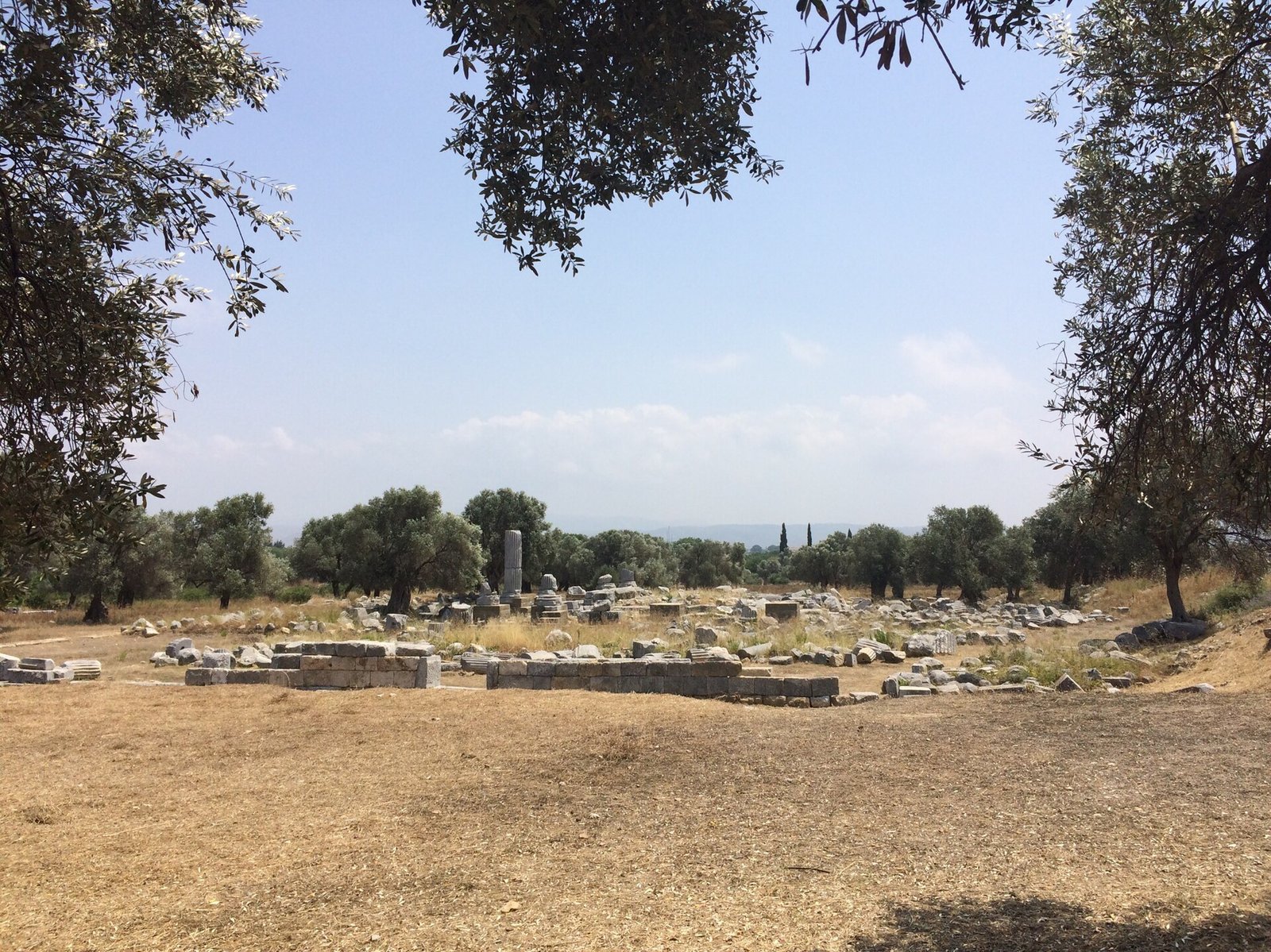
Ancient Teos near Sığacık was one of the 12 city-states of the Ionian League, and its Temple of Dionysus honoured the god associated with wine, vines, and theatre. Attributed to the Hellenistic architect Hermogenes, the temple belonged to a sanctuary whose construction extended from the late third century BCE into the Roman imperial period.
Why did a city with two ancient harbours also become home to an association of poets, musicians, actors, and singers? At Teos, you can follow that connection through the sanctuary, its festival imagery, and the history of its performers. The temple’s columns provide a starting point. Its entrance steps, building inscriptions, and wider setting reveal more of the city around it.
Where is ancient Teos near Sığacık?
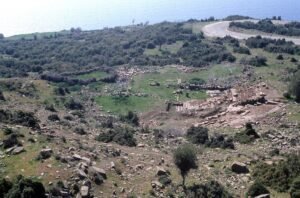
Teos stands in Sığacık, in the Seferihisar district of İzmir. It lies approximately 60 kilometres southwest of İzmir, on a small peninsula called Isthmos. Its acropolis rises on Kocakır Tepe. Ancient harbours occupy positions to the north and south of the city.
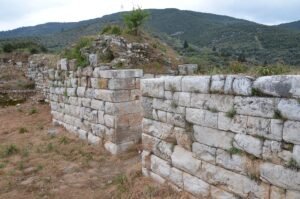
The Hellenistic city wall enclosed 65 hectares. Within that area stood the Sanctuary of Dionysus, the theatre, the agora, and the council building. When you consider the temple alongside these monuments, its place within an inhabited city becomes clearer. Religious activity shared the enclosed urban area with performance and civic institutions.
How old is Teos, and who founded it?
Archaeological evidence for continuous settlement at Teos reaches back to the Protogeometric period, approximately 1050–900 BCE. This is the foundation for the excavation project’s account of the city’s earliest occupation. It gives Teos a settlement history extending well before the Hellenistic sanctuary’s construction.
A different account survives in the foundation myth reported by Strabo. That story names Athamas as the city’s founder. The myth and the archaeological evidence answer different questions. Athamas belongs to a transmitted foundation narrative. The dating of continuous occupation rests on material evidence from the Protogeometric period.
Teos later experienced migration under Persian pressure. During the second half of the sixth century BCE, many inhabitants left for Abdera on the Thracian coast. In 129 BCE, Teos became part of Rome’s province of Asia. These events place the city’s religious monuments within a longer history of movement and political change.
Why was Dionysus important at Teos?
The Sanctuary of Dionysus was dedicated to a god associated with wine, vines, and theatre. It hosted festivals connected with his cult. During the Roman imperial period, Teos was known for its wine, theatre, and Temple of Dionysus. The sanctuary therefore brings together several activities for which the city was remembered.
The connection with performance also took an organised form. In the third century BCE, an association of Dionysian artists was established at Teos. Its members included poets, musicians, actors, and singers. This places performers directly within the city’s history, alongside the temple and the festivals celebrated in its sanctuary.
Relations between the association and the city became troubled. After the artists were regarded as a source of unrest, the association was sent first to Ephesos, then to Myonnessos, and finally to Lebedos. The history of Dionysus at Teos includes this institutional conflict as well as worship and artistic activity.
Who designed the Temple of Dionysus?
The Temple of Dionysus is attributed to Hermogenes, an architect of the Hellenistic period. It also appears in the work of the Roman architectural writer Vitruvius. The attribution connects the building with a named architect, while its appearance in Vitruvius gives it a place in ancient architectural writing.
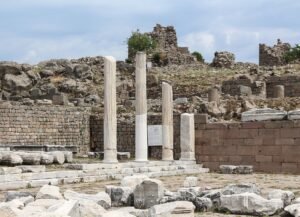
The excavation team measures the Ionic temple at 22.75 metres wide and 42.25 metres long. It has a peripteral plan. This means that a single row of columns surrounds its inner structure. There were six columns along each short side and eleven along each long side.
If you picture the temple through those measurements, its shape becomes easier to understand. The long sides extended considerably beyond the width of the entrance front. The six-by-eleven arrangement describes the column layout; the term peripteral explains how that layout related to the enclosed structure inside.
When were the temple and sanctuary built?
The İzmir Provincial Directorate of Culture and Tourism dates the Temple of Dionysus to the early second century BCE. A wider construction chronology appears in Musa Kadıoğlu’s 2022 study. It places building activity throughout the Sanctuary of Dionysus between the last quarter of the third century BCE and CE 120–130.
These dates concern different scales of construction. The early second-century BCE date refers to the temple. The longer range concerns development across the whole sanctuary. You should therefore read the sanctuary as a complex with a building history that crossed from the Hellenistic period into the Roman imperial period.
The surrounding complex included a trapezoidal sacred enclosure, or temenos, and colonnaded galleries. A stepped altar stood to the east. A monumental entrance, called a propylon, also formed part of the sanctuary. The temple was the central subject of this religious setting, but it was only one of its architectural components.
Details you won’t find in guidebooks
The eastern entrance front of the temple had 12 steps. The other sides had five. This difference gives the entrance a specific architectural distinction. It also offers a concrete detail to consider when you reconstruct the building in your mind from its recorded plan.
The sculpted friezes depicted Dionysian festivities. Their figures were directed towards a meeting point at the centre above the eastern entrance. The images therefore had a planned orientation. The same eastern side that carried the longer staircase also provided the central meeting point for the festival imagery.
The sanctuary’s propylon has been dated to 3 BCE. That date comes from considering a fragmentary Latin building inscription together with the style of a Corinthian capital. The conclusion depends on both written and architectural evidence, giving the monumental gateway a more specific date within the sanctuary’s long development.
Teos also contributed 17 ships to the Battle of Lade in 494 BCE. This detail adds a naval episode to the history of a city with northern and southern harbours. It belongs to an earlier chapter than the Hellenistic temple and the association of Dionysian artists.
An everyday-life connection emerged in October 2016, when excavators found a rental-contract inscription approximately 2,200 years old. It contained legal terms and detailed provisions. If you have ever worked through the clauses of a rental agreement, that document offers a familiar point of contact with ancient Teos: people here also recorded rental arrangements in precise language.
Timeline
- 1050–900 BCE: Protogeometric finds provide evidence for continuous settlement at Teos.
- Second half of the sixth century BCE: Many inhabitants migrate to Abdera under Persian pressure.
- 494 BCE: Teos contributes 17 ships to the Battle of Lade.
- Third century BCE: The association of Dionysian artists is established at Teos.
- Last quarter of the third century BCE: Sanctuary construction begins according to the wider chronology presented in the 2022 study.
- 129 BCE: Teos becomes part of Rome’s province of Asia.
- 3 BCE: The propylon is dated to this year through its inscription and architectural style.
- CE 120–130: The sanctuary reaches the final phase of the construction sequence identified in the 2022 study.
- 1764–1765: Richard Chandler and Nicholas Revett conduct the first archaeological investigations for the Society of Dilettanti.
- 1962–1967: Yusuf Boysal and Baki Öğün direct the first excavations by Turkish archaeologists.
- 2010: Excavation and restoration restart under Musa Kadıoğlu.
- October 2016: Excavators discover the approximately 2,200-year-old rental-contract inscription.
How has archaeology revealed Teos?
The first archaeological investigations took place in 1764–1765. Richard Chandler and Nicholas Revett carried them out for the British Society of Dilettanti. Turkish archaeological excavations followed in 1962–1967, directed by Yusuf Boysal and Baki Öğün of Ankara University.
Excavation and restoration resumed in 2010 under Ankara University’s Musa Kadıoğlu. The temple measurements, the assessment of the propylon, and the sanctuary’s extended construction chronology give different kinds of evidence for reading the site. Together, they connect individual architectural details with the development of the larger religious complex.
Teos travel: what should you know before visiting?
For a visit centred on ancient history, place the Sanctuary of Dionysus within the city’s 65-hectare walled area. The theatre, agora, and council building belong to that same urban setting. The acropolis on Kocakır Tepe and the two ancient harbours add further points to your understanding of Teos’s layout.
The Ministry visitor page checked on 16 November 2026 lists Teos as open every day from 08:30 to 17:30. The ticket office closes at 17:00. The same visitor information states that MüzeKart is valid for citizens of the Republic of Türkiye.
FAQ
Where is ancient Teos?
Teos is in Sığacık, within İzmir’s Seferihisar district, approximately 60 kilometres southwest of İzmir. The ancient city developed on a small peninsula called Isthmos.
Who designed the Temple of Dionysus at Teos?
The temple is attributed to the Hellenistic architect Hermogenes. The Roman architectural writer Vitruvius also mentions it.
When was the Temple of Dionysus built?
The İzmir Provincial Directorate of Culture and Tourism dates the temple to the early second century BCE. Musa Kadıoğlu’s 2022 study places construction across the wider sanctuary between the last quarter of the third century BCE and CE 120–130.
What are the visiting hours for Teos?
The Ministry visitor information checked on 16 November 2026 lists daily opening from 08:30 to 17:30, with the ticket office closing at 17:00. MüzeKart is accepted for citizens of the Republic of Türkiye.
Sources
- İzmir Provincial Directorate of Culture and Tourism — Teos Excavation, Seferihisar izmir.ktb.gov.tr
- Ministry of Culture and Tourism — Teos Archaeological Site muze.gov.tr
- Ankara University Teos Archaeology Project — History of the City teos.ankara.edu.tr
- Ankara University Teos Archaeology Project — City History teos.ankara.edu.tr
- Ankara University Teos Archaeology Project — The Sanctuary of Dionysus teos.ankara.edu.tr
- Musa Kadıoğlu, Höyük, 2022 — Teos Dionysos Kutsal Alanı Propylonu hoyuk.gov.tr
- İzmir Provincial Directorate of Culture and Tourism — Teos, Seferihisar izmir.ktb.gov.tr
- Ankara University Teos Archaeology Project — Research History teos.ankara.edu.tr
- Anadolu Agency — İş Bankası Support for Excavations at Ancient Teos aa.com.tr
- English Wikipedia — Teos en.wikipedia.org
Image: Teos, Sığacık.jpg — Kadı, CC BY-SA 4.0