Where is Knidos in Turkey?
Knidos stands at Tekir Burnu, the western tip of the Datça Peninsula. It lies in the Datça district of Muğla. The provincial culture and tourism authority gives its distance from Datça as 33 kilometers. If you are placing the ruins on a map, start with the end of the peninsula.
The ancient city belonged to Caria. It was also a member of the Doric Hexapolis, a group formed by six Doric cities. These connections place Knidos within both a regional landscape and a wider association of ancient communities.
The setting helps explain the ruins. Knidos occupied mountainous ground, with buildings arranged on terraces rising from the coast toward the acropolis. Strabo compared its shape to a theater. You can use that comparison to understand how the lower waterfront and higher terraces belonged to the same city.
Knidos map: how do the two ancient harbors fit together?
The archaeological site lies at approximately 36.68583 degrees north and 27.37500 degrees east. Its layout includes the mainland and an island section called Kap Krio. Filling the water between them created the arrangement of two separate harbors.
The smaller northern harbor served military purposes. The southern harbor accommodated trading ships. This division is central to understanding Knidos: the waterfront supported different activities in distinct spaces. When you look across the harbor areas, you are looking at a planned separation of military and commercial use.
The streets followed a grid of intersecting parallel routes. That ordered plan existed alongside the terraces required by the mountainous terrain. The street grid and the rising ground therefore explain different parts of the same layout. One organized movement across the city; the other shaped where buildings stood.
Knidos ancient city: which ruins should you look for?
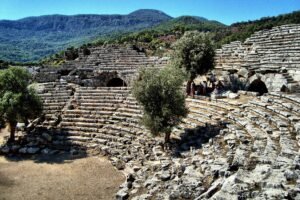
The Small Theater greets visitors near the entrance. It held approximately 5,000 people and remains one of the principal visible structures. Its capacity gives you a concrete measure of the public gathering space within the city.
The Great Theater and the Sanctuary of Demeter lie in the eastern part of Knidos. Only wall remains survive from that theater. Keep the two theaters separate in your understanding of the site: the approximately 5,000-seat figure belongs to the Small Theater.
The Apollo Terrace lies below the Round Temple Terrace. A temple foundation survives there, together with seating built for spectators attending the Apollo Karneios festivities. These remains connect a sacred building with the people who gathered to watch events associated with its celebrations.
South of the Apollo Terrace stands the Pink Temple. Its name comes from the color of the local building stone. The structure later served as a church. The provincial culture and tourism authority also includes the Dionysos Stoa and Temple among the principal ruins visitors can see at Knidos.
Knidos Aphrodite: where is the original statue?
Praxiteles made the original Aphrodite of Knidos in the middle of the fourth century BC. It was created for the Knidos sanctuary dedicated to Aphrodite Euploia. The sculpture is therefore tied to a specific sacred setting in the ancient city.
The original has not survived. Its appearance is known through numerous ancient copies and adaptations. When you encounter a surviving Knidian Aphrodite, the distinction between the lost work and a later version matters. The name can identify the sculptural tradition without identifying the original object.
A Roman copy dating to the first century AD stands in the Sculpture Gallery of the Pitti Palace in Florence. It measures 199 centimeters in height. This surviving statue offers a concrete answer to where a copy can be seen, while the original by Praxiteles remains lost.
The Round Temple at Knidos requires another distinction. Iris Cornelia Love identified it as the Temple of Aphrodite. The Culture Portal reports that later research showed the building was dedicated to another deity. The round remains should therefore not be presented as the securely identified home of the famous sculpture.
Knidos Lion: what is the Knidos Aslanı, and where is it?
The Knidos Lion, also called Knidos Aslanı, is a marble sculpture displayed in the Great Court of the British Museum in London. Its museum inventory number is 1859,1226.24. The lion is a surviving object associated with Knidos that you can trace beyond the archaeological site.
Its dimensions explain its substantial presence: 2.89 meters long, 1.82 meters high, and 1.17 meters deep. The eye sockets are now empty. They probably originally contained glass inlays, a detail that changes how you might imagine the sculpture’s former appearance.
The lion’s date has been debated. One claim links its creation to the naval battle of 394 BC. Another interpretation dates the tomb’s Doric architecture to around 175 BC. The British Museum catalog places the sculpture in the second century BC, so the battle connection should remain a claim rather than a settled explanation.
How did wine and everyday work shape Knidos?
Knidos was known in antiquity for producing and exporting wine. Its southern harbor served trading vessels. Read together, these facts connect the city’s commercial waterfront with an economy that included wine production and overseas sales.
Excavations on Kap Krio uncovered shops, workshops, and houses arranged on terraces. Settlement finds extend from the fourth century BC to the fifth century AD. These remains add working and domestic spaces to a site often described through its temples and theaters.
Think of the everyday relationship between your home, your workplace, and the shops you use. Kap Krio offers an ancient point of comparison because houses, workshops, and shops all occupied its terraces. The excavated buildings make daily activity part of the story alongside public ceremonies and harbor trade.
Details to look for at Knidos
A marble altar on the Apollo Terrace carries an inscription stating its dedication to Apollo. This gives the terrace more than an architectural outline. The inscription supplies direct evidence of the deity honored there, alongside the temple foundation and festival seating.
Knidos has seven known churches. In the example near the east–west street, one floor-paving block bears inscriptions scratched in Arabic. This small detail belongs to the material record of the church and adds another element to the city’s surviving written traces.
The Boulakrates Fountain stands east of Harbor Street. Its structure rises from a square substructure measuring approximately three by three meters. Above that base, the plan becomes circular, with a conical roof. The combination of square base and rounded upper section gives you a specific architectural feature to recognize.
Was Knidos moved from Burgaz?
Official presentations identify Burgaz as Old Knidos and describe a move to Tekir Burnu during the fourth century BC. This account provides a framework for discussing the relationship between the two places. It should still be distinguished from certainty about how the change occurred.
A 2025 academic study treats a shift in population and urban centrality as a possibility. It also states that historical records do not clarify the cause. The careful formulation is therefore a possible fourth-century BC shift whose character and reasons remain uncertain.
Timeline
- Fourth century BC: Official presentations place the move from Burgaz to Tekir Burnu in this period; the 2025 academic study treats a shift in population and urban centrality as a possibility whose cause is not clarified by historical records.
- Middle of the fourth century BC: Praxiteles made the original Aphrodite of Knidos.
- Second century BC: This is the date adopted for the Knidos Lion in the British Museum catalog.
- First century AD: The Roman Aphrodite copy now in the Pitti Palace was made.
- 1857–1859: Charles Newton conducted excavations at Knidos for the British Museum. Many finds were taken to the museum.
- 1967: Excavations resumed under Iris Cornelia Love for Long Island University.
- 1977: Turkey withdrew permission for the excavations led by Love.
FAQ
Where is Knidos in Turkey?
Knidos is at Tekir Burnu, on the western tip of the Datça Peninsula in the Datça district of Muğla. The provincial culture and tourism authority places it 33 kilometers from Datça.
What ruins can you see at Knidos?
The main remains include the Small Theater, Apollo Terrace, Round Temple remains, Pink Temple, Dionysos Stoa and Temple, and Boulakrates Fountain. The ancient city also has two harbors.
Where is the Aphrodite of Knidos?
The original sculpture by Praxiteles has not survived. A first-century AD Roman copy is held in the Sculpture Gallery of the Pitti Palace in Florence.
Where is the Knidos Lion?
The marble Knidos Lion is displayed in the Great Court of the British Museum in London. Its inventory number is 1859,1226.24.
Sources
- Ministry of Culture and Tourism — Muğla Knidos Archaeological Site muze.gov.tr
- Muğla Provincial Directorate of Culture and Tourism — Places to Visit mugla.ktb.gov.tr
- Wikipedia — Knidos en.wikipedia.org
- Vikipedi — Knidos tr.wikipedia.org
- Muğla Provincial Directorate of Culture and Tourism — Knidos mugla.ktb.gov.tr
- Culture Portal — Knidos Ancient City kulturportali.gov.tr
- OpenMETU — Harbor Geoarchaeology and Urban Change in the Ancient Knidia open.metu.edu.tr
- Uffizi Galleries — Knidian Aphrodite uffizi.it
- Erlangen-Nürnberg University — Die Aphrodite von Knidos klassischearchaeologie.phil.uni-erlangen.de
- British Museum — The Lion of Knidos britishmuseum.org
- British Museum / Google Arts & Culture — Colossal Marble Lion from a Tomb Monument artsandculture.google.com
Image: Knidos-Häfen.jpg — Tischbeinahe, CC BY-SA 3.0