Hattusa was the capital of the Hittites in the Late Bronze Age. Today it is an archaeological site in the Boğazkale district of Çorum province, Turkey. You can walk through its gates, stand in its temple district and see a section of its wall rebuilt in clay.
This guide explains where Hattusa is, what the ruins are, and what to look at first. It also covers the green stone that visitors ask about most.
Hattusa, Turkey: what the place is
The name has more than one spelling. Turkish sources write Hattuşa or Hattuşaş. The Hattians called the city Hattuş. Under Hittite rule it was known as Hattuşa.
The ruins sit inside the great bend of the Kızılırmak river in Anatolia. The site lies at the southern end of the Budaközü Plain. The city was built on slopes that rise about 300 metres above the valley floor.
The human story here is much older than the Hittite state. Traces of the earliest settlement go back to the 6th millennium BC. In the 19th and 18th centuries BC, Assyrian merchants set up a trading settlement in the Lower City.
Around 1700 BC, Anitta, King of Kuşşara, destroyed the city. He left a curse behind. It asked the Storm God of heaven to punish any king who resettled the place.
The curse did not last. Around 1650–1600 BC, under Hattusili I, Hattusa was chosen as the Hittite capital.
UNESCO added Hattusa to the World Heritage List in 1986 as a cultural site.
Hattusa location and how to get there
Hattusa lies in Boğazkale, a district of Çorum province. The Ministry of Culture and Tourism says Boğazköy-Hattusa is 82 kilometres southwest of Çorum city center. That is the distance to plan around if you start in Çorum.
The reference coordinates are about 40.01972° N and 34.61528° E. Think of how you share a pin with a friend when you meet somewhere. Paste these numbers into your phone’s map app the same way, and it will place you at the ruins.
The Boğazkale municipality offers a visitor guide. It suggests starting at the district center and the museum area. It then continues to the Great Temple, the Green Stone, the Lion Gate and Yazılıkaya. That order is a practical way to plan your day.
Hattusa map: how the city is laid out
A small stream, the Kızlarkayası, divides the city in two. The Lower City is to the north. The Upper City is to the south.
On a map, think of the city as a bowl climbing a hillside. The Lower City holds the Great Temple. The Upper City holds the gates and the defensive walls.
The royal residence stood on a high ridge known today as Büyükkale. It is a separate landmark on the plan, apart from the temples and gates.
Yazılıkaya is not inside the city plan. It is a short distance away, about 2 kilometres to the northeast.
Hattusa ruins: the main things to see
The walls and gates
UNESCO says the monumental wall circuit around Hattusa is more than 8 kilometres long. The Upper City had a double-wall defence system. It had more than a hundred towers and five known gates.
Three of the gates are easy to place:
- The Lion Gate is in the southwest of the city.
- The King’s Gate is in the southeast.
- The Sphinx Gate is in the south.
The Sphinx Gate is at Yerkapı. It stands on an artificial rise with stone-faced slopes. A stone-vaulted tunnel runs beneath it.
The Great Temple
The Great Temple is in the Lower City. UNESCO calls it the best-preserved Hittite temple remains and dates it to the 13th century BC. It is a reminder that Hattusa was a religious center as well as a fortress.
Büyükkale and Nişantepe
Büyükkale is the ridge where the royal residence was built. Nişantepe is in the Upper City. It holds the longest Hittite hieroglyphic inscription known from the Hittite Empire period.
Yazılıkaya
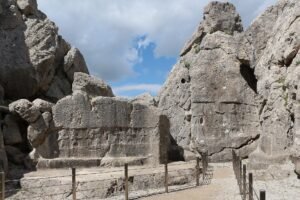
Yazılıkaya is a rock sanctuary about 2 kilometres northeast of Hattusa. It has two open-air chambers among natural rock outcrops. Its rock reliefs show gods and goddesses. They also show portrayals of the Great King Tudhaliya IV.
Hattusa green stone
The green stone is one of the most asked-about objects at Hattusa. You can see it in the area of the Great Temple in the Lower City. The Boğazkale municipality’s visitor guide lists it as a stop between the Great Temple and the Lion Gate.
What is it made of? Andreas Schachner, the excavation director, gave an answer in 2019. He said the stone is serpentinite or nephrite. He added that such stones are found in the region.
Locals sometimes call it the Wishing Stone. That name is a popular belief about what the stone was used for. Schachner says the stone’s meaning in the ancient cult and the period of its use cannot be determined.
He also made a point about its position. The stone lies about 1 metre below the neighboring Hittite gate threshold. For that reason, he said, it was not used in its present position in Hittite times.
So you can enjoy the stone, but treat the wishing legend as a popular belief rather than a documented Hittite practice.
Hattusa reconstruction: the rebuilt wall
One of the most useful stops for understanding the city is a rebuilt section of its wall. The German Archaeological Institute rebuilt a 65-metre stretch of the mud-brick wall in 2003–2005. It includes two towers. It was done as experimental archaeology.
The scale of the work is clear from the numbers. The team made 64,000 mud bricks. Together with mortar and plaster, the wall took about 2,700 tons of clay-rich earth.
The builders did not guess the shapes. For the towers, windows and battlements, they used ancient terracotta architectural models. These models decorate the rims of large cult vessels. They are small clay copies of how Hittite buildings looked.
Boğazköy Museum and the sphinxes
The Boğazköy Museum opened on 12 September 1966. It displays finds from the Hattusa excavations. It makes sense to visit it with the site, because the ruins alone do not show you the objects.
One detail is worth knowing. A Boğazköy sphinx was returned from Berlin. Since 26 November 2011 it has been displayed in the museum together with its pair from the Istanbul Archaeological Museums.
Timeline
- 6th millennium BC: earliest traces of settlement at the Hattusa site.
- 19th–18th centuries BC: Assyrian merchants establish a trading settlement in the Lower City.
- About 1700 BC: Anitta destroys Hattusa and leaves a curse against resettlement.
- About 1650–1600 BC: Hattusa becomes the Hittite capital under Hattusili I.
- 13th century BC: the date UNESCO gives for the Great Temple.
- 1906: Hugo Winckler and Theodor Makridy begin systematic excavations.
- 1966: Boğazköy Museum opens.
- 1986: UNESCO lists Hattusa as a World Heritage site.
- 2003–2005: a 65-metre mud-brick wall section is rebuilt.
- 2011: the two Boğazköy sphinxes go on display together in the museum.
Details you won’t find in guidebooks
- Anitta’s curse. The king who destroyed the city around 1700 BC asked the Storm God to punish whoever resettled it. Hattusili I chose it as his capital anyway.
- The green stone sits low. It lies about 1 metre below the neighboring Hittite gate threshold. That is why Schachner says it was not used there in Hittite times.
- Pottery as blueprint. The rebuilt wall’s towers, windows and battlements follow models on the rims of ancient cult vessels.
- The wall in numbers. The reconstruction took 64,000 bricks and about 2,700 tons of clay-rich earth.
- The sphinx reunion. The returned sphinx from Berlin has stood beside its pair from Istanbul since 26 November 2011.
- Early digging. The first systematic excavations were in 1906. They were led by Hugo Winckler and Theodor Makridy, an archaeologist of the Istanbul Museum.
FAQ
Where is Hattusa?
Hattusa is in the Boğazkale district of Çorum province, Turkey. The Ministry of Culture and Tourism places it 82 kilometres southwest of Çorum city center. Its reference coordinates are about 40.01972° N, 34.61528° E.
Why was Hattusa added to the UNESCO list?
UNESCO inscribed Hattusa in 1986 as a cultural site. The listing covers a Hittite capital with an 8-kilometre-plus wall circuit, monumental gates, temples and the rock sanctuary of Yazılıkaya.
What is the green stone at Hattusa?
It is a green stone in the Great Temple area of the Lower City. Excavation director Andreas Schachner said in 2019 that it is serpentinite or nephrite, and that such stones occur in the region. Its meaning in ancient worship has not been determined.
Is the wall at Hattusa original?
Part of it is a modern reconstruction. Between 2003 and 2005 the German Archaeological Institute rebuilt a 65-metre section of the mud-brick wall with two towers, as an experimental archaeology project.
Is Yazılıkaya part of the same site?
It is part of the World Heritage listing but lies about 2 kilometres northeast of Hattusa. It is a rock sanctuary with two open-air chambers among natural rock outcrops.
Sources
- Vikipedi — Hattuşaş tr.wikipedia.org
- Wikipedia — Hattusa en.wikipedia.org
- UNESCO — Hattusha: the Hittite Capital whc.unesco.org
- Kültür ve Turizm Bakanlığı — Gezilecek Yerler tanitma.ktb.gov.tr
- Kültür Varlıkları ve Müzeler Genel Müdürlüğü — Hattuşa kvmgm.ktb.gov.tr
- Kültür ve Turizm Bakanlığı — Hattuşa ktb.gov.tr
- Kültür ve Turizm Bakanlığı — Hattuşaş (Boğazköy) ekitap.ktb.gov.tr
- Kültür ve Turizm Bakanlığı — Boğazköy Müzesi muze.gov.tr
- Boğazkale Belediyesi — Hattuşa Ziyaret Rehberi bogazkale.bel.tr
- TRT Haber / Anadolu Ajansı — Antik kentteki yeşil kaya gizemini koruyor trthaber.com
- Jürgen Seeher — Ein Stück Stadtmauer in Hattuša archaeologie-online.de
Image: Lion Gate, Hattusa 01.jpg — Bernard Gagnon, CC BY-SA 3.0