Take a coin or a bank card out of your wallet. Every time you pay for a coffee, you rely on an idea that was tried out in western Anatolia more than 2,600 years ago. The people credited with it were the Lydians.
This guide explains who they were, where they lived, how they made their coins and what you can still see of them in Turkey.
Where was Lydia?
Lydia’s core region lay in western Anatolia. It sat in the Gediz Valley, north of the Bozdağ mountains.
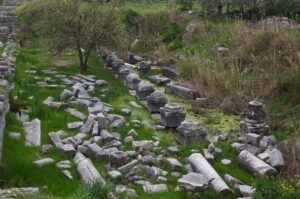
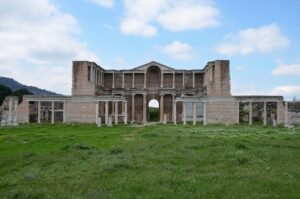
The capital was Sardis. Its ruins lie near the settlement of Sart in today’s Manisa Province.
The Lydians were an Iron Age civilization. They stood out in western Anatolia especially between the 8th and 6th centuries BC.
What exactly did the Lydians invent?
“The people who invented money” is a popular phrase. The historical claim is narrower and easier to defend.
The Lydians are credited with standard-weight, stamped metal coins. These appeared in Anatolia in the 7th century BC. A stamp on a piece of metal told you what it was worth. That made trade faster.
The Greek historian Herodotus backs this up. In Book I, section 94 of his Histories, he names the Lydians as the first people to strike and use gold and silver coins.
Electrum: the first coins were not pure gold
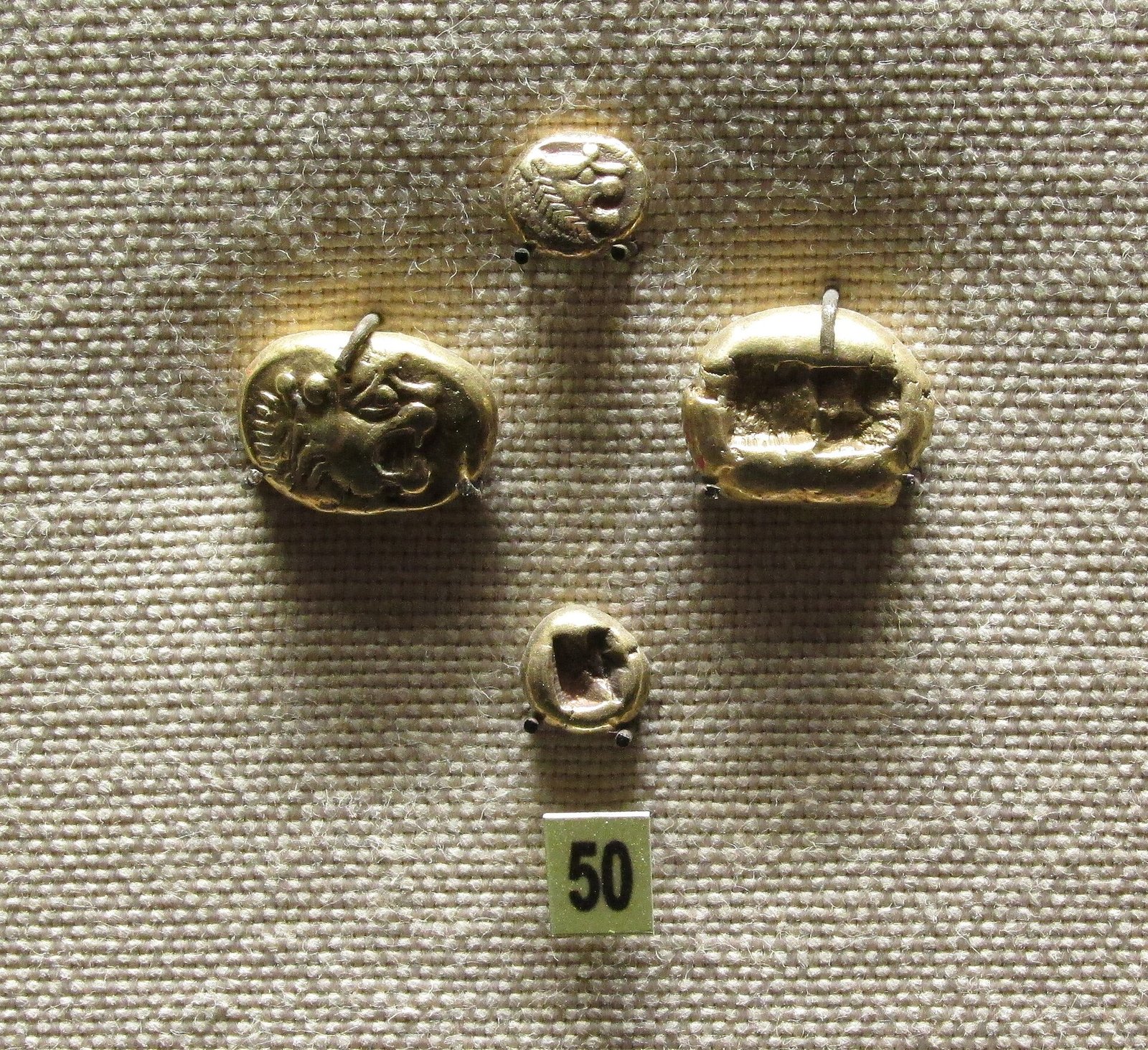
The earliest Lydian coins were not pure gold. They were made of electrum, a mix of gold and silver.
Early Lydian coins were struck by hand. A piece of metal was laid on an anvil that carried an engraved die. A punch was then placed on top and hit with a hammer.
Many early coins carry a lion’s head. That might suggest the kings issued them. But the British Museum notes that the authority behind these coins cannot be identified with certainty.
Timeline
- 8th–6th centuries BC: Lydia stands out as one of western Anatolia’s strong Iron Age civilizations.
- 7th century BC: The first electrum coins linked to the Lydians appear in western Anatolia.
- First half of the 6th century BC: Gold and silver are separated at the Pactolus North refining area in Sardis.
- Mid-6th century BC: Croesus’s coin reform brings separate pure gold and pure silver coins.
- 546 BC (traditional date): Cyrus II captures Sardis and the independent Lydian kingdom ends.
- 5th–4th centuries BC: Most surviving Lydian inscriptions date from this period.
- 2025: Sardis and the Lydian Tumuli of Bin Tepe join the UNESCO World Heritage List.
The WALWET question
Some lion-head electrum coins carry the inscription WALWET. Many scholars read it as the name of King Alyattes. This is a widely held reading, but it is not settled.
Croesus and the reform
Towards the middle of the 6th century BC, King Croesus changed the system. He replaced electrum coins with separate coins of pure gold and pure silver.
The Greek world knew his gold coins as Croesids. The name points back to the king.
Coins attributed to Croesus, in both gold and silver, show the foreparts of a lion and a bull facing each other.
During Croesus’s reign, Lydia also brought the Greek cities of Ionia, Aeolis and Doris on the Anatolian mainland under its rule.
The refinery outside Sardis
A reform like Croesus’s needs metal that has been separated and purified. Excavations at Sardis found the places where this was done.
The area is called Pactolus North and lies outside the city walls. Its facilities date to the first half of the 6th century BC. There, electrum was separated into gold and silver.
The process was slow. Electrum sheets were packed in vessels with salt and brick dust. They were then heated at about 800 °C for hours, and probably for days. This purified the gold.
Near these refining facilities, archaeologists also found a small altar used for offerings to the goddess Cybele.
Where did the gold come from?
The traditional theory says the electrum for Lydian coins came naturally from the Sart Stream. New analyses have challenged this. Local stream gold turns out to be almost pure. That reopens the question of where the raw material came from.
Language and writing
The Lydians had their own language. Lydian belongs to the Anatolian branch of the Indo-European family and is related to Hittite.
Their alphabet came from a variety of the Greek alphabet. It had 26 signs: 8 vowels and 18 consonants.
Lydian was usually written from right to left. Most surviving texts date to the 5th and 4th centuries BC.
Walls and royal tombs
According to UNESCO, Sardis’s defences included a wall about 20 metres thick.
The royal cemetery of Bin Tepe lies north of the city. It is a field of Lydian burial mounds called tumuli. They stretch roughly 7 to 17 kilometres north of the Sardis acropolis.
How the kingdom ended
The traditional date for the fall of the Lydian kingdom is 546 BC. The Persian king Cyrus II took Sardis.
The city did not vanish. After the conquest, the Persians kept using Sardis as the administrative centre of the satrapy of Lydia.
Details you won’t find in guidebooks
- A tiny coin. Lydian 1/96 stater coins with a lion’s paw design weighed about 0.15 grams. They were only 4 millimetres across.
- A huge number of furnaces. The Sardis refinery excavations uncovered about 200 dish-shaped hearths. They were used to separate silver from lead.
- A Lydian note in Egypt. One example of Lydian writing is a graffito at Silsilis in Upper Egypt. That is far from western Anatolia.
- Lost mounds. In the 1940s at least 149 tumuli were recorded at Bin Tepe. The excavation team says farming has destroyed some of them.
Visiting Sardis and Bin Tepe
Sardis and Bin Tepe are in Manisa Province. UNESCO listed them together in 2025.
When you go, think of the two parts as one story. The city is where metal was refined and the kingdom was run. The tumuli, to the north, are where its rulers were buried.
FAQ
Where was Lydia?
Lydia’s core lay in western Anatolia, in the Gediz Valley north of the Bozdağ mountains. Its capital, Sardis, stood near the village of Sart in today’s Manisa Province.
Did the Lydians invent money?
Not money in general. They are credited with standard-weight, stamped metal coins, which appeared in Anatolia in the 7th century BC. Herodotus calls the Lydians the first people to strike and use gold and silver coins.
What were the first Lydian coins made of?
They were made of electrum, a natural mix of gold and silver, not pure gold. King Croesus later replaced them with separate pure gold and pure silver coins.
When did the Lydian kingdom end?
Traditionally in 546 BC, when the Persian king Cyrus II took Sardis. Sardis then became the administrative centre of the Persian province of Lydia.
Is Sardis a UNESCO site?
Yes. Sardis and the Lydian Tumuli of Bin Tepe were added to the UNESCO World Heritage List in 2025.
Sources
- Wikipedia (Turkish) — Lidya tr.wikipedia.org
- Wikipedia — Lydia en.wikipedia.org
- Wikipedia — Sardis en.wikipedia.org
- American Numismatic Association — Lydia & the First Coins money.org
- British Museum — Electrum 1/6 stater artsandculture.google.com
- British Museum — Money Gallery, Room 68 britishmuseum.org
- Sardis Expedition — John H. Kroll, The Coins of Sardis sardisexpedition.org
- Sardis Expedition — Pactolus North sardisexpedition.org
- Sardis Expedition — Gold and Silver Refining at Sardis sardisexpedition.org
- Sardis Expedition — H. Craig Melchert, Lydian Language and Inscriptions sardisexpedition.org
- Sardis Expedition — Bin Tepe, The Tumulus of Alyattes, and Karnıyarık Tepe sardisexpedition.org
- UNESCO — Sardis and the Lydian Tumuli of Bin Tepe whc.unesco.org
Image: Lydian electrum Lion coins – Flickr – brewbooks.jpg — brewbooks from near Seattle, USA, CC BY-SA 2.0