Where is Side?
Side is on the Mediterranean coast, in Manavgat district of Antalya Province. The ancient city stands on a peninsula. It runs about 1 kilometre from north to south and is about 400 metres wide.
That small size matters. The city is compact, and its main monuments sit on a narrow strip of land by the sea.
The name itself carries a detail you can use at the breakfast table. Side is explained in Anatolian languages as meaning “pomegranate.” The next time you see that fruit, you are looking at the name of the city.
A harbor city that grew rich on the sea
Ancient writers told how Side was founded. Strabo and Arrian pass on a tradition that Greek settlers came from Kyme in the region of Aiolis. The city’s story may be older than that tradition, though. Excavators found a basalt column base linked to the Late Hittite tradition. It dates to the 7th century BC.
The sea made Side important. The Oxford Classical Dictionary describes its harbor as one of the centres of sea links. In the east, those links reached Syria, Egypt and Cyprus. In the west, they reached Rhodes and the Aegean.
Not every customer was respectable. In the 2nd and 1st centuries BC, Side gave Cilician pirates a place to maintain their ships. It also gave them a market where they could sell their captives.
In the Roman Empire, Side became a wealthy port. It competed with Perge, the other major city of the region.
The Temple of Apollo
The Temple of Apollo stands at the end of the colonnaded street, at the entrance of the ancient harbor. The Temple of Athena stands right beside it. Standing there, you face the sea.
The Ministry of Culture’s publication on historic cities dates both temples to the middle of the 2nd century AD. For the Apollo temple, the date is more exact. It was built around AD 150, during the reign of Emperor Antoninus Pius, who ruled from AD 138 to 161.
Its architecture follows the Corinthian order. That is the style with columns topped by leafy capitals. The columns you see rising by the water today belong to this Roman building.
The temple also shows how Apollo was imagined here. A coin from the reign of Emperor Gallienus shows the god holding an offering bowl in his right hand and a laurel branch in his left. Scholars read the coin’s inscription and named this type Apollo Sidetes, meaning Apollo of Side.
The Theatre
The Side Theatre lies where the peninsula narrows. It stands south of the commercial agora, the old market square.
It was built in the 2nd century AD on Hellenistic foundations. So the Roman builders did not start from nothing. They raised their seats over an earlier Greek base.
The Ministry’s publication gives its capacity as about 16,000 to 17,000 people. That is a large crowd for a city on a peninsula only about 400 metres wide.
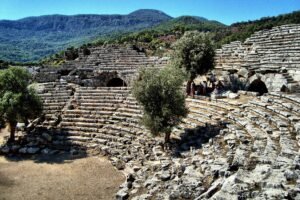
The structure is clever. The lower rows of seats lean against a hillside. The upper rows rest on vaults, which are arched stone supports. The stage building rises three storeys.
From stage to arena to church
Buildings change with the people who use them. The theatre changed twice.
The first change is an interpretation. Turkish Museums reports an architectural reading that the orchestra, the flat space in front of the stage, was closed off with a high wall in the 3rd century AD. This would have turned the space into an arena. Treat this as a theory, not a settled fact.
The second change is firmer. In the 5th century AD, chapels were built inside the theatre. The building served as an open-air church in the Early Christian period.
The same century brought another change at the harbor. A large basilica was built, and its courtyard was arranged so that it enclosed the Temples of Apollo and Athena. The pagan temples ended up inside a Christian precinct.
The Cleopatra legend
The best-known story about Side is not about the temple builders. It is about Cleopatra and Mark Antony.
The Ministry of Culture and Tourism’s promotional page on the Apollo temple presents Side as the place where the two met and bathed in a pool. The page does not show an ancient text or an excavation find that supports the story.
A simple date check adds a warning. The Apollo temple dates to about AD 150. Cleopatra and Antony lived in the 1st century BC. So the temple you see today cannot be the building from their time.
Be careful with what this proves. It shows that the standing temple is not their backdrop. It does not settle whether the couple ever stopped at Side. So the safest way to tell it is this: the pool story is a local legend, and the temple belongs to a later emperor.
How the temples were dug out and rebuilt
The first excavations at the harbor temples began in 1947 under Arif Müfit Mansel. They covered the Apollo and Athena temples around the harbor.
Restoration came later. In 1988, Jale İnan reported on work at the Apollo temple. The report records a small, human problem. No crane could be found, so the work planned for October could not be carried out.
The effort paid off in the end. In 1991, the rebuilt south-western corner of the Apollo temple was opened.
Things to do in Side today
Start at the harbor. Walk the colonnaded street to the Temples of Apollo and Athena, and read the corner raised in 1991.
Then go to the theatre. Look for the three-storey stage building and the vaults under the upper seats. Think of the chapels of the 5th century that once stood inside it.
Finish at the Side Museum. It occupies the old Agora Bath and displays Hellenistic, Roman and Byzantine works from the city’s excavations. A bath turned museum is a fitting end, since you are walking through rooms Romans once used for bathing.
Timeline
- 7th century BC: The basalt column base of Side’s early history dates to this period.
- 2nd–1st centuries BC: The harbor is tied to Cilician pirates and their trade in captives.
- 2nd century AD: The Roman theatre is built on Hellenistic foundations.
- About AD 150: The Temple of Apollo is built.
- 3rd century AD: The theatre’s orchestra is thought to have become an arena.
- 5th century AD: The basilica encloses the temples in its courtyard, and chapels are built inside the theatre.
- 1947: Arif Müfit Mansel begins excavations at the harbor temples.
- 1988: Restoration work at the Apollo temple under Jale İnan.
- 1991: The raised south-western corner of the Apollo temple opens.
Details you won’t find in guidebooks
- The name is a fruit. Side is explained as “pomegranate” in Anatolian languages.
- The temples ended up inside a church courtyard. The great basilica of the 5th century was laid out so that its courtyard enclosed both the Apollo and Athena temples.
- Apollo has a local name. On a coin from Gallienus’s reign, the god holds an offering bowl and a laurel branch. The inscription gave this type the name Apollo Sidetes.
- A frieze tells a life story. On the podium of the theatre’s first floor, a frieze of Dionysos tells the god’s life in order. It runs from west to east.
- A missing crane stopped a restoration. In 1988, the work planned on the Apollo temple for October could not go ahead because no crane was available.
FAQ
Where is ancient Side?
Ancient Side lies on the Mediterranean coast in Manavgat district, Antalya Province. The old city sits on a peninsula about 1 kilometre long and 400 metres wide.
When was the Temple of Apollo at Side built?
The temple dates to about AD 150, under Emperor Antoninus Pius, who ruled from AD 138 to 161. Its architecture is Corinthian.
Did Cleopatra and Mark Antony really meet at Side?
No ancient text or excavation find supports it. The Ministry’s promotional page tells the story, but the surviving Apollo temple was built about two centuries after the couple lived. That date alone does not prove whether they ever visited Side.
How many people did the Side Theatre hold?
The Ministry of Culture and Tourism’s publication on historic cities gives the capacity as roughly 16,000 to 17,000 people.
What can you see in Side besides the temple and theatre?
The Side Museum, inside the old Agora Bath, shows Hellenistic, Roman and Byzantine finds from the city’s excavations. You can also see the neighbouring Temple of Athena and the colonnaded street.
Sources
- Ministry of Culture and Tourism — Side antalya.ktb.gov.tr
- Wikipedia — Side, Turkey en.wikipedia.org
- Vikipedi — Side tr.wikipedia.org
- Oxford Classical Dictionary — Side academic.oup.com
- Ministry of Culture e-Book — Önemli Antik Kentler ekitap.ktb.gov.tr
- Wikipedia — Temple of Apollo (Side) en.wikipedia.org
- Cedrus — Apollon Sidetes iconography on Roman imperial coins of Side dergipark.org.tr
- Turkish Museums — Antalya Side Archeological Site turkishmuseums.kprod.kultur.gov.tr
- Ministry of Culture and Tourism, Taşkent — Side, Apollon Tapınağı taskentkulturvetanitma.ktb.gov.tr
- Anadolu University — Apollon ve Athena Tapınakları koruma altına alınıyor gazete.anadolu.edu.tr
- Jale İnan — Side Apollon Tapınağı Restorasyonu 1988 Yılı Çalışmaları kvmgm.ktb.gov.tr
Image: Sunrise apollo side.jpg — Saffron Blaze, CC BY-SA 3.0