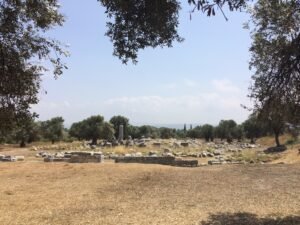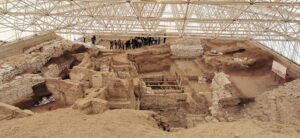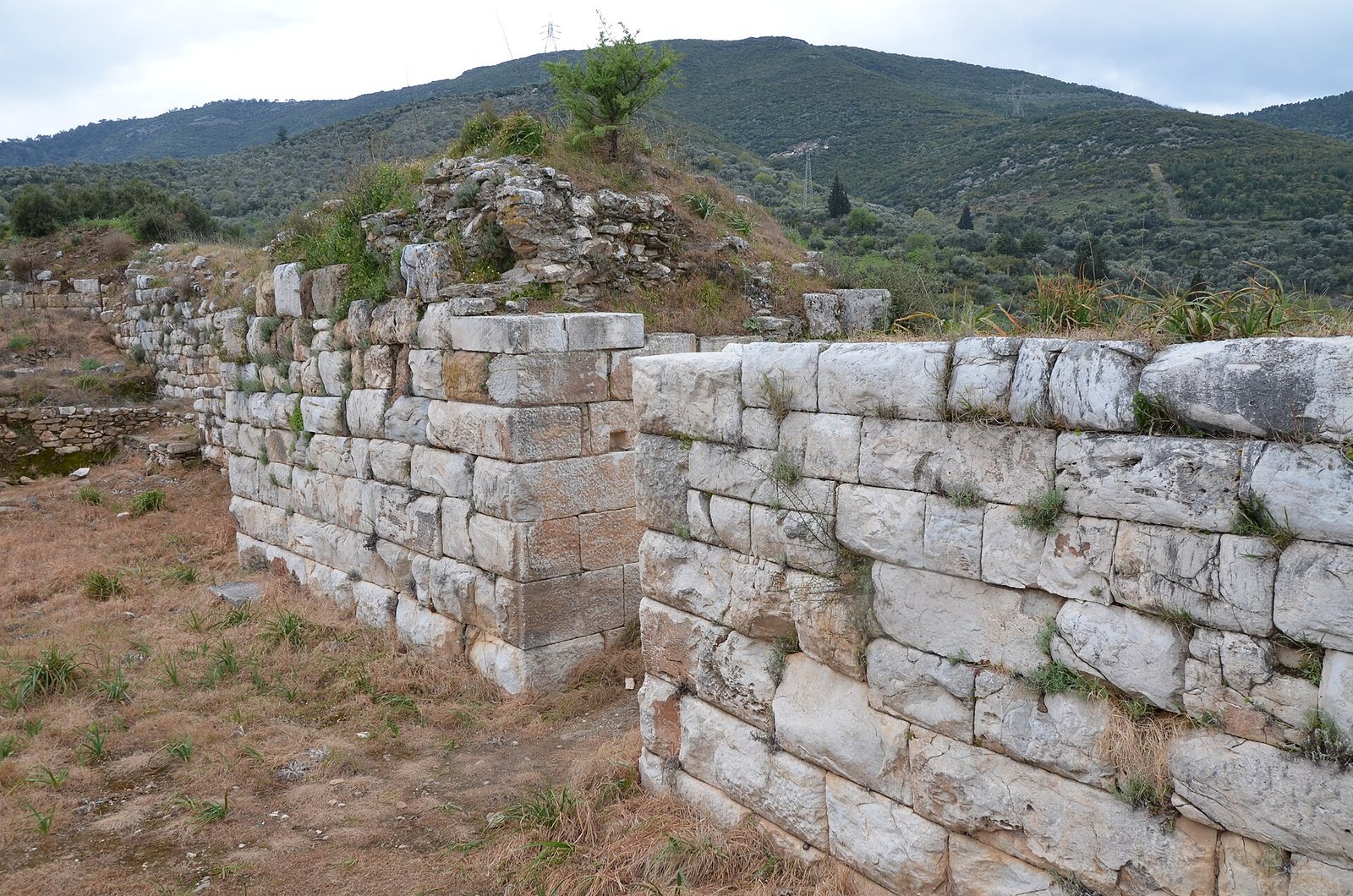
Explore Metropolis near Torbalı by focusing on its theatre, council house, stoa, courtyard house, and acropolis. Reach the site by car via the İzmir–Aydın Motorway, or take İZBAN to Tepeköy and continue by Yeniköy minibus. The ancient city occupies a hill between Yeniköy and Özbey in İzmir’s Torbalı district.
A marble seat decorated with griffins offers a useful starting question: whose seat are you actually seeing? The example in the theatre is a copy; the original is in İzmir Archaeology Museum. Follow that distinction into a visit that connects public buildings, domestic spaces, inscriptions, and discoveries beneath the acropolis.
Where is Metropolis, and how do you get there?
Metropolis spreads across a hill and its slopes, overlooking the Torbalı Plain from an elevation of 142 metres. Its address is Yeniköy Mahallesi, Metropolis Caddesi, Sevgi Yolu Sokak, 35860 Torbalı/İzmir. Use that address when planning your arrival at the archaeological site.
Dokuz Eylül University describes two ways to reach Metropolis. Drivers can use the İzmir–Aydın Motorway. If you use public transport, the connection is through İZBAN Tepeköy station and the Yeniköy minibuses. Keep both parts of that journey together when planning your route.
The Ministry’s visitor information, accessed on November 13, 2026, lists opening hours as 08:30–17:30 every day. The ticket office closes at 17:00, and admission is listed as free. Those separate closing times matter when deciding when to arrive.
How should you explore the ancient city?
Use the theatre, bouleuterion, stoa, peristyle house, and acropolis as the main anchors of your visit. They bring different parts of Metropolis into view: entertainment, civic government, public patronage, domestic architecture, and fortification. Treat this as a reading order for the ruins rather than a fixed walking circuit.
The city’s setting deserves attention alongside its buildings. By the second century CE, Metropolis had streets and avenues intersecting at right angles, despite its hillside location. As you consider the slopes, hold that planned street arrangement in mind. The terrain and the street plan belong to the same urban story.
What should you look for in the theatre?
The Hellenistic theatre could accommodate approximately 4,000 spectators. Its scale makes it a useful place to begin thinking about public life at Metropolis. The city prospered with support from the Kingdom of Pergamon in the second century BCE, when the theatre, stoa, and council house became prominent public buildings.
The theatre also carries Roman alterations. Its floor received marble paving, and its stage building was enlarged during the Roman period. These changes mean the structure represents more than its Hellenistic beginnings. Its later restoration took place in 2000–2001.
Look for the marble honorary seat decorated with griffins. Discovered in 1995, the original is now displayed in İzmir Archaeology Museum. A copy stands in the theatre. That distinction lets you connect an object encountered among the ruins with the original preserved in the museum.
What do the council house and stoa reveal?
The bouleuterion was the city’s council house. Built around the middle of the second century BCE, it had a square plan and room for 350 people. Compare that capacity with the theatre’s approximately 4,000 seats. The two buildings served public gatherings at very different scales.
The stoa also dates to the second century BCE. Names inscribed on its front columns identify wealthy people who provided financial support for the building. Read those names as part of the architecture. They connect a public structure with the individuals who helped pay for it.
There is an everyday-life link here: the stoa’s inscriptions connect shared space with named financial contributors. The council house connects another public building with civic decision-making. Together, these structures let you approach Metropolis through practical questions about money, participation, and the use of communal buildings.
How do the house and baths bring daily life into view?
On the southern slope of the theatre stands a Roman peristyle house. Its courtyard has marble paving and is surrounded by columns. After the theatre and council house, this courtyard provides a domestic point of comparison. Here, the architectural focus is a house and its central space.
Metropolis also had a large bath and palaestra complex, built during the reign of the Roman emperor Antoninus Pius. Place this complex alongside the courtyard house when considering the Roman city. Both belong to the evidence for life beyond the earlier Hellenistic public monuments.
The second-century CE street plan adds another layer to that picture. Streets and avenues crossed at right angles on the hillside. Consider the bath complex, house, and planned streets together. They help you think about Metropolis as an inhabited city, with buildings connected by an organized urban layout.
Why does the acropolis matter?
The acropolis covers approximately 16,000 square metres and overlooks the Torbalı Plain. Its strongly fortified enclosure was constructed in the third century BCE. This gives the hilltop a clear place in the city’s development before the prosperity associated with Pergamon’s support in the following century.
Finds from the acropolis reach further back. Excavations produced Early and Middle Bronze Age pottery, stone axes, and a seal contemporary with the Hittite period. These objects document activity earlier than the surviving Hellenistic fortifications. The age of a wall therefore does not define the beginning of the hill’s human history.
The acropolis also preserves evidence from much later periods. Four interconnected cisterns were discovered in 2020 beneath seven metres of earth fill. Their contents included food remains, animal bones, and pottery. Those deposits show that the structures were used as rubbish dumps in the twelfth and thirteenth centuries CE.
What does the name Metropolis mean?
The name Metropolis is understood here as “City of the Mother Goddess.” That interpretation is linked to the cult of Meter Gallesia, whose name appears in the city’s inscriptions. The connection gives the city’s name a specific religious setting.
A cave dedicated to Meter Gallesia lies at Uyuzdere, approximately 5 kilometres north of the ancient city. Keep this separate location in mind when planning your exploration. Excavations began at the Mother Goddess cult cave in 1989, making it central to the modern investigation of Metropolis.
Timeline
- Early and Middle Bronze Age: Pottery from these periods has been found on the acropolis, alongside stone axes and a seal contemporary with the Hittite period.
- Third century BCE: The strongly fortified acropolis is constructed.
- Second century BCE: Support from Pergamon accompanies prosperity and major public buildings.
- 17 CE: The excavation directorate interprets repairs and architectural alterations in some buildings as evidence that Metropolis suffered damage in the western Anatolian earthquake.
- Second century CE: The large bath and palaestra complex is built under Antoninus Pius.
- Sixth century CE: Metropolis is known as a bishopric.
- Twelfth–thirteenth centuries CE: The acropolis cisterns are used as rubbish dumps.
- 1989: Excavations begin at the Uyuzdere Mother Goddess cult cave.
- 1995: The griffin-decorated marble honorary seat is discovered.
- 2000–2001: The ancient theatre is restored.
- Since 2007: Excavations continue under a team led by Prof. Dr. Serdar Aybek.
- 2020: Four interconnected cisterns are uncovered on the acropolis.
- 2021: Systematic work begins at the medieval church in Araplıtepe, and remains of a mosaic gallery are discovered.
Details you won’t find in guidebooks
An inscription dated to the second century BCE names Alexandra Mirton as a female gymnasion administrator, according to the Ministry’s presentation. This is a detail to carry into your reading of the public buildings. It adds a named woman and an administrative role to the city’s surviving evidence.
The cistern deposits offer a different kind of detail. Food remains, animal bones, and pottery helped establish their later use as dumps. The connection with everyday life is direct: discarded material records what happened to structures after their earlier purpose had changed.
Discoveries in 2021 included the remains of a mosaic gallery reached by marble steps from a stone-paved courtyard. Excavators also found a female statue and part of a commander’s statue. These finds add a courtyard, decorated gallery, and sculpture to the evidence from the city.
Metropolis was a bishopric in the sixth century CE. Systematic investigations at the medieval church in Araplıtepe began in 2021. Together, those facts extend your view beyond the Hellenistic and Roman monuments into the city’s later religious history.
FAQ
Where is the ancient city of Metropolis?
Metropolis stands on a hill between Yeniköy and Özbey in the Torbalı district of İzmir. Its hill rises to 142 metres above sea level and overlooks the Torbalı Plain.
How can you reach Metropolis from İzmir?
You can drive via the İzmir–Aydın Motorway. For public transport, travel to İZBAN Tepeköy station and continue on a Yeniköy minibus.
What are the opening hours and admission charge?
The Ministry visitor information dated November 13, 2026 lists daily opening hours of 08:30–17:30, with the ticket office closing at 17:00. Admission is listed as free.
Is the Mother Goddess cult cave inside the ancient city?
The cave dedicated to Meter Gallesia is a separate location at Uyuzdere, approximately 5 kilometres north of the ancient city.
Sources
- Metropolis Excavation Directorate — A Brief History of the City metropolistr.org
- Dokuz Eylül University — İzmir/Torbalı Metropolis Excavations arkeoloji.deu.edu.tr
- Ministry of Culture and Tourism — Metropolis Archaeological Site muze.gov.tr
- İzmir Provincial Directorate of Culture and Tourism — Metropolis Excavation / Torbalı izmir.ktb.gov.tr
- Anadolu Agency — Four Interconnected Cisterns Discovered at Metropolis aa.com.tr
- Sabancı Foundation — Mosaic Public Building and City Square Finds at Metropolis sabancivakfi.org
Image: Metropolis, Ionia, Turkey (43926105985).jpg — Carole Raddato from FRANKFURT, Germany, CC BY-SA 2.0