Mu has not been scientifically verified as a real continent. The lost-continent claim grew from a mistaken nineteenth-century reading of a Maya manuscript and later became a Pacific civilization story through James Churchward’s books.
If you want to understand Mu, follow the manuscript before following the map. The story connects a Maya codex, Augustus Le Plongeon’s Atlantic setting, Churchward’s Pacific setting, and underwater formations at Yonaguni. Each offers a different kind of claim, and each needs a separate explanation.
Where did the name Mu come from?
The name’s origin lies in Charles Étienne Brasseur de Bourbourg’s interpretation of the Troano Codex in 1864. He used the de Landa alphabet and misread the manuscript. He claimed that the expression he read as Mu described a country submerged after a catastrophe. That interpretation supplied a name and a disaster story for later writers.
The Troano manuscript is part of the book now called the Madrid Codex or Tro-Cortesian Codex. It is preserved at Museo de América in Madrid. The museum identifies it as a Maya work from Yucatán and dates it to the fifteenth century. The physical manuscript is therefore a documented object, while the submerged country arose from an erroneous reading of it.
The museum describes the codex’s contents as ritual subjects and divination formulas used by priests. This matters because the lost-continent argument depends on treating the manuscript as an account of destruction. Its identified ritual content does not support that interpretation. When you distinguish the manuscript from the story attached to it, the central problem becomes clear.
There is an everyday parallel here. If you trace a forwarded message back to its starting point, you can ask whether later versions preserve its meaning. Apply that question to Mu: Brasseur’s catastrophic reading and the museum’s description of priestly ritual content lead in different directions. The manuscript’s existence does not validate every interpretation placed upon it.
How did Augustus Le Plongeon develop the claim?
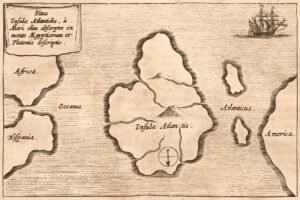
Augustus Le Plongeon developed the Mu narrative after studying Maya ruins in Yucatán. In his version, Mu was associated with Atlantis and placed in the Atlantic Ocean. His account connected the supposed lost land with a wider explanation of ancient civilization. Mu’s familiar Pacific location was therefore absent from this earlier version.
Le Plongeon also claimed that Queen Moo survived Mu’s destruction and founded Egyptian civilization. This was a claim linking the Maya world, a submerged homeland, and Egypt. It should be read as part of his proposed narrative. Mu’s existence and the migration story attached to it have not been established as historical events.
Where was Mu supposed to be?
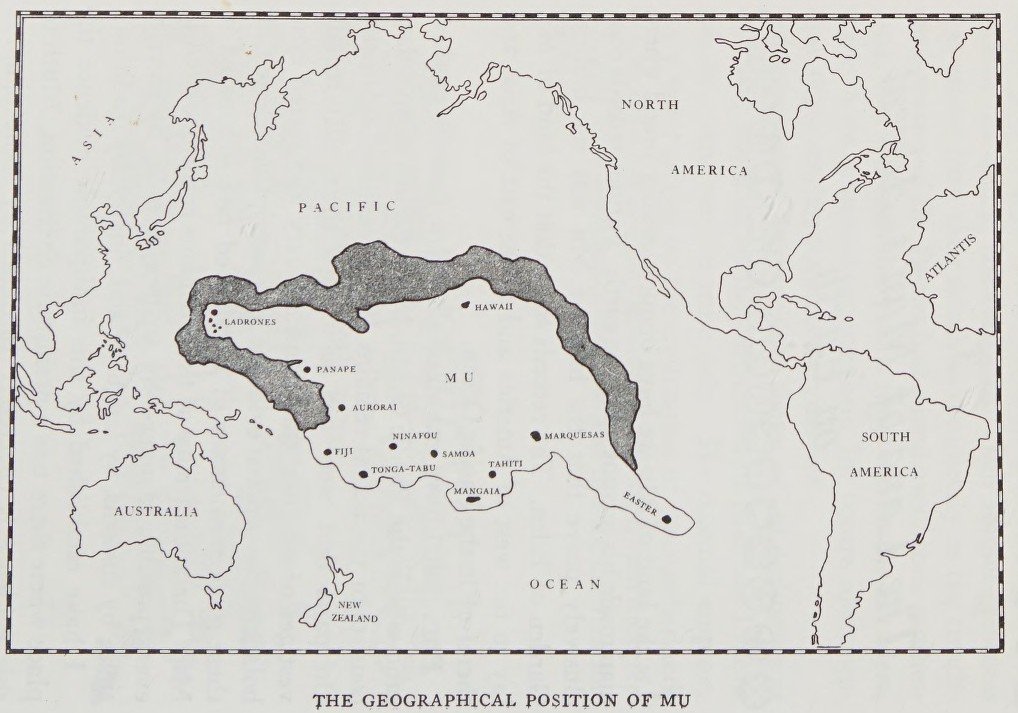
Mu’s location changed between its major promoters. Le Plongeon’s version belonged in the Atlantic and was identified with Atlantis. James Churchward moved the story to the Pacific. Asking where Mu was therefore requires another question: whose account are you reading? The two settings belong to different versions of the claim.
Churchward placed Mu between the Mariana Islands and Easter Island from west to east. From north to south, his proposed land extended between Hawaii and Mangaia. These island names give his story a geographic outline. They describe the location he proposed; they do not establish that a continent occupied that area.
Churchward brought the claim to a broad audience through his 1926 book, Lost Continent of Mu, the Motherland of Man. He asserted that Mu had a population of 64 million when it disappeared about 12,000 years ago. Both figures belong to his account. They should not be presented as a verified population or an established destruction date.
What evidence did Churchward claim to have?
Churchward’s preface attributed his narrative to translations of Naacal tablets. He claimed to have found them in India and said they had been written in Burma or Mu. The distinction between that claim and the existence of his book is essential. A published account records what its author asserted; publication does not itself establish the proposed ancient events.
The Smithsonian library catalogue records a 1931 edition of The Lost Continent of Mu as a work of 335 pages. That entry provides a concrete publication record for Churchward’s writing. It documents an edition of the book. It does not turn the author’s proposed tablets, continent, population, or destruction scenario into independently verified history.
Could Mu have disappeared almost overnight?
Churchward described Mu’s destruction as the collapse of underground gas cavities. In his account, the continent disappeared almost overnight. The geological objection addresses that mechanism directly: a continental mass could not wholly sink or vanish within the very short period he proposed. His destruction scenario therefore faces a physical objection as well as problems with its textual foundation.
Patrick D. Nunn examined Mu in his 2008 chapter, Mythical Continents of the Pacific. His assessment attributes lost-continent narratives largely to mistaken deductions and imagination. He also connects such beliefs with diffusionist thinking. This is the view that human cultures spread around the world from one or a few original centers. Churchward’s proposed motherland fits that wider explanatory pattern.
Is Yonaguni evidence for Mu?
A 2007 National Geographic report described underwater formations at Yonaguni in Japan that some researchers associated with Mu. The debate concerned whether their shapes were natural or artificial. An association with Mu, however, is itself an interpretation. To assess it, you need to examine the explanation offered for the formations rather than treating their underwater location as proof.
Robert Schoch, a Boston University researcher who dived at Yonaguni, explained the apparent artificial steps through natural fracture planes in sandstone. This offers a natural explanation for shapes interpreted as construction. The disagreement therefore concerns the formations themselves before it can support a further claim about a lost continent.
The National Geographic report dated 19 September 2007 also stated that Japan’s Agency for Cultural Affairs and the Okinawa government had not recognized the formations as important cultural property. That statement describes their reported status at the time. Alongside Schoch’s explanation, it gives you a more precise account than simply calling Yonaguni the remains of Mu.
Timeline
- Fifteenth century: According to Museo de América’s dating, the Madrid Codex is produced in Yucatán. Its Troano portion will later become central to the Mu claim.
- 1864: Brasseur de Bourbourg’s mistaken interpretation of the Troano Codex supplies the name Mu and an alleged account of catastrophic submergence.
- Nineteenth century: Augustus Le Plongeon combines Mu with Atlantis and claims connecting the Maya world with Egyptian civilization.
- 1926: James Churchward publishes his book placing Mu in the Pacific and presenting it as humanity’s motherland.
- 1931: The edition of The Lost Continent of Mu recorded in the Smithsonian catalogue is published.
- 2007: National Geographic reports the debate over whether the Yonaguni underwater formations are natural or artificial, including their association with Mu.
- 2008: Patrick D. Nunn evaluates Mu within Mythical Continents of the Pacific and relates lost-continent beliefs to diffusionist thought.
Details you won’t find in guidebooks
The Madrid Codex consists of a single folded strip, arranged like an accordion. It has 56 leaves and 112 pages. These physical details help you picture the actual manuscript behind the controversy. The object is a folded Maya book with identified ritual contents, rather than a geographic record whose lost-continent interpretation has been established.
Its alternative names preserve the history of its separated portions. Troano comes from Juan Tro y Ortolano. Cortesianus commemorates Hernán Cortés. The two portions were found separately and later recognized as parts of the same book. This explains why the Mu story refers to Troano while the museum presents the manuscript as the Madrid or Tro-Cortesian Codex.
Churchward also treated the statues of Easter Island as evidence for Mu. Yet their pukao headpieces were made from volcanic scoria found on the island. That material detail matters when assessing the proposed connection. The headpieces have an identified island source; their inclusion in Churchward’s narrative does not establish a connection to his submerged continent.
FAQ
Was Mu a real continent?
Mu has not been scientifically verified as a continent or civilization. The claim developed from a mistaken nineteenth-century interpretation of a Maya manuscript.
Where was Mu supposed to be?
Augustus Le Plongeon associated Mu with Atlantis in the Atlantic Ocean. James Churchward later placed it in the Pacific, between the Mariana Islands and Easter Island, and between Hawaii and Mangaia.
Does the Madrid Codex describe Mu sinking?
The Mu interpretation began with Brasseur de Bourbourg’s mistaken reading of the Troano portion. Museo de América describes the manuscript’s contents as ritual subjects and divination formulas used by priests.
Is Yonaguni evidence for Mu?
Some researchers have linked the underwater formations at Yonaguni to Mu. Robert Schoch explained the apparent steps through natural fracture planes in sandstone, providing a natural explanation for the shapes.
Sources
- Vikipedi — Mu tr.wikipedia.org
- Wikipedia — Mu (mythical lost continent) en.wikipedia.org
- Smithsonian Institution — The lost continent of Mu si.edu
- University of Hawai‘i Press / Oxford Academic — Mythical Continents of the Pacific academic.oup.com
- Spain’s Ministry of Culture, Museo de América — Madrid (Tro-Cortesian) Codex cultura.gob.es
- National Geographic — Japan’s Ancient Underwater Pyramid Mystifies Scholars nationalgeographic.com
Image: Book map1.jpg — James Churchward, Public domain