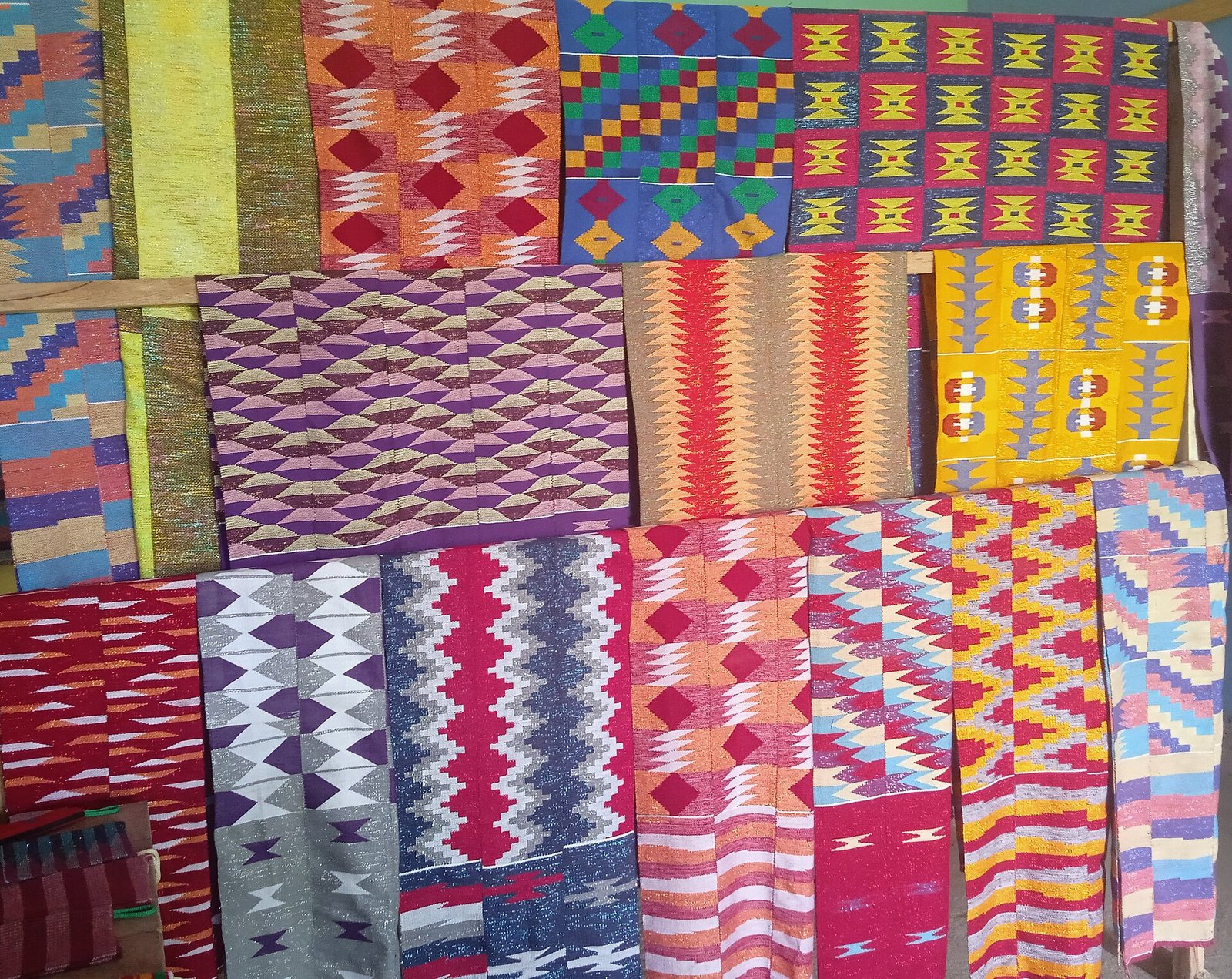
Kente is a cloth made in Ghana by joining strips of silk, cotton or rayon woven on horizontal looms. Its colors and named patterns carry meanings connected with royalty, social position, historical figures and personal memories. Developed within Asante and Ewe weaving traditions, kente has been produced since at least the seventeenth century.
A pattern can honor a president and his wife, proclaim a weaver’s skill or remember a deceased son. If you want to understand kente, its construction matters alongside its colors. Following the strips from the loom to royal wrappers and graduation stoles reveals how these meanings take material form.
Where is kente cloth from?
The Victoria and Albert Museum places kente production among Asante and Ewe communities in West Africa, principally in present-day Ghana. Its account dates the tradition to at least the seventeenth century. Kazuyo Iseki’s research also documents narrow-strip weaving in Ghana and Togo.
Bonwire is a kente weaving center in Ghana’s Ashanti Region. It stands on the Kumasi–Mampong road, about 18 kilometers from Kumasi. The Bonwire Kente Museum opened on 10 January 2024, according to the government’s tourism, arts and culture activity record.
The cloth has more than one explanatory name. In Akan, nwentoma means “woven cloth.” The name kente is explained as deriving from kenten, meaning “basket,” because the weaving resembles basket construction. Both names direct attention to how the material is made.
Kente cloth history: evidence and oral traditions
Spindle whorls and dye pits found at Begho and Bono Manso date between the fourteenth and eighteenth centuries. They provide archaeological evidence of textile production in southern Ghana. Their significance concerns that wider history of making cloth; the V&A separately identifies kente production from at least the seventeenth century.
A Bonwire origin story describes two brothers learning to weave by observing spider webs. The Open University records this account through a weaving chief. It belongs to oral tradition, rather than a historically verified record of an invention.
Another Asante oral tradition describes a loom brought from Bono Gyaman by a person from Bonwire. It places the event in the seventeenth century, during Nana Oti Akenten’s rule. These accounts preserve different explanations of how weaving knowledge reached the community.
In Asante society, kente was initially a prestige garment made for kings, queens and chiefs. Birmingham Museum of Art describes early examples using hand-spun cotton, indigo and local dyes obtained from plants or minerals. The history therefore includes changes in materials as well as the cloth’s association with authority.
Timeline
- Fourteenth–eighteenth centuries: Spindle whorls and dye pits at Begho and Bono Manso attest to textile production in southern Ghana.
- At least the seventeenth century: The V&A identifies kente production among Asante and Ewe communities.
- Around 1730: Danish traders record imported silk fabrics being unraveled so their threads can be woven into local cloth.
- 1982: Kazuyo Iseki’s research records narrow woven strips being sewn into large garments in Ghana and Togo.
- 10 January 2024: The Bonwire Kente Museum opens.
- 2024: Kente craftsmanship enters UNESCO’s Representative List of the Intangible Cultural Heritage of Humanity.
Kente cloth designs: how strips become patterns
Kente begins as narrow woven strips. Iseki’s 1982 study records strips approximately 10 centimeters wide being sewn together to create large garments. The finished cloth therefore joins the work of weaving with the work of assembling those lengths.
The Metropolitan Museum of Art describes large Asante wrappers made by cutting a long weaving into sections and sewing them side by side. A panel can contain as many as 24 strips. When you examine a large wrapper, those seams help explain how a narrow loom produces a broad garment.
Asante and Ewe examples also show different design tendencies. According to the V&A, geometric patterns in silk are prominent in Asante kente. Ewe examples include animal, human and letter motifs woven in cotton and silk. Kente patterns thus extend beyond arrangements of geometric shapes.
Kente cloth meaning: colors and named designs
UNESCO records that a wearer’s age, social position and gender influence the selection of kente colors and designs. Choosing a cloth therefore involves the person who will wear it. Color symbolism forms part of that choice, alongside the identity of a named pattern.
Ghana’s National Commission on Culture associates gold with royalty, wealth and spiritual purity. Blue signifies peace, harmony and love. These associations give specific meanings to colors that you might first notice simply for their visual effect.
The same commission connects black with maturity and ancestral strength. Green represents renewal, growth and fertility. Red expresses sacrifice and struggle, while white represents purity and victory. These meanings belong to the commission’s explanation of kente symbolism.
Pattern names carry another layer of meaning. Adweneasa means “I have exhausted my skills.” The National Commission on Culture associates it with creativity, excellence and mastery. Its name makes the weaver’s accomplishment part of the cloth’s message.
Fathia Fata Nkrumah honors Ghana’s first president, Kwame Nkrumah, and his Egyptian wife, Fathia. The commission connects the pattern with cross-cultural union. Here, a named design links the cloth to particular historical people and their relationship.
Details you won’t find in guidebooks
Around 1730, Danish traders recorded imported silk cloth being unraveled so its threads could be reused in local weaving. This detail explains one way silk entered the production process: an existing textile supplied material for another woven cloth.
Birmingham Museum of Art’s Ewe wrapper numbered 1988.84 contains keys, scissors, hair combs and chameleons. The objects make a concrete connection with everyday life. A comb or a pair of scissors can appear within the same textile tradition that also carries royal associations.
Princeton’s man’s wrapper numbered 1998-698 contains 24 strips. Among its red and yellow motifs is nnwötoa, translated as “snail’s bottom.” The name attaches a recognizable subject to a woven form whose meaning might otherwise escape a viewer.
A cloth at the Metropolitan Museum bears the name nkontompo ntama, or “liar’s cloth.” An account relayed by Rattray says an Asante king wore this pattern to confuse liars appearing before him. This is a reported story attached to the design, rather than a documented test of its effect.
Personal loss can also produce a pattern name. In an Open University interview, Bonwire master weaver Osei Antobre describes naming a new design to commemorate the sudden death of his son, who was a doctor. The cloth’s meaning comes from a family memory.
Kente cloth for men: wrappers and graduation stoles
Princeton University Art Museum describes traditional kente as wrapped around the body without clasps or similar fasteners. The wearer repeatedly adjusts it during use. If you have ever straightened a slipping wrap, that everyday movement offers a way to picture this aspect of wearing kente.
Museum examples identified as men’s wrappers show the scale of this clothing form. Princeton’s 24-strip cloth and the Metropolitan Museum’s account of large Asante panels both document garments assembled from multiple narrow lengths. Their construction differs in scale from the narrow neck strips made for graduations.
The Open University’s interview with Bonwire weaver Nana Asante documents kente neck strips produced for American graduations. University names and graduation years can be woven into them. These stoles give the cloth a further ceremonial setting, with wording tied to a particular institution and graduating year.
How kente knowledge is passed on
UNESCO identifies several routes through which people learn kente craftsmanship in Ghana. Knowledge passes within families, through apprenticeship to master weavers, and through secondary and higher education institutions. The tradition is sustained through both personal instruction and formal education.
Producer communities also have a chief weaver. UNESCO describes this person’s responsibilities as regulating production standards and resolving disputes between weavers. Maintaining kente craftsmanship therefore involves community organization alongside technical skill.
Bristol Museums’ record for cloth T/GHAN/251 notes that such textiles are generally commissioned from a weaver and expensive to purchase. Commissioning connects the finished garment to its maker. Alongside UNESCO’s account of training and standards, it places the textile within relationships of production and use.
FAQ
Where is kente cloth from?
Kente belongs to the weaving traditions of Asante and Ewe communities in West Africa, principally in present-day Ghana. The Victoria and Albert Museum dates its production to at least the seventeenth century.
What do kente cloth colors mean?
Ghana’s National Commission on Culture associates gold with royalty, wealth and spiritual purity; blue with peace, harmony and love; black with maturity and ancestral strength; green with renewal, growth and fertility; red with sacrifice and struggle; and white with purity and victory.
Did kente cloth originate in Northern Europe?
The claim conflicts with the Victoria and Albert Museum’s account, which locates the tradition among Asante and Ewe communities in West Africa.
What is a kente graduation stole?
It is a narrow strip worn around the neck for graduation. An Open University interview with Bonwire weaver Nana Asante documents production for American graduations, including woven university names and graduation years.
Sources
- UNESCO — Craftsmanship of traditional woven textile Kente ich.unesco.org
- Wikipedia — Kente kumaşı tr.wikipedia.org
- Princeton University Art Museum — Man’s wrapper (kente) artmuseum.princeton.edu
- Victoria and Albert Museum — Africa fashion: cloth of a continent vam.ac.uk
- Wikipedia — Kente cloth en.wikipedia.org
- The Open University — History of kente open.edu
- Wikipedia — Bonwire en.wikipedia.org
- Ghana Ministry of Finance — 2025 Ministry of Tourism, Arts and Culture budget document mofep.gov.gh
- Kazuyo Iseki — A Description of the Ceremonial Cloth of the Ewe and Asante People jstage.jst.go.jp
- The Metropolitan Museum of Art — Man’s Prestige Cloth metmuseum.org
- Birmingham Museum of Art — Wrapper (kente), Asante artsbma.org
- Birmingham Museum of Art — Wrapper (kente), Ewe artsbma.org
- Ghana National Commission on Culture — Royal Legacies: Kente and Symbolic Cloths ghanaculture.gov.gh
- The Open University — The meaning of kente designs open.edu
- The Open University — The functions of kente open.edu
- Bristol Museums — Cloth, T/GHAN/251 museums.bristol.gov.uk
Image: Different Kente cloth, Tafi, Volta region.jpg — Warmglow, CC0